
Close Deals

Automate Lead Routing

Automate Lead Routing

The right lead reaches the right rep immediately — every time, without exceptions or manual overrides.

The right lead reaches the right rep immediately — every time, without exceptions or manual overrides.

faster first response when routing is automated vs. leads distributed manually through a shared queue.

faster first response when routing is automated vs. leads distributed manually through a shared queue.

THE brıef

Lead routing sounds simple until you have territories, segments, overlapping account ownership, partner-sourced leads, re-engagement triggers, and a 30-person sales team with coverage gaps. Manual routing creates delays, routing errors, and rep conflicts. The agent applies complex routing logic automatically — mapping leads to the right rep based on territory, vertical specialization, account ownership, lead score, and availability — and routes every lead within 60 seconds of qualification.
Applies multi-dimensional routing rules in real time

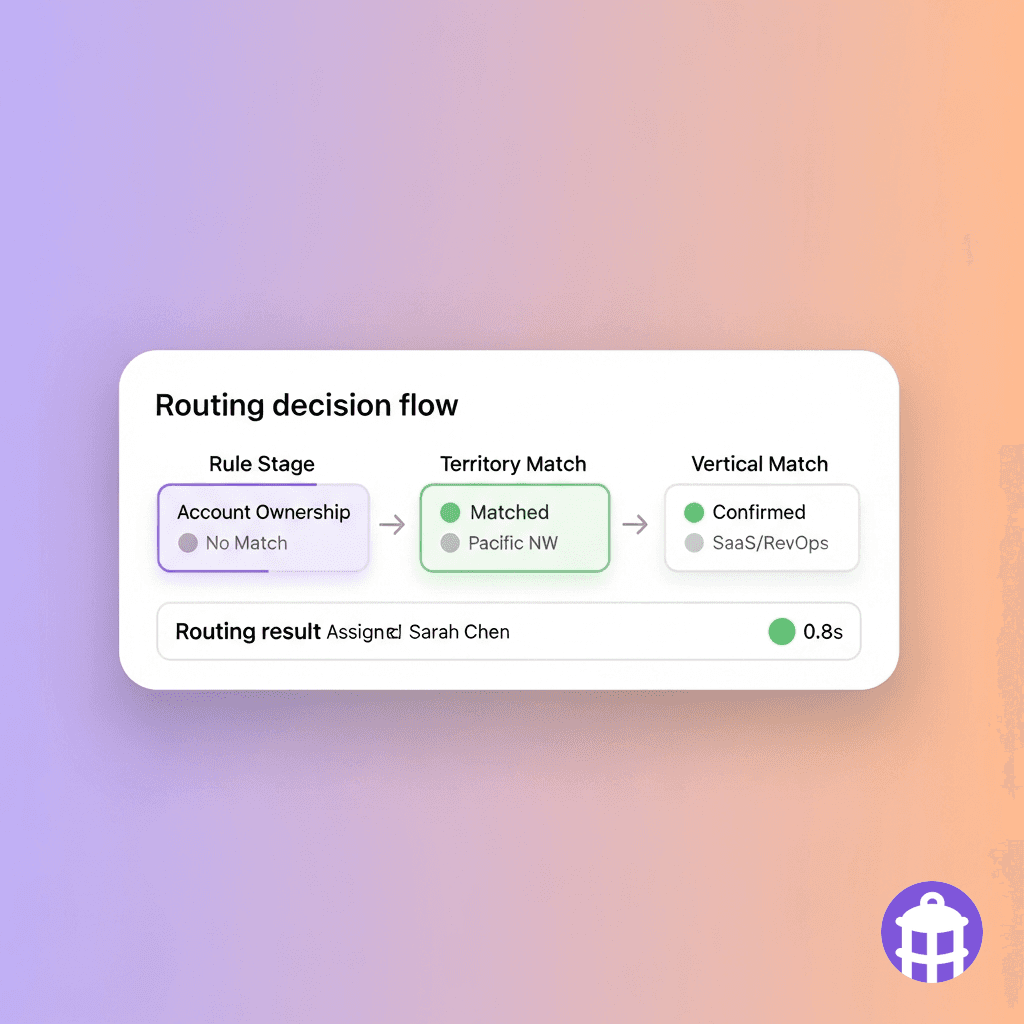
Routing logic isn't just territory assignment. The agent applies a hierarchy of routing rules: first, does an account already have an owner (existing account routing)? Second, does the lead's territory assignment match an available rep (territory routing)? Third, does the lead require segment-specific expertise (vertical or product-line routing)? Fourth, is the lead partner-sourced (partner attribution routing)? Each rule set is applied in priority order, with fallback rules when the primary criteria don't produce a clear match. The routing decision is made in under 60 seconds.

Lead: Jordan M., Prism Analytics. Routing rules evaluated: 1. Existing account ownership — none. 2. Territory: West, 200–500 employees → Jordan K. (available). 3. Vertical: RevOps — Jordan K. (specialist). Routed: Jordan K. (matched 2/3 criteria).

Applies multi-dimensional routing rules in real time

Routing logic isn't just territory assignment. The agent applies a hierarchy of routing rules: first, does an account already have an owner (existing account routing)? Second, does the lead's territory assignment match an available rep (territory routing)? Third, does the lead require segment-specific expertise (vertical or product-line routing)? Fourth, is the lead partner-sourced (partner attribution routing)? Each rule set is applied in priority order, with fallback rules when the primary criteria don't produce a clear match. The routing decision is made in under 60 seconds.

Lead: Jordan M., Prism Analytics. Routing rules evaluated: 1. Existing account ownership — none. 2. Territory: West, 200–500 employees → Jordan K. (available). 3. Vertical: RevOps — Jordan K. (specialist). Routed: Jordan K. (matched 2/3 criteria).

Manages rep availability and load balancing

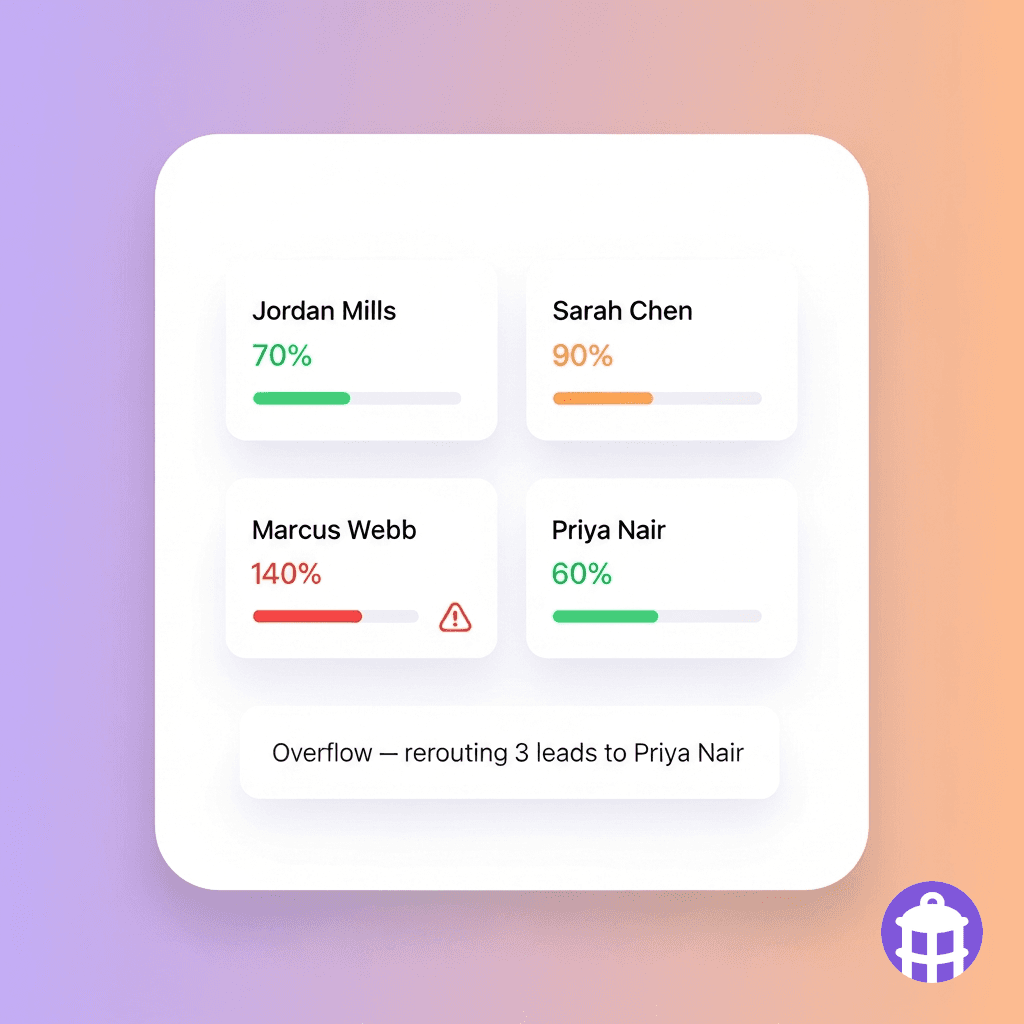
Territory-based routing breaks down when a rep is on PTO, has a full queue, or is a new hire still ramping. The agent monitors rep availability (connected to calendar and out-of-office settings) and lead queue depth (how many open leads each rep is working) and applies load-balancing rules when primary territory routing isn't optimal. A rep at 150% of queue capacity gets fewer leads routed than a rep at 80%. A rep on PTO has leads temporarily re-routed to the backup assigned in the routing rules. Queue overflow doesn't mean leads sit unrouted — it means the system redistributes appropriately.

Jordan K.: queue at 140% capacity, returns from PTO Monday. Routing adjustment: Tier 1 lead re-routed to backup rep Sarah L. (West Enterprise, 90% capacity). Jordan K. notified on return. Tier 2 leads held in queue for Monday.

Manages rep availability and load balancing

Territory-based routing breaks down when a rep is on PTO, has a full queue, or is a new hire still ramping. The agent monitors rep availability (connected to calendar and out-of-office settings) and lead queue depth (how many open leads each rep is working) and applies load-balancing rules when primary territory routing isn't optimal. A rep at 150% of queue capacity gets fewer leads routed than a rep at 80%. A rep on PTO has leads temporarily re-routed to the backup assigned in the routing rules. Queue overflow doesn't mean leads sit unrouted — it means the system redistributes appropriately.

Jordan K.: queue at 140% capacity, returns from PTO Monday. Routing adjustment: Tier 1 lead re-routed to backup rep Sarah L. (West Enterprise, 90% capacity). Jordan K. notified on return. Tier 2 leads held in queue for Monday.

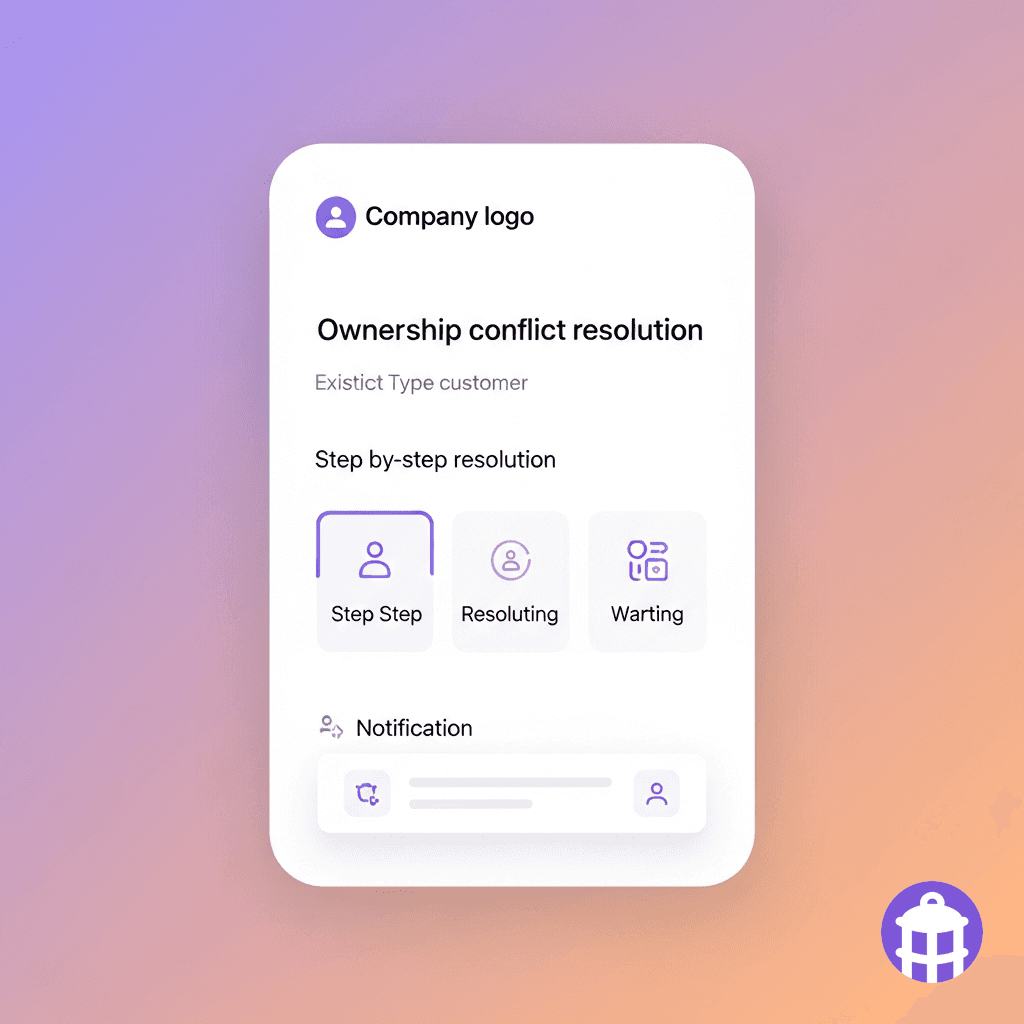
Handles account ownership conflicts and multi-rep scenarios

Real routing complexity comes from edge cases: a lead from a known account that has two reps on it (AE + CSM), a re-engagement from a closed-lost account where the original rep has left, a lead from a company that's a current customer in a different division. The agent applies ownership resolution rules for each scenario: active account with CSM routes new leads to the CSM-plus-AE combination; closed-lost with departed rep routes to the territory rep; current customer in different division routes to the AE with an internal handoff note flagged. Every edge case has a defined resolution.

Edge case: Apex Corp (current customer in EMEA division) submits form for US product. Routing: US territory rep (Jordan K.) flagged with note — 'Existing EMEA customer, Sarah K. (EMEA CSM) to be copied on first outreach.' Relationship preserved.

Handles account ownership conflicts and multi-rep scenarios

Real routing complexity comes from edge cases: a lead from a known account that has two reps on it (AE + CSM), a re-engagement from a closed-lost account where the original rep has left, a lead from a company that's a current customer in a different division. The agent applies ownership resolution rules for each scenario: active account with CSM routes new leads to the CSM-plus-AE combination; closed-lost with departed rep routes to the territory rep; current customer in different division routes to the AE with an internal handoff note flagged. Every edge case has a defined resolution.

Edge case: Apex Corp (current customer in EMEA division) submits form for US product. Routing: US territory rep (Jordan K.) flagged with note — 'Existing EMEA customer, Sarah K. (EMEA CSM) to be copied on first outreach.' Relationship preserved.

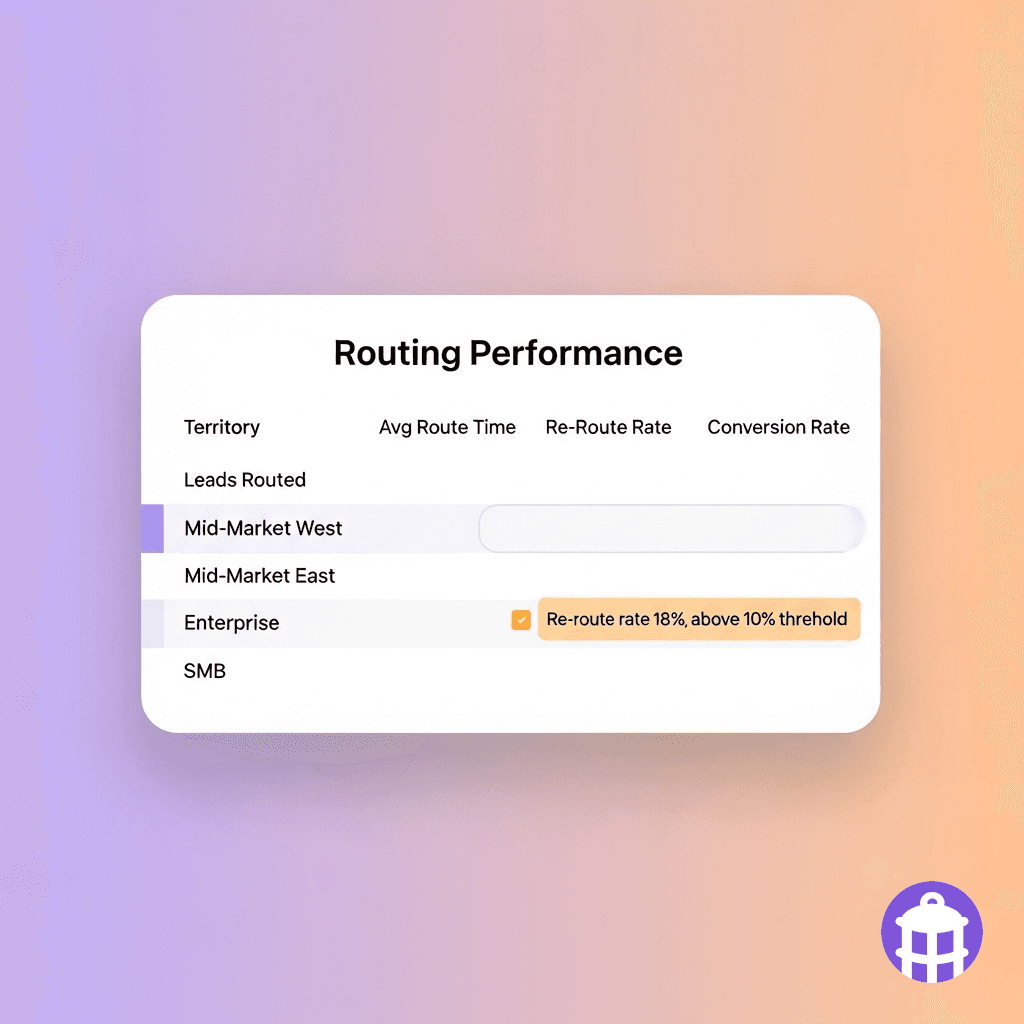
Reports routing accuracy, speed, and rep performance by segment

Routing without measurement produces invisible problems: a territory mapping error that routes 20% of Tier 1 leads to the wrong segment, a capacity rule that's chronically redistributing leads away from the best rep for a specific vertical, or a routing rule that triggers a 10-minute delay for leads that should be immediate. The agent tracks routing speed by tier, routing accuracy (how often the first-assigned rep was the right rep), and rep performance on routed leads (conversion rate by routing rule) — and surfaces anomalies that indicate a routing rule needs adjustment.

Routing report (last 30 days): Avg route time Tier 1: 48 seconds. Accuracy: 94% (6% re-routed after initial assignment). Rep performance: Jordan K. — Tier 1 conversion 31%, Sarah L. — 22%. Anomaly: West territory Tier 2 leads re-routed 18% of the time (capacity issue).

Reports routing accuracy, speed, and rep performance by segment

Routing without measurement produces invisible problems: a territory mapping error that routes 20% of Tier 1 leads to the wrong segment, a capacity rule that's chronically redistributing leads away from the best rep for a specific vertical, or a routing rule that triggers a 10-minute delay for leads that should be immediate. The agent tracks routing speed by tier, routing accuracy (how often the first-assigned rep was the right rep), and rep performance on routed leads (conversion rate by routing rule) — and surfaces anomalies that indicate a routing rule needs adjustment.

Routing report (last 30 days): Avg route time Tier 1: 48 seconds. Accuracy: 94% (6% re-routed after initial assignment). Rep performance: Jordan K. — Tier 1 conversion 31%, Sarah L. — 22%. Anomaly: West territory Tier 2 leads re-routed 18% of the time (capacity issue).

Today vs. with

Today vs. with

Automate Lead Routing

Automate Lead Routing

Today

Leads are routed manually through a shared inbox or ops queue — delays of 2–8 hours are common, with routing errors from misapplied territory rules.

Rep on PTO means leads sit unrouted until they return — or another rep picks them up informally without an official reassignment.

Routing accuracy isn't tracked — re-routing decisions are informal and don't surface patterns that indicate systematic rule problems.

With ABM Strategist

Every lead routes within 60 seconds using a full hierarchy of routing rules — no manual touchpoint, no queue delay.

PTO coverage and backup assignment is enforced by the routing system — leads route to the designated backup automatically.

Routing accuracy and re-route rate are tracked per territory and tier — systematic errors surface as reportable anomalies.

Three layers, one platform by Lantern

Three layers, one platform by Lantern

Every agent runs on three layers: a unified data model, 150+ enrichment providers, and an open-source engine where every decision is auditable.

Every agent runs on three layers: a unified data model, 150+ enrichment providers, and an open-source engine where every decision is auditable.

Data Waterfall

150+ enrichment providers. Sequential routing optimized per segment. The best answer wins. No vendor lock-in.

Agent Engine

Open-source execution engine. Workflows defined in code. Human-in-the-loop checkpoints. Full audit trail on every action.

Revenue Ontology

Every data source normalized into one model. Entity resolution across systems. Relationships stored, not inferred. Schema that evolves with your business.

FAQ

FAQ

How complex can the routing rules get — are there limits on the number of conditions?

Can we set round-robin routing within a territory pool instead of specific rep assignment?

How do partner-sourced leads get attributed and routed differently?

What happens when the routing system can't find a matching rep — no coverage for a territory?

Routing is a systems problem that looks like a people problem until you fix the system.

Routing is a systems problem that looks like a people problem until you fix the system.

USE CASES

Revenue Team

Marketing Team

Customer Success

PRICING

Pricing

RESOURCES

Blog

About Lantern

Status

Support

© LANTERN 2025

Terms

Privacy

Linkedin

USE CASES

Revenue Team

Marketing Team

Customer Success

PRICING

Pricing

RESOURCES

Blog

About Lantern

Status

Support

© LANTERN 2025

Terms

Privacy

Linkedin

USE CASES

Revenue Team

Marketing Team

Customer Success

PRICING

Pricing

RESOURCES

Blog

About Lantern

Status

Support

© LANTERN 2025

Terms

Privacy

Linkedin