
Operate

Audit SEO Content

Audit SEO Content

Find out which content is earning its keep — and which is dragging your domain down.

Find out which content is earning its keep — and which is dragging your domain down.

of content pages on the average B2B SaaS site generate zero organic traffic — the audit identifies exactly which pages to update, consolidate, or retire to concentrate authority on pages that can rank.

of content pages on the average B2B SaaS site generate zero organic traffic — the audit identifies exactly which pages to update, consolidate, or retire to concentrate authority on pages that can rank.

THE brıef

Most content libraries are quietly deteriorating — rankings decaying, traffic eroding, pages cannibalizing each other, and high-investment articles with nothing to show in Search Console. The Audit SEO Content agent systematically evaluates every page in your content library against ranking position, organic traffic, CTR, backlink profile, and content quality signals — then produces a prioritized action plan telling you exactly what to update, consolidate, redirect, or retire.
Maps ranking position and traffic for every page

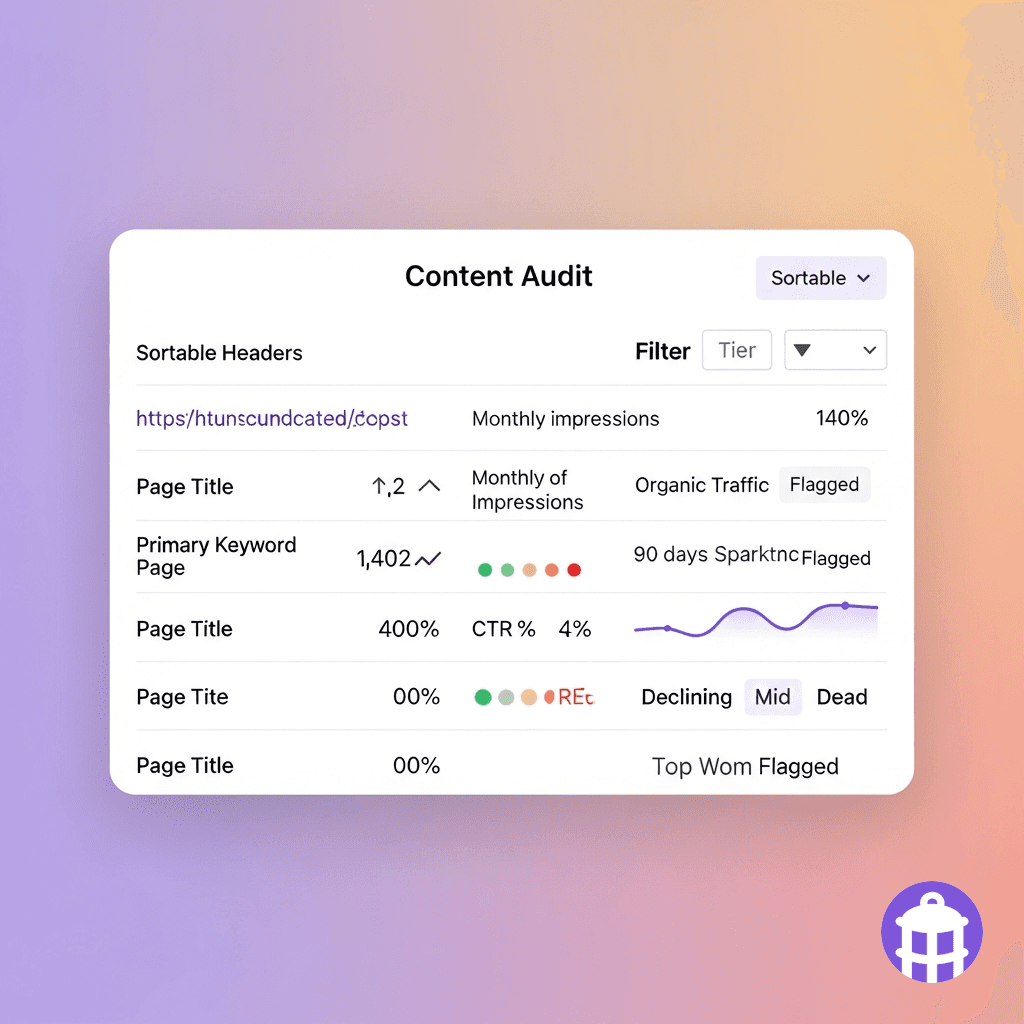
The agent pulls ranking data from Google Search Console and third-party rank tracking tools to build a complete picture of where every page in your content library stands today — position by keyword, impression volume, CTR, and organic traffic trend over 12 months. Pages are segmented into performance tiers: top performers holding positions 1–3, mid-pack pages stuck in positions 4–20 with high update ROI potential, and declining pages that peaked and are now losing ground. The historical trend view is critical — a page in position 8 trending upward is a different priority than a page in position 8 with six months of continuous decline.

withlantern.com content audit: 312 pages analyzed. 41 top performers (pos 1–3). 87 mid-pack pages (pos 4–20), avg 14% traffic decline YoY. 103 pages with zero impressions in 90 days. 81 pages not indexed. Highest-opportunity page: 'B2B lead scoring guide' — pos 11, 8,400 monthly impressions, CTR 1.2% (benchmark: 3.1%).

Maps ranking position and traffic for every page

The agent pulls ranking data from Google Search Console and third-party rank tracking tools to build a complete picture of where every page in your content library stands today — position by keyword, impression volume, CTR, and organic traffic trend over 12 months. Pages are segmented into performance tiers: top performers holding positions 1–3, mid-pack pages stuck in positions 4–20 with high update ROI potential, and declining pages that peaked and are now losing ground. The historical trend view is critical — a page in position 8 trending upward is a different priority than a page in position 8 with six months of continuous decline.

withlantern.com content audit: 312 pages analyzed. 41 top performers (pos 1–3). 87 mid-pack pages (pos 4–20), avg 14% traffic decline YoY. 103 pages with zero impressions in 90 days. 81 pages not indexed. Highest-opportunity page: 'B2B lead scoring guide' — pos 11, 8,400 monthly impressions, CTR 1.2% (benchmark: 3.1%).

Detects keyword cannibalization

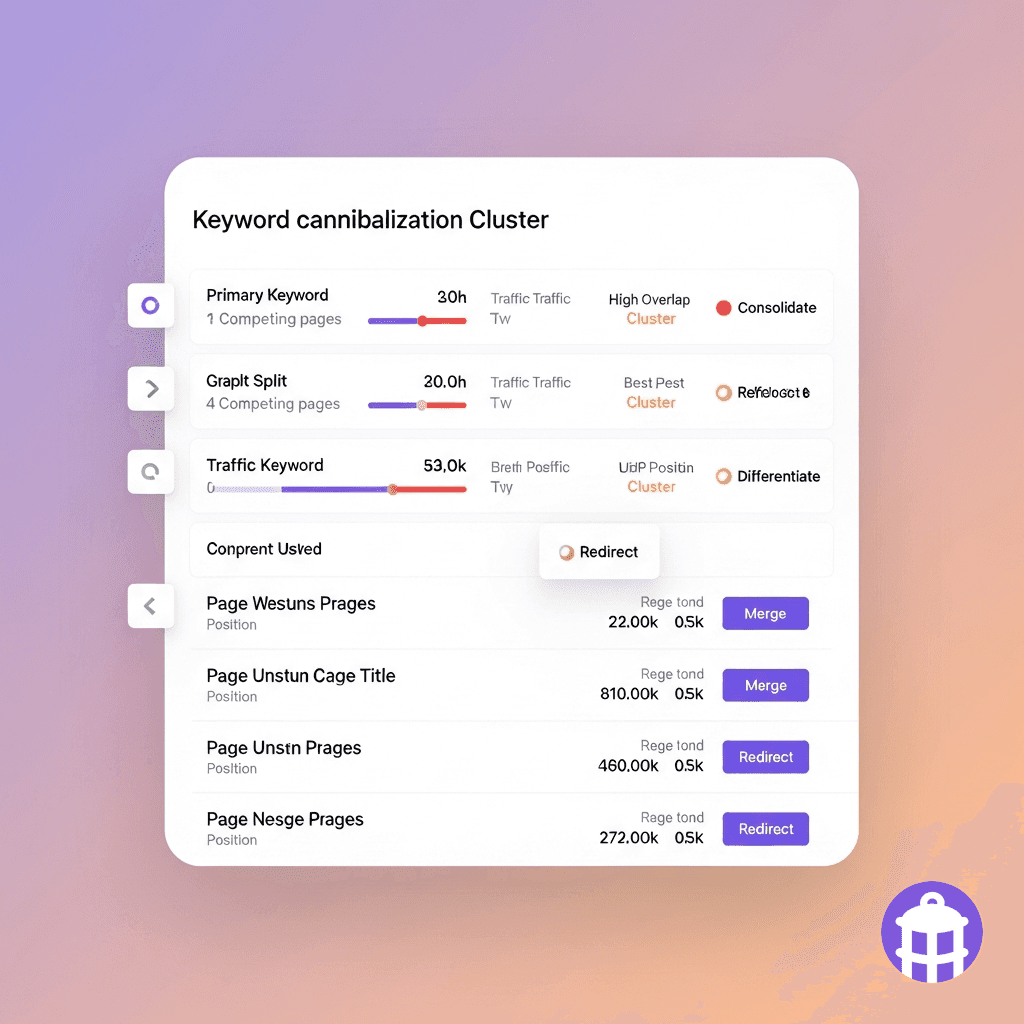
Keyword cannibalization is one of the most common and most overlooked SEO problems at scale — two or more pages competing for the same query, splitting ranking signals and confusing search engines about which page to surface. The agent scans the full content library for pages with keyword overlap above configurable thresholds, maps cannibalization clusters, and identifies which page in each cluster has the strongest authority signals to be the canonical winner. For each cannibalization cluster, the agent recommends whether to consolidate, redirect, or differentiate — and which page should absorb the others' link equity rather than starting from scratch.

Cannibalization scan: 23 cannibalization clusters detected. Largest: 'account based marketing' — 6 pages competing, combined traffic: 3,400/mo, none ranking above position 14. Recommendation: consolidate 4 supporting pages into primary guide, redirect 2 thin pages. Projected impact: pos 14 → estimated pos 5–7.

Detects keyword cannibalization

Keyword cannibalization is one of the most common and most overlooked SEO problems at scale — two or more pages competing for the same query, splitting ranking signals and confusing search engines about which page to surface. The agent scans the full content library for pages with keyword overlap above configurable thresholds, maps cannibalization clusters, and identifies which page in each cluster has the strongest authority signals to be the canonical winner. For each cannibalization cluster, the agent recommends whether to consolidate, redirect, or differentiate — and which page should absorb the others' link equity rather than starting from scratch.

Cannibalization scan: 23 cannibalization clusters detected. Largest: 'account based marketing' — 6 pages competing, combined traffic: 3,400/mo, none ranking above position 14. Recommendation: consolidate 4 supporting pages into primary guide, redirect 2 thin pages. Projected impact: pos 14 → estimated pos 5–7.

Scores content quality and freshness

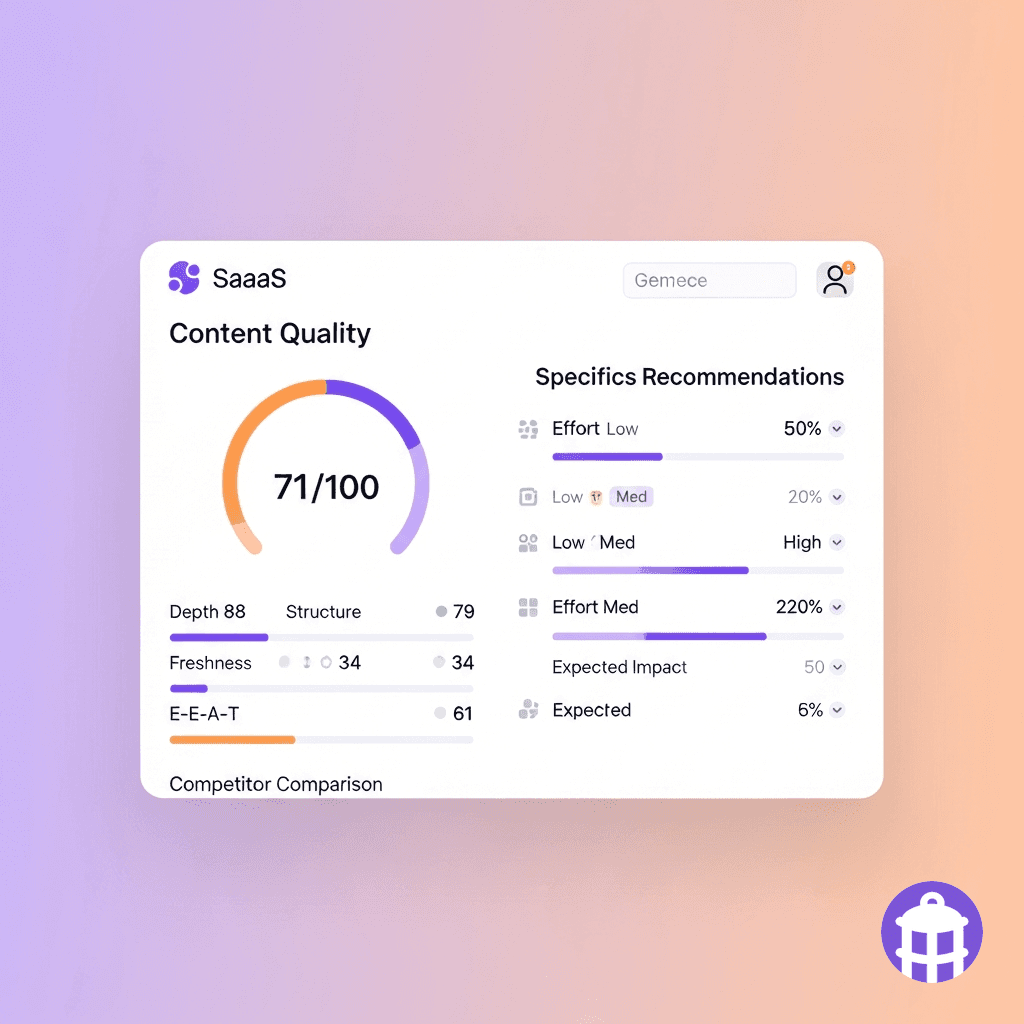
Rankings and traffic tell you the outcome. Content quality scoring tells you why — and what to do about it. The agent evaluates each page against signals correlated with ranking performance: word count versus SERP benchmark for the query, heading structure, internal link count, last updated date, image alt text coverage, and on-page schema. Pages are scored on a 100-point quality index, with individual sub-scores for depth, freshness, structure, and E-E-A-T signals. A page scoring 43/100 on freshness but 89/100 on depth needs a targeted update, not a full rewrite — and the agent's recommendations reflect that level of specificity so your content team knows exactly what to fix.

'Complete guide to sales automation' — Quality Score: 71/100. Sub-scores: Depth 88/100 (strong), Structure 79/100 (good), Freshness 34/100 (last updated 18 months ago — flagged), E-E-A-T signals 61/100 (add author bio and cite recent data). Recommended action: targeted refresh, estimated 3–4 hours.

Scores content quality and freshness

Rankings and traffic tell you the outcome. Content quality scoring tells you why — and what to do about it. The agent evaluates each page against signals correlated with ranking performance: word count versus SERP benchmark for the query, heading structure, internal link count, last updated date, image alt text coverage, and on-page schema. Pages are scored on a 100-point quality index, with individual sub-scores for depth, freshness, structure, and E-E-A-T signals. A page scoring 43/100 on freshness but 89/100 on depth needs a targeted update, not a full rewrite — and the agent's recommendations reflect that level of specificity so your content team knows exactly what to fix.

'Complete guide to sales automation' — Quality Score: 71/100. Sub-scores: Depth 88/100 (strong), Structure 79/100 (good), Freshness 34/100 (last updated 18 months ago — flagged), E-E-A-T signals 61/100 (add author bio and cite recent data). Recommended action: targeted refresh, estimated 3–4 hours.

Produces a prioritized content action plan

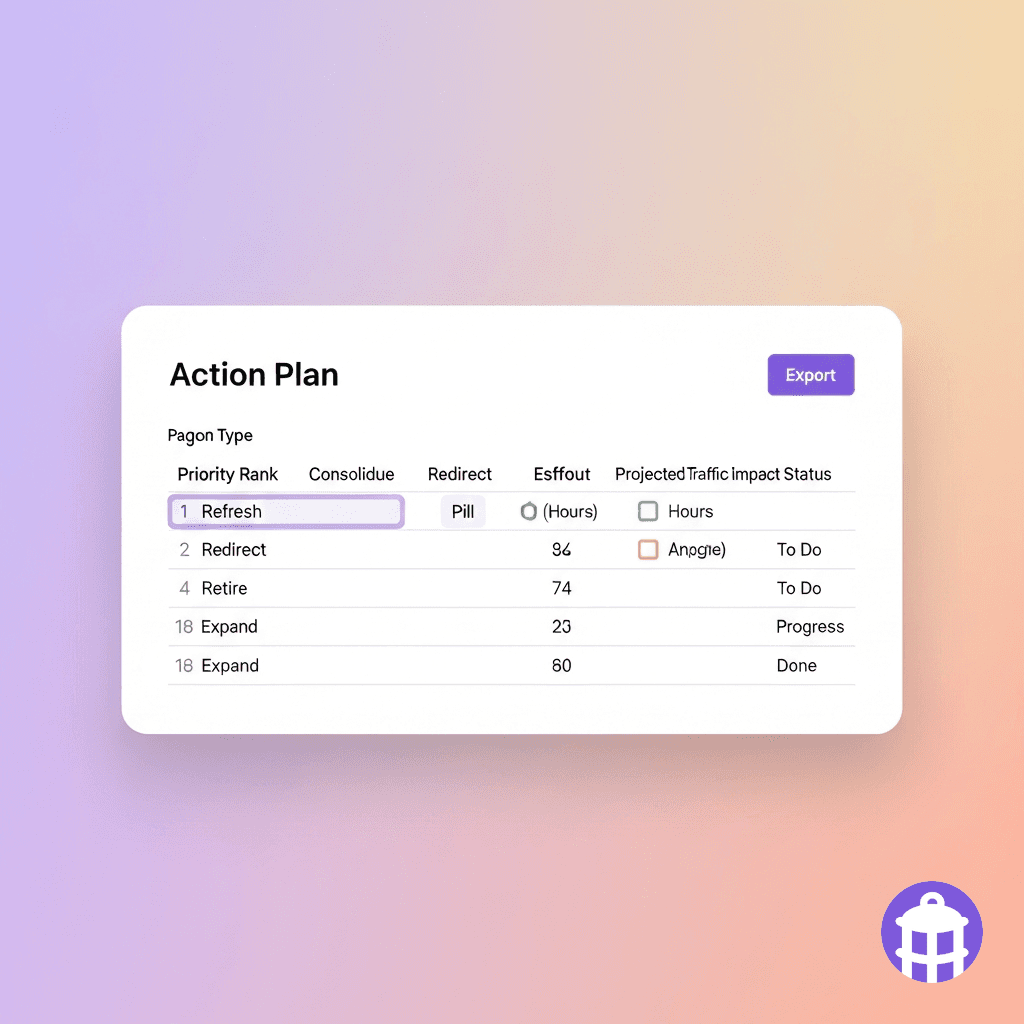
A content audit without a ranked action plan is just a spreadsheet that stresses people out. The agent synthesizes all signals — ranking position, traffic trend, quality score, cannibalization risk, and keyword opportunity — into a single prioritized action list ordered by estimated ROI. Each action item includes a specific recommendation (update, consolidate, redirect, retire, or expand), a difficulty estimate, a projected traffic impact range, and the specific changes needed. The output is designed to be handed directly to a content team or freelancer with enough context to execute without another briefing — not a high-level finding that requires a follow-up audit to translate into work.

Q2 content action plan: 18 priority actions. Top 3: (1) Refresh 'outbound sales cadence guide' — pos 9, low effort, projected +1,200 traffic/mo. (2) Consolidate 'ABM strategy' cluster — 4 pages into 1, projected pos 14 → 6. (3) Retire 12 thin pages under 300 words with zero impressions — free crawl budget for priority URLs.

Produces a prioritized content action plan

A content audit without a ranked action plan is just a spreadsheet that stresses people out. The agent synthesizes all signals — ranking position, traffic trend, quality score, cannibalization risk, and keyword opportunity — into a single prioritized action list ordered by estimated ROI. Each action item includes a specific recommendation (update, consolidate, redirect, retire, or expand), a difficulty estimate, a projected traffic impact range, and the specific changes needed. The output is designed to be handed directly to a content team or freelancer with enough context to execute without another briefing — not a high-level finding that requires a follow-up audit to translate into work.

Q2 content action plan: 18 priority actions. Top 3: (1) Refresh 'outbound sales cadence guide' — pos 9, low effort, projected +1,200 traffic/mo. (2) Consolidate 'ABM strategy' cluster — 4 pages into 1, projected pos 14 → 6. (3) Retire 12 thin pages under 300 words with zero impressions — free crawl budget for priority URLs.

Today vs. with

Today vs. with

Audit SEO Content

Audit SEO Content

Today

Content audits done manually in spreadsheets twice a year — most actionable data is stale by the time anyone acts on it

No systematic detection of keyword cannibalization — pages compete against each other without anyone noticing

Content team guesses which pages to update based on age or gut feel, not ranking data and quality signals

With ABM Strategist

Automated audit running continuously, with a prioritized action plan updated as rankings and traffic change

Full cannibalization scan across the content library with specific consolidation and redirect recommendations per cluster

Prioritized refresh queue ranked by estimated traffic ROI — highest-impact pages first, with specific instructions per page

Three layers, one platform by Lantern

Three layers, one platform by Lantern

Every agent runs on three layers: a unified data model, 150+ enrichment providers, and an open-source engine where every decision is auditable.

Every agent runs on three layers: a unified data model, 150+ enrichment providers, and an open-source engine where every decision is auditable.

Data Waterfall

150+ enrichment providers. Sequential routing optimized per segment. The best answer wins. No vendor lock-in.

Agent Engine

Open-source execution engine. Workflows defined in code. Human-in-the-loop checkpoints. Full audit trail on every action.

Revenue Ontology

Every data source normalized into one model. Entity resolution across systems. Relationships stored, not inferred. Schema that evolves with your business.

FAQ

FAQ

How large a content library can the agent audit?

Does it require Google Search Console access?

How often does the audit update?

Can it audit content across multiple domains or subdomains?

Your best content is being held back by everything around it — find it, fix it, and let it rank.

Your best content is being held back by everything around it — find it, fix it, and let it rank.

USE CASES

Revenue Team

Marketing Team

Customer Success

PRICING

Pricing

RESOURCES

Blog

About Lantern

Status

Support

© LANTERN 2025

Terms

Privacy

Linkedin

USE CASES

Revenue Team

Marketing Team

Customer Success

PRICING

Pricing

RESOURCES

Blog

About Lantern

Status

Support

© LANTERN 2025

Terms

Privacy

Linkedin

USE CASES

Revenue Team

Marketing Team

Customer Success

PRICING

Pricing

RESOURCES

Blog

About Lantern

Status

Support

© LANTERN 2025

Terms

Privacy

Linkedin