
Operate

Map Topical Authority

Map Topical Authority

Know which topic clusters you own, which are gaps, and exactly what to build to close them.

Know which topic clusters you own, which are gaps, and exactly what to build to close them.

Average organic traffic multiplier for domains that reach full topical authority in a cluster versus those with partial coverage — the compounding effect of owning a topic, not just having a page about it.

Average organic traffic multiplier for domains that reach full topical authority in a cluster versus those with partial coverage — the compounding effect of owning a topic, not just having a page about it.

THE brıef

Google rewards domains that demonstrate comprehensive topical coverage — not just pages that are individually well-optimized. The Map Topical Authority agent builds a full topical authority map for your domain: which clusters you own with strong coverage, which are partially covered, which are gaps your competitors exploit, and a sequenced content roadmap for building the authority signals that compound across the whole cluster.
Maps your current topical coverage against domain authority signals

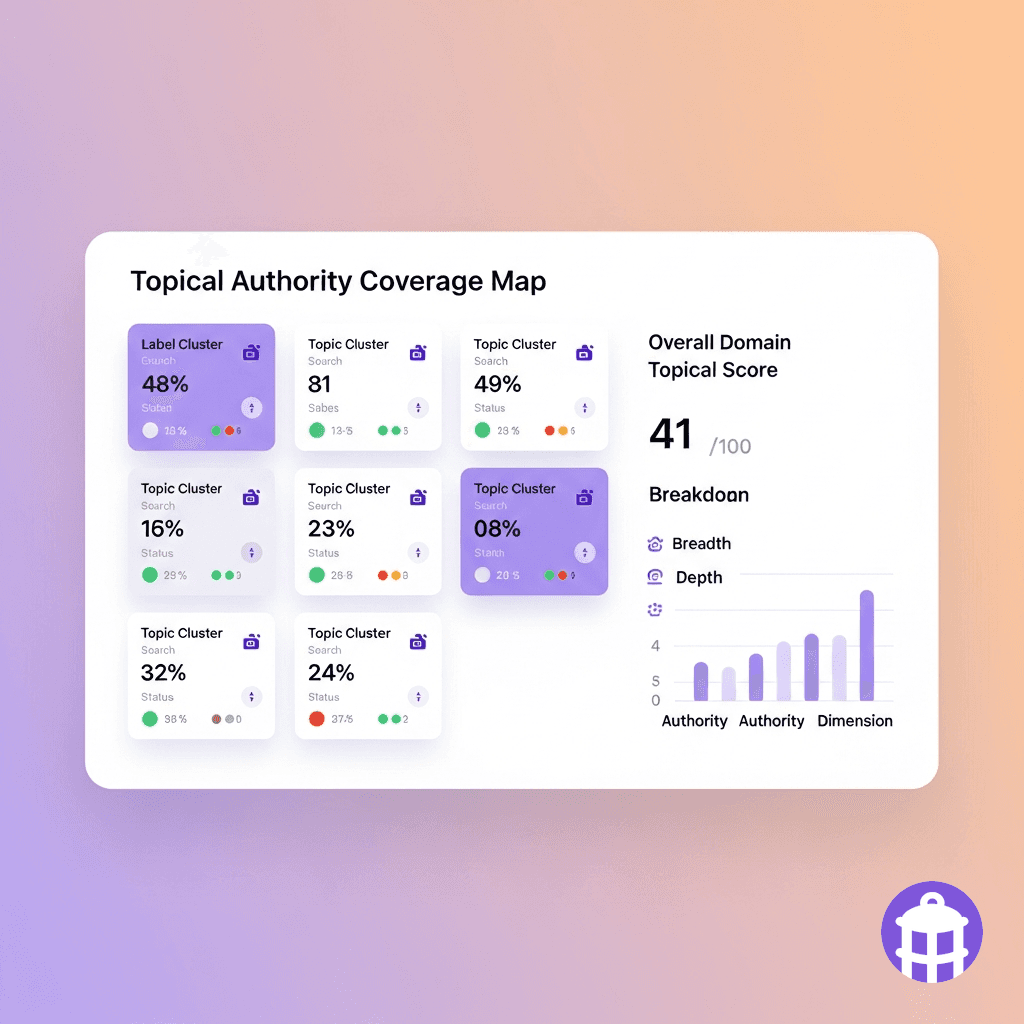
The agent analyzes your full content library against a comprehensive topic map of your category — every topic cluster, subtopic, and intent variation that searchers in your market use. For each cluster, it scores your current coverage by three dimensions: breadth (what percentage of subtopics have at least one page), depth (whether those pages meet the content depth threshold for the query), and authority signal (average ranking position and link equity concentrated in the cluster). The coverage map visualizes your domain's topical profile: the clusters you own, the ones you're in but weak, and the blank spots where you have zero presence. This is the baseline for every subsequent content investment decision.

Topical authority map — withlantern.com: 14 topic clusters analyzed. Strong ownership (≥70% coverage, avg pos ≤8): 3 clusters — CRM Data, Lead Enrichment, Sales Operations. Partial presence (30–70% coverage): 6 clusters. No presence: 5 clusters including 'Revenue Intelligence' (high competitive cluster) and 'Go-to-Market Planning' (large search volume, low competition). Total topical coverage score: 41/100.

Maps your current topical coverage against domain authority signals

The agent analyzes your full content library against a comprehensive topic map of your category — every topic cluster, subtopic, and intent variation that searchers in your market use. For each cluster, it scores your current coverage by three dimensions: breadth (what percentage of subtopics have at least one page), depth (whether those pages meet the content depth threshold for the query), and authority signal (average ranking position and link equity concentrated in the cluster). The coverage map visualizes your domain's topical profile: the clusters you own, the ones you're in but weak, and the blank spots where you have zero presence. This is the baseline for every subsequent content investment decision.

Topical authority map — withlantern.com: 14 topic clusters analyzed. Strong ownership (≥70% coverage, avg pos ≤8): 3 clusters — CRM Data, Lead Enrichment, Sales Operations. Partial presence (30–70% coverage): 6 clusters. No presence: 5 clusters including 'Revenue Intelligence' (high competitive cluster) and 'Go-to-Market Planning' (large search volume, low competition). Total topical coverage score: 41/100.

Identifies cluster-level competitor gaps and threats

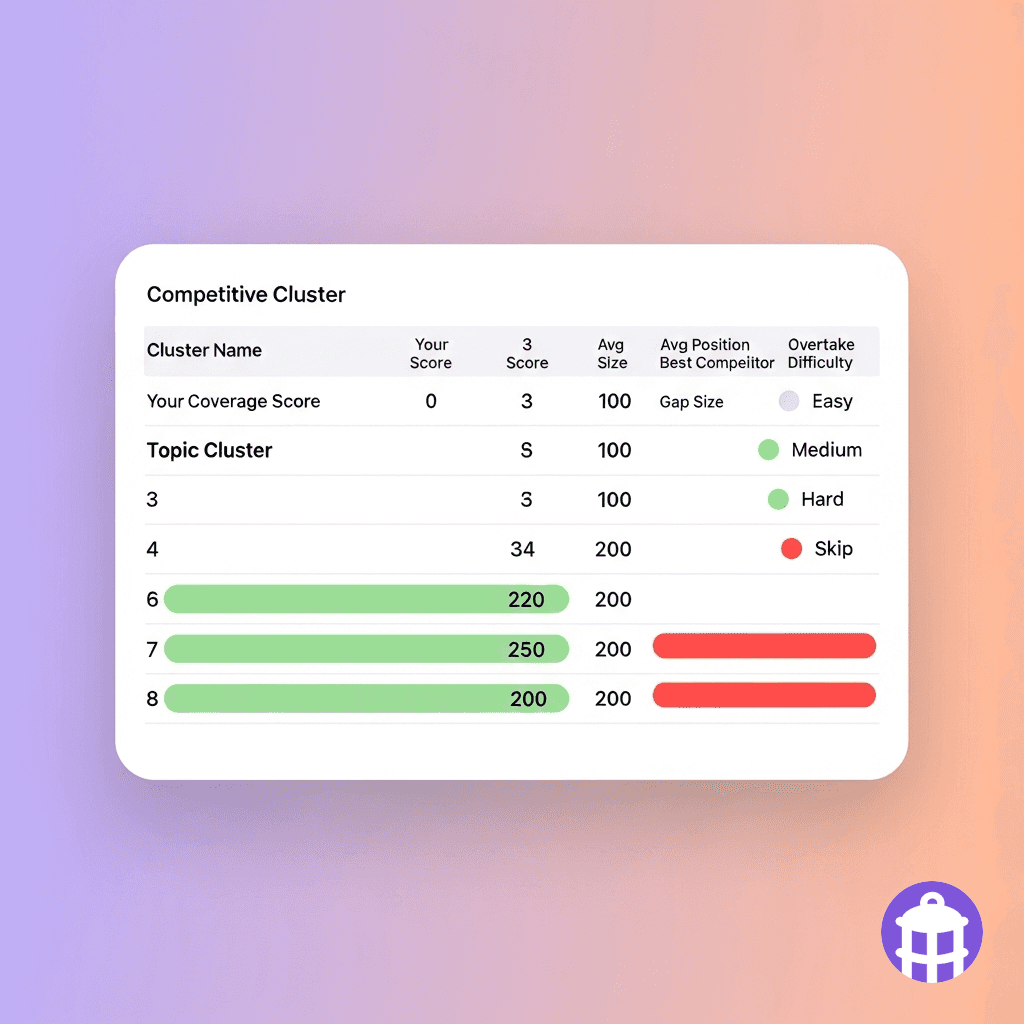
Topical authority is relative — you own a cluster when you have deeper, more comprehensive coverage than the alternatives Google has to rank. The agent benchmarks your cluster coverage against your top-three organic competitors per cluster, identifying where you lead, where you trail, and where a competitor has built a dominant cluster position that would be expensive to displace versus where their coverage is thin and an investment sprint could flip the competitive position in your favor. Competitive gap analysis is done at the cluster level, not just the individual keyword level, which surfaces strategic opportunities that keyword-level analysis misses: a competitor owns 'Sales Territory Planning' as a topic but has done it with low-quality, shallow content — a focused build could flip that cluster quickly.

Competitive cluster analysis: 'Sales Territory Planning' — you: 2 pages, avg pos 22. Competitor A (Salesforce): 8 pages, avg pos 6.1, cluster authority score 72. However: avg content quality score 59/100 — thin coverage. Overtake assessment: achievable with 6 high-quality pages in 4–6 months. 'Revenue Intelligence' cluster — HubSpot dominates (score 91), 18 pages, high link equity. Overtake cost: very high — not recommended near-term.

Identifies cluster-level competitor gaps and threats

Topical authority is relative — you own a cluster when you have deeper, more comprehensive coverage than the alternatives Google has to rank. The agent benchmarks your cluster coverage against your top-three organic competitors per cluster, identifying where you lead, where you trail, and where a competitor has built a dominant cluster position that would be expensive to displace versus where their coverage is thin and an investment sprint could flip the competitive position in your favor. Competitive gap analysis is done at the cluster level, not just the individual keyword level, which surfaces strategic opportunities that keyword-level analysis misses: a competitor owns 'Sales Territory Planning' as a topic but has done it with low-quality, shallow content — a focused build could flip that cluster quickly.

Competitive cluster analysis: 'Sales Territory Planning' — you: 2 pages, avg pos 22. Competitor A (Salesforce): 8 pages, avg pos 6.1, cluster authority score 72. However: avg content quality score 59/100 — thin coverage. Overtake assessment: achievable with 6 high-quality pages in 4–6 months. 'Revenue Intelligence' cluster — HubSpot dominates (score 91), 18 pages, high link equity. Overtake cost: very high — not recommended near-term.

Designs the cluster content architecture

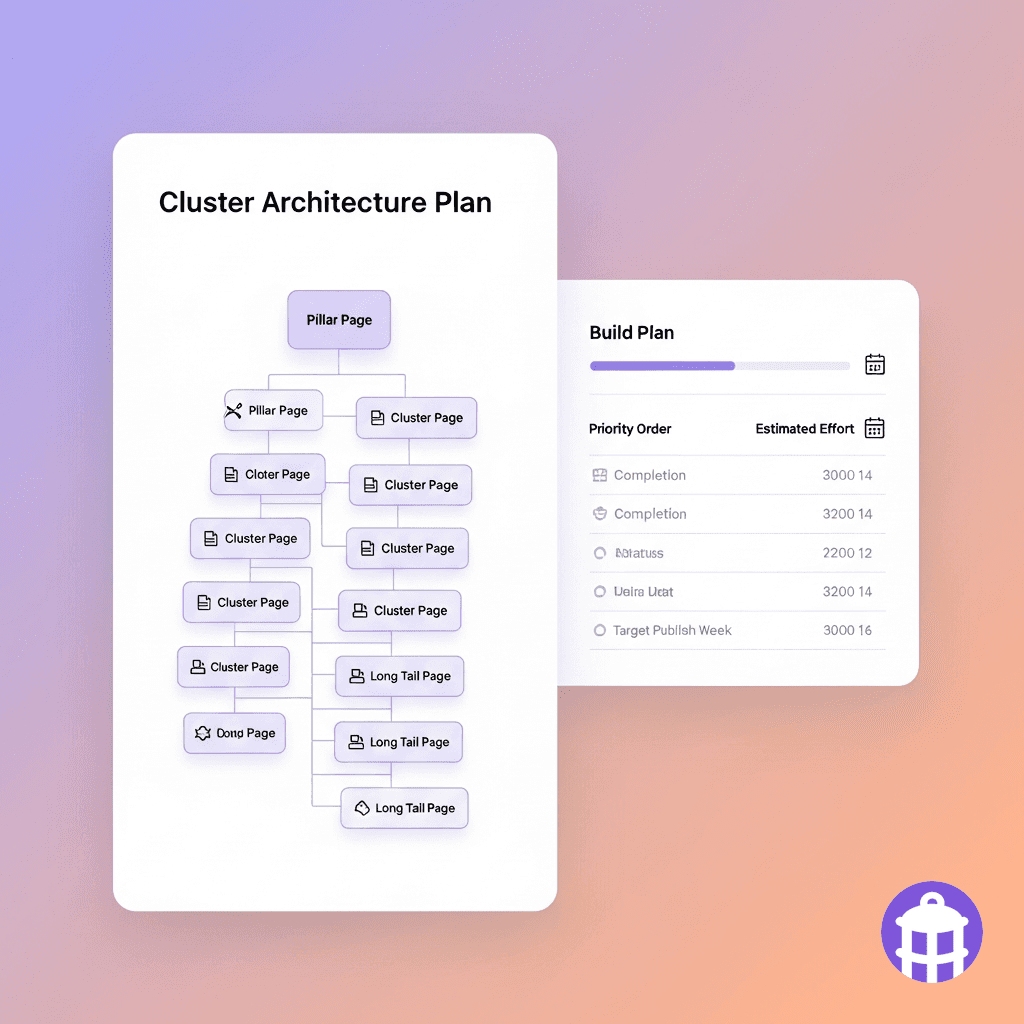
A topical authority strategy needs a structural content architecture to execute against — not just a list of topics to cover. For each priority cluster, the agent designs the full content hierarchy: the pillar page that establishes topical breadth, the cluster content pages that establish depth across each subtopic, the long-tail supporting pages that signal comprehensive coverage of the intent variants, and the internal linking structure that concentrates authority signals across the cluster. Each page in the architecture has a clearly defined scope — what it covers, what it links to, and what it doesn't overlap with — preventing the cannibalization that undermines cluster authority when pages compete against each other.

'Sales Engagement' cluster architecture: 1 pillar page (all intent, broad coverage, 4,000 words). 8 cluster pages (each H2 topic from pillar becomes a dedicated page, 1,800–2,400 words each). 14 long-tail support pages (specific questions and intent variants, 800–1,200 words). Internal link map: pillar links to all 8 cluster pages. Each cluster page links to pillar and 3–5 long-tail pages. Estimated build time: 12–14 weeks at 2 pages/week.

Designs the cluster content architecture

A topical authority strategy needs a structural content architecture to execute against — not just a list of topics to cover. For each priority cluster, the agent designs the full content hierarchy: the pillar page that establishes topical breadth, the cluster content pages that establish depth across each subtopic, the long-tail supporting pages that signal comprehensive coverage of the intent variants, and the internal linking structure that concentrates authority signals across the cluster. Each page in the architecture has a clearly defined scope — what it covers, what it links to, and what it doesn't overlap with — preventing the cannibalization that undermines cluster authority when pages compete against each other.

'Sales Engagement' cluster architecture: 1 pillar page (all intent, broad coverage, 4,000 words). 8 cluster pages (each H2 topic from pillar becomes a dedicated page, 1,800–2,400 words each). 14 long-tail support pages (specific questions and intent variants, 800–1,200 words). Internal link map: pillar links to all 8 cluster pages. Each cluster page links to pillar and 3–5 long-tail pages. Estimated build time: 12–14 weeks at 2 pages/week.

Tracks authority growth and ranking progression across clusters

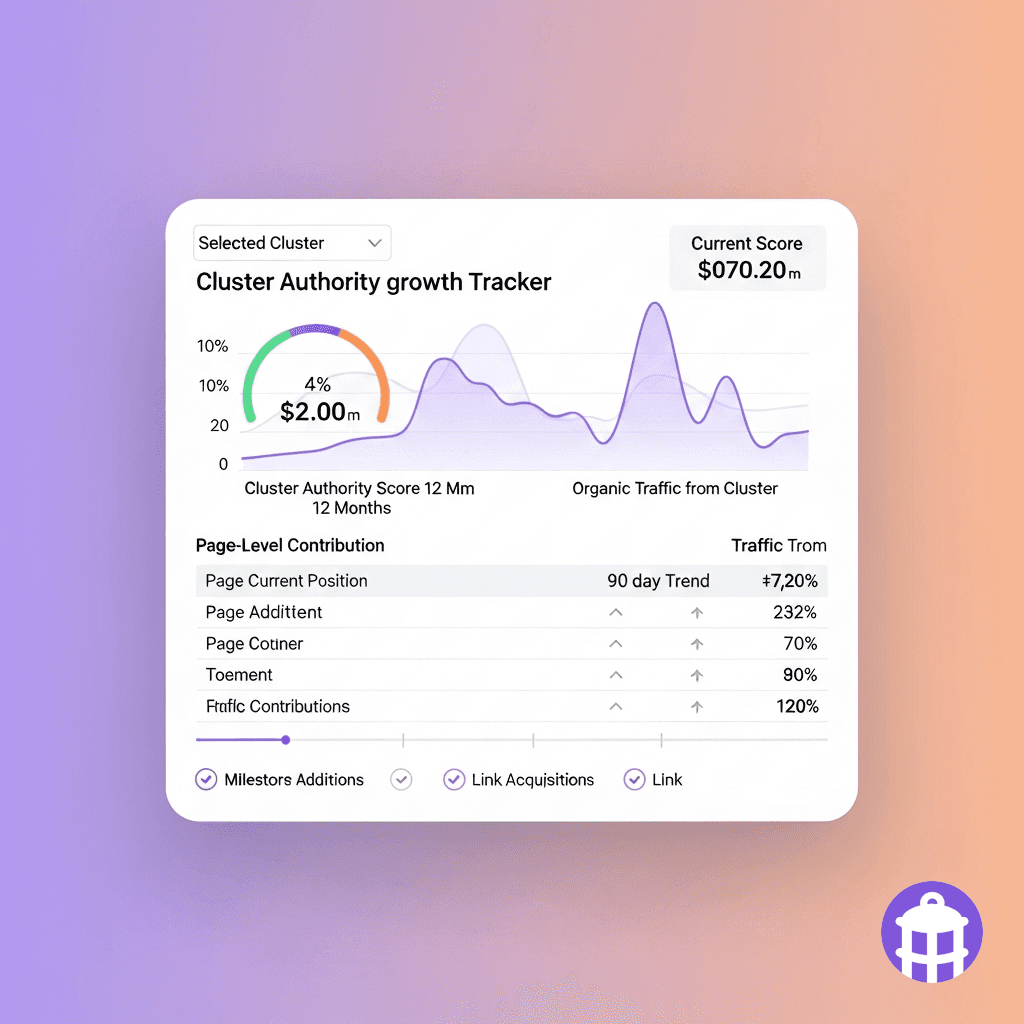
Topical authority builds over time — a cluster doesn't flip from weak to strong overnight. The agent tracks authority progression across all clusters on a rolling basis: ranking position trends for each page in the cluster, changes in the cluster's aggregate authority score as new content is added and indexed, link equity accumulation into the cluster, and featured snippet capture rate within the cluster (a leading indicator of recognized topical authority). Progress is reported at the cluster level, not the individual page level, so the team can see the compounding effect of a sustained content investment — not just individual page performance that can mask or overstate the cluster's trajectory.

'Sales Engagement' cluster authority progress — Q1 2026: Cluster authority score: 38 → 57 (+19). New pages added: 6. Avg cluster ranking position: 18.4 → 11.2. Featured snippets in cluster: 0 → 4. Organic traffic from cluster: +2,840 visits/mo vs. Q4 2025. 'Sales Operations' cluster (mature): score 78, stable — monitoring for competitive threats.

Tracks authority growth and ranking progression across clusters

Topical authority builds over time — a cluster doesn't flip from weak to strong overnight. The agent tracks authority progression across all clusters on a rolling basis: ranking position trends for each page in the cluster, changes in the cluster's aggregate authority score as new content is added and indexed, link equity accumulation into the cluster, and featured snippet capture rate within the cluster (a leading indicator of recognized topical authority). Progress is reported at the cluster level, not the individual page level, so the team can see the compounding effect of a sustained content investment — not just individual page performance that can mask or overstate the cluster's trajectory.

'Sales Engagement' cluster authority progress — Q1 2026: Cluster authority score: 38 → 57 (+19). New pages added: 6. Avg cluster ranking position: 18.4 → 11.2. Featured snippets in cluster: 0 → 4. Organic traffic from cluster: +2,840 visits/mo vs. Q4 2025. 'Sales Operations' cluster (mature): score 78, stable — monitoring for competitive threats.

Today vs. with

Today vs. with

Map Topical Authority

Map Topical Authority

Today

Content strategy is a list of individual article ideas with no visibility into how they build cluster authority or where topical gaps remain

No way to know which topics competitors own strongly versus which they have thin coverage on — all competition looks equally difficult

Content performance tracked page-by-page — the compounding effect of cluster authority building is invisible in individual page metrics

With ABM Strategist

Full topical map with cluster-level coverage scores — every content decision made in the context of which cluster it serves and what gap it fills

Cluster-level competitive benchmarking identifies where competitor coverage is weak and a focused sprint can flip the competitive position

Cluster-level authority tracking shows the accumulating impact of content investment — authority score, position trends, and traffic attribution per cluster

Three layers, one platform by Lantern

Three layers, one platform by Lantern

Every agent runs on three layers: a unified data model, 150+ enrichment providers, and an open-source engine where every decision is auditable.

Every agent runs on three layers: a unified data model, 150+ enrichment providers, and an open-source engine where every decision is auditable.

Data Waterfall

150+ enrichment providers. Sequential routing optimized per segment. The best answer wins. No vendor lock-in.

Agent Engine

Open-source execution engine. Workflows defined in code. Human-in-the-loop checkpoints. Full audit trail on every action.

Revenue Ontology

Every data source normalized into one model. Entity resolution across systems. Relationships stored, not inferred. Schema that evolves with your business.

FAQ

FAQ

How is topical authority different from domain authority?

How many topic clusters does the average B2B SaaS company have in their category?

How long does it take to build topical authority in a new cluster?

Does internal linking really matter that much for cluster authority?

Search doesn't reward individual pages anymore — it rewards domains that own topics.

Search doesn't reward individual pages anymore — it rewards domains that own topics.

USE CASES

Revenue Team

Marketing Team

Customer Success

PRICING

Pricing

RESOURCES

Blog

About Lantern

Status

Support

© LANTERN 2025

Terms

Privacy

Linkedin

USE CASES

Revenue Team

Marketing Team

Customer Success

PRICING

Pricing

RESOURCES

Blog

About Lantern

Status

Support

© LANTERN 2025

Terms

Privacy

Linkedin

USE CASES

Revenue Team

Marketing Team

Customer Success

PRICING

Pricing

RESOURCES

Blog

About Lantern

Status

Support

© LANTERN 2025

Terms

Privacy

Linkedin