
Close Deals

Build Competitive Battlecards

Build Competitive Battlecards

Battlecards that are actually current — built from live signals, not a stale Notion page.

Battlecards that are actually current — built from live signals, not a stale Notion page.

higher win rate in competitive deals when reps consult an up-to-date battlecard vs. deals with no competitive prep.

higher win rate in competitive deals when reps consult an up-to-date battlecard vs. deals with no competitive prep.

THE brıef

Competitive battlecards fail when they're outdated — which they always are when built manually. A competitor changes pricing, ships a new feature, or shifts messaging, and the battlecard that reps rely on reflects last quarter's competitive landscape. The agent builds battlecards from live competitive intelligence: current pricing, recent product announcements, review site patterns, and messaging positioning. Battlecards update automatically when new signals arrive, so the rep consulting the card before a competitive call sees what's true today.
Builds the initial battlecard from multi-source competitive intelligence

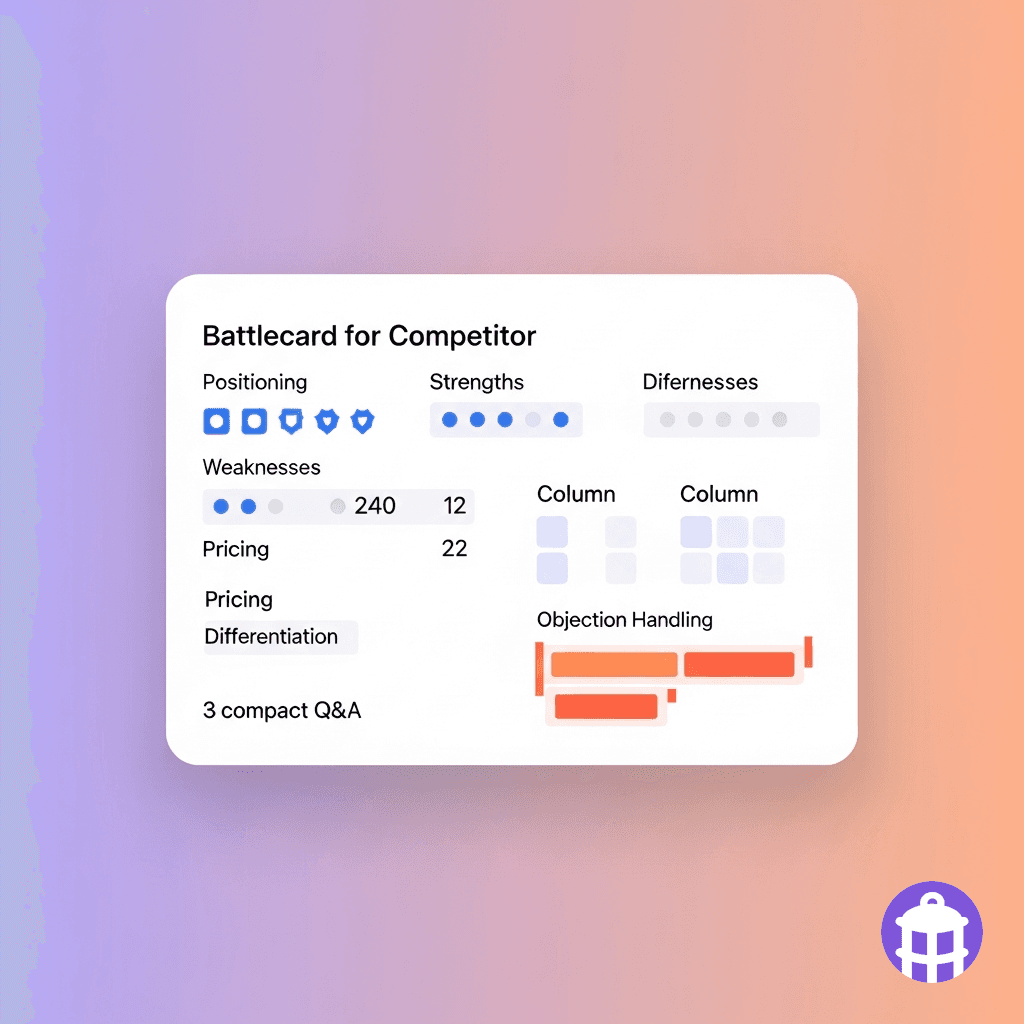
The agent assembles a comprehensive battlecard for each competitor from the full range of available signals: product website analysis (features claimed, messaging framing, pricing structure), review site analysis (strengths and weaknesses cited by actual customers), job posting analysis (which functions are being hired for signals strategic direction), third-party analyst coverage, and your own internal win/loss data from CRM notes. Each battlecard section is sourced and dated — so reps know whether the product comparison is based on data from last week or last month.

Clearbit battlecard: Positioning (their current headline + how they frame the category), Strengths (cited by G2 reviewers), Weaknesses (14 reviews mention data gaps in financial services), Pricing (3-tier structure), Our Differentiation (waterfall vs. single source), Common Objections (3 + responses).

Builds the initial battlecard from multi-source competitive intelligence

The agent assembles a comprehensive battlecard for each competitor from the full range of available signals: product website analysis (features claimed, messaging framing, pricing structure), review site analysis (strengths and weaknesses cited by actual customers), job posting analysis (which functions are being hired for signals strategic direction), third-party analyst coverage, and your own internal win/loss data from CRM notes. Each battlecard section is sourced and dated — so reps know whether the product comparison is based on data from last week or last month.

Clearbit battlecard: Positioning (their current headline + how they frame the category), Strengths (cited by G2 reviewers), Weaknesses (14 reviews mention data gaps in financial services), Pricing (3-tier structure), Our Differentiation (waterfall vs. single source), Common Objections (3 + responses).

Updates battlecards automatically when new signals arrive

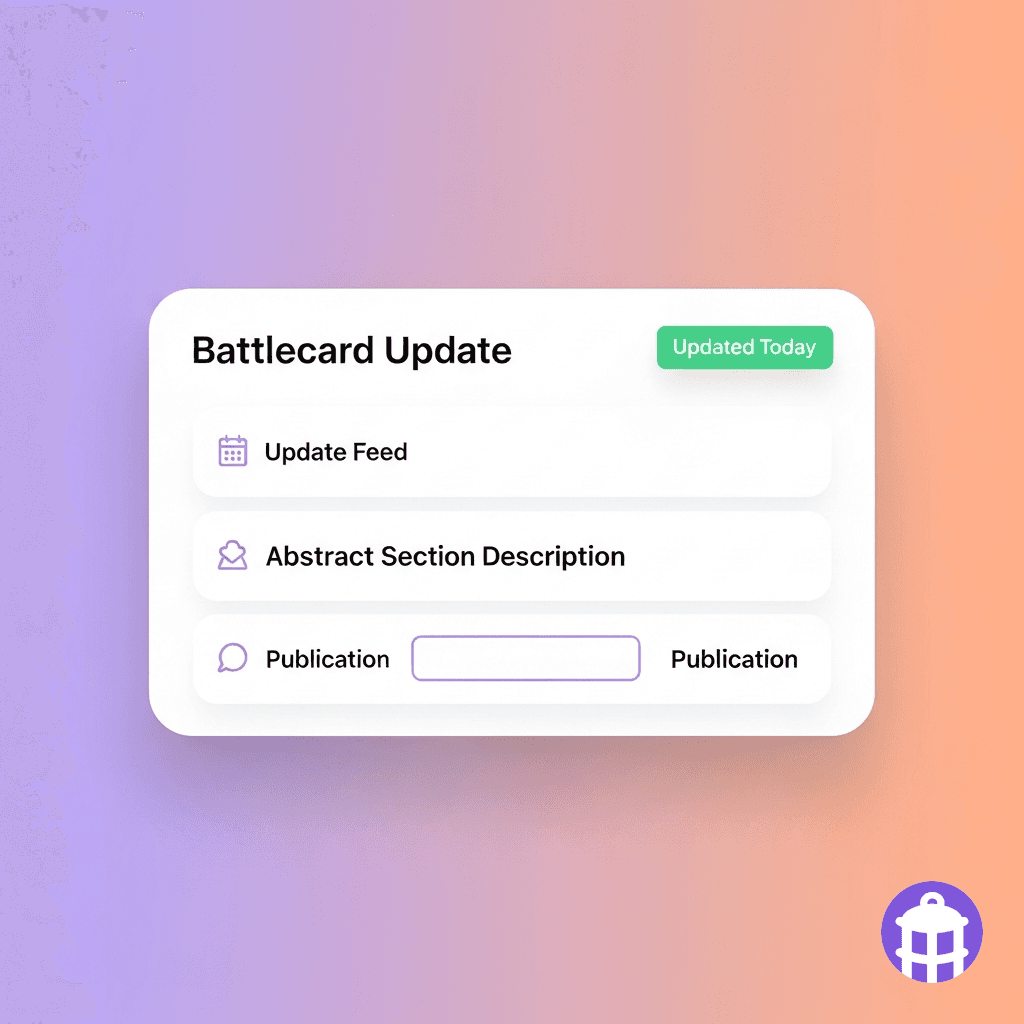
The most important feature of a battlecard is that it reflects current reality. The agent monitors all competitive intelligence sources continuously and updates the relevant battlecard section whenever a material signal arrives: a pricing page change triggers an update to the pricing section, a new G2 review trend updates the weaknesses analysis, a product announcement updates the feature comparison. Each update is logged with the date and source so reps can see not just what the card says but when it was last verified. Updates surface in the rep's CRM deal view when they're actively working a competitive opportunity.

Clearbit battlecard updated today: Pricing section revised — new enterprise tier announced this morning. Feature comparison: AI enrichment section updated (new claim on G2, unverified). Last full review: 6 days ago.

Updates battlecards automatically when new signals arrive

The most important feature of a battlecard is that it reflects current reality. The agent monitors all competitive intelligence sources continuously and updates the relevant battlecard section whenever a material signal arrives: a pricing page change triggers an update to the pricing section, a new G2 review trend updates the weaknesses analysis, a product announcement updates the feature comparison. Each update is logged with the date and source so reps can see not just what the card says but when it was last verified. Updates surface in the rep's CRM deal view when they're actively working a competitive opportunity.

Clearbit battlecard updated today: Pricing section revised — new enterprise tier announced this morning. Feature comparison: AI enrichment section updated (new claim on G2, unverified). Last full review: 6 days ago.

Generates objection handling scripts from win/loss data and review patterns

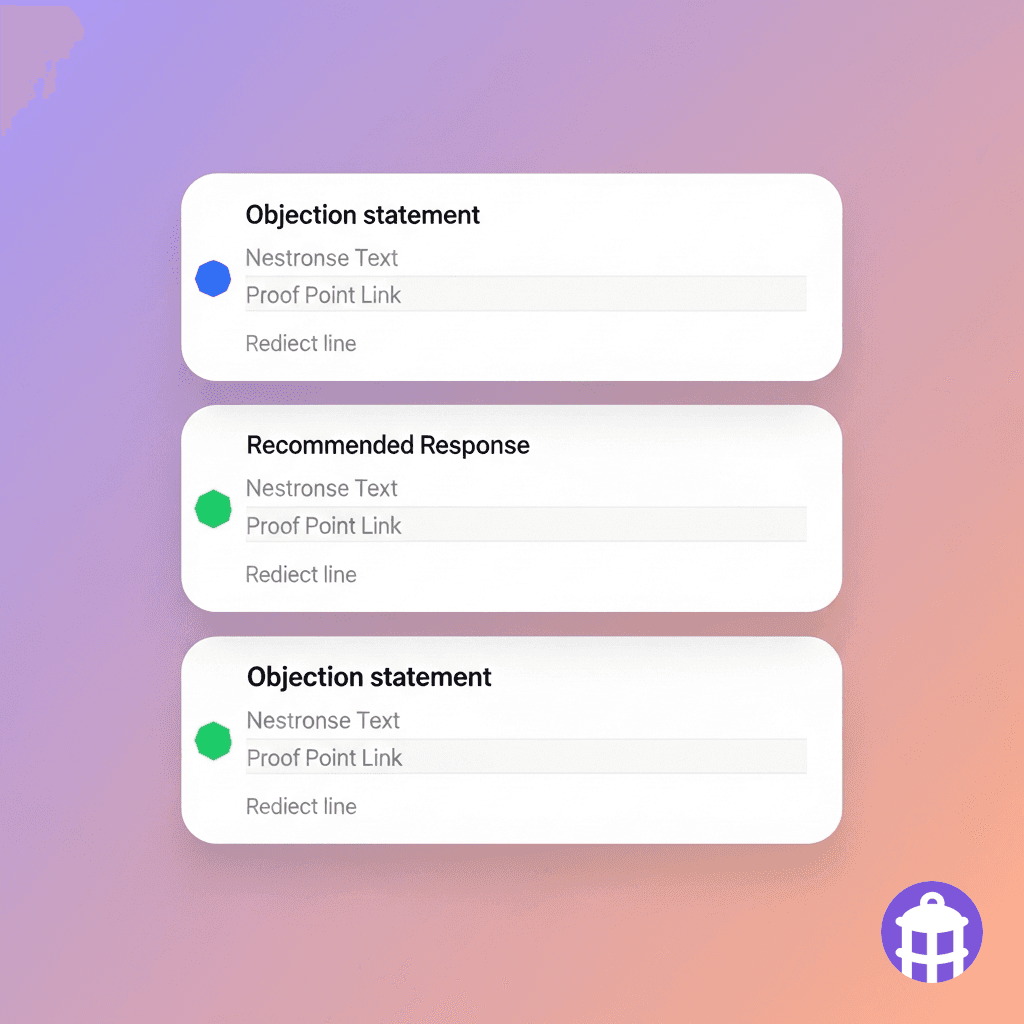
The most useful part of a battlecard is the objection handling section — and the most useful objections are the ones that actually come up in competitive deals, not hypothetical scenarios. The agent analyzes win/loss notes from competitive deals in the CRM, rep call transcripts, and review site patterns to identify the objections that come up most frequently when a specific competitor is in the deal. Each objection gets a recommended response, a supporting proof point (case study or G2 stat), and a suggested redirect to your differentiator. Objection scripts are calibrated to the competitor — not generic responses applied to all competitive situations.

Clearbit objection #1: 'We're already using Clearbit and it works fine.' Response: 'Clearbit is strong for early-stage companies — at your scale, the coverage gap tends to show up around month 6. Here's what Meridian Financial found when they hit that point.'

Generates objection handling scripts from win/loss data and review patterns

The most useful part of a battlecard is the objection handling section — and the most useful objections are the ones that actually come up in competitive deals, not hypothetical scenarios. The agent analyzes win/loss notes from competitive deals in the CRM, rep call transcripts, and review site patterns to identify the objections that come up most frequently when a specific competitor is in the deal. Each objection gets a recommended response, a supporting proof point (case study or G2 stat), and a suggested redirect to your differentiator. Objection scripts are calibrated to the competitor — not generic responses applied to all competitive situations.

Clearbit objection #1: 'We're already using Clearbit and it works fine.' Response: 'Clearbit is strong for early-stage companies — at your scale, the coverage gap tends to show up around month 6. Here's what Meridian Financial found when they hit that point.'

Surfaces the right battlecard in the deal view automatically

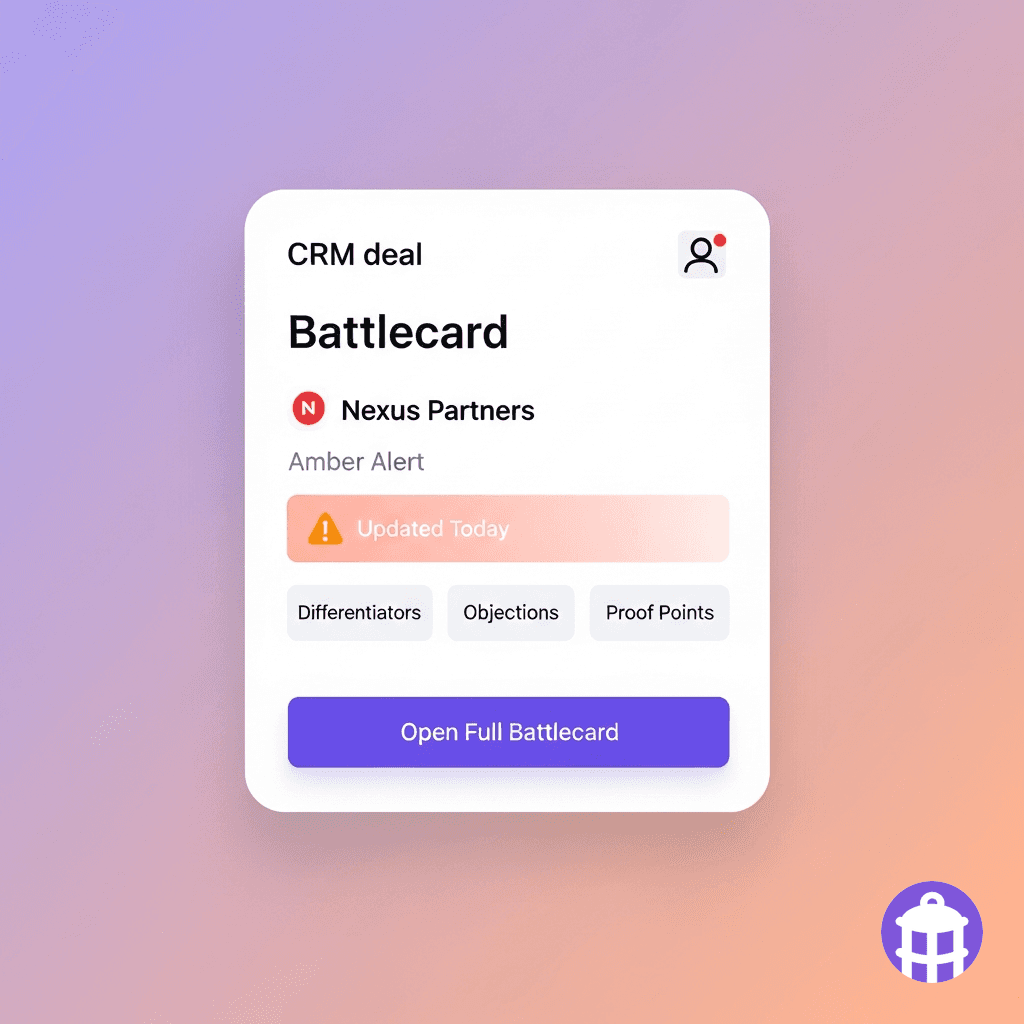
Battlecards only influence deals when reps actually use them — and reps only use them when they're easy to find at the right moment. The agent monitors the CRM for competitive tags in active deals and surfaces the relevant battlecard directly in the deal view: if a deal has 'Clearbit' tagged as the competing vendor, the Clearbit battlecard appears in the deal sidebar with an alert if it's been updated in the last 7 days. The rep doesn't have to navigate to a separate tool, search a Notion database, or remember to check. The battlecard is where the rep is working.

Deal: Nexus Partners. Competing vendor: Clearbit (tagged). Battlecard surfaced in deal sidebar. Alert: 'Updated today — pricing section revised.' Quick links: Our Differentiators, Objection Scripts, Case Studies.

Surfaces the right battlecard in the deal view automatically

Battlecards only influence deals when reps actually use them — and reps only use them when they're easy to find at the right moment. The agent monitors the CRM for competitive tags in active deals and surfaces the relevant battlecard directly in the deal view: if a deal has 'Clearbit' tagged as the competing vendor, the Clearbit battlecard appears in the deal sidebar with an alert if it's been updated in the last 7 days. The rep doesn't have to navigate to a separate tool, search a Notion database, or remember to check. The battlecard is where the rep is working.

Deal: Nexus Partners. Competing vendor: Clearbit (tagged). Battlecard surfaced in deal sidebar. Alert: 'Updated today — pricing section revised.' Quick links: Our Differentiators, Objection Scripts, Case Studies.

Today vs. with

Today vs. with

Build Competitive Battlecards

Build Competitive Battlecards

Today

Battlecards are manually updated quarterly — by the time a rep uses one, it reflects a competitor landscape from 3 months ago.

Objection handling scripts are written from hypothetical scenarios — not the objections that actually come up in competitive deals.

Battlecards live in Notion or a shared drive — reps have to remember to check and navigate away from the CRM to find them.

With ABM Strategist

Battlecard sections update automatically when new competitive signals arrive — pricing, features, and objections reflect current reality.

Objections are sourced from win/loss notes and review patterns — the actual objections reps face, with responses calibrated to each competitor.

Battlecard surfaces in the deal sidebar when a competitor is tagged — no navigation required, always current.

Three layers, one platform by Lantern

Three layers, one platform by Lantern

Every agent runs on three layers: a unified data model, 150+ enrichment providers, and an open-source engine where every decision is auditable.

Every agent runs on three layers: a unified data model, 150+ enrichment providers, and an open-source engine where every decision is auditable.

Data Waterfall

150+ enrichment providers. Sequential routing optimized per segment. The best answer wins. No vendor lock-in.

Agent Engine

Open-source execution engine. Workflows defined in code. Human-in-the-loop checkpoints. Full audit trail on every action.

Revenue Ontology

Every data source normalized into one model. Entity resolution across systems. Relationships stored, not inferred. Schema that evolves with your business.

FAQ

FAQ

How many competitors can we build battlecards for?

Can reps add notes or customize a battlecard for a specific deal?

How do we handle competitive information that shouldn't be in a battlecard — internal pricing strategy, upcoming releases?

Can win/loss interview data be incorporated into the battlecard objection scripts?

A battlecard that's wrong is worse than no battlecard at all. Keep it current.

A battlecard that's wrong is worse than no battlecard at all. Keep it current.

USE CASES

Revenue Team

Marketing Team

Customer Success

PRICING

Pricing

RESOURCES

Blog

About Lantern

Status

Support

© LANTERN 2025

Terms

Privacy

Linkedin

USE CASES

Revenue Team

Marketing Team

Customer Success

PRICING

Pricing

RESOURCES

Blog

About Lantern

Status

Support

© LANTERN 2025

Terms

Privacy

Linkedin

USE CASES

Revenue Team

Marketing Team

Customer Success

PRICING

Pricing

RESOURCES

Blog

About Lantern

Status

Support

© LANTERN 2025

Terms

Privacy

Linkedin