
Close Deals

Coach Deal Strategy

Coach Deal Strategy

Every rep gets deal coaching calibrated to what's actually happening in their specific opportunity.

Every rep gets deal coaching calibrated to what's actually happening in their specific opportunity.

improvement in win rate for reps who receive deal-specific coaching at each stage vs. reps with no structured coaching.

improvement in win rate for reps who receive deal-specific coaching at each stage vs. reps with no structured coaching.

THE brıef

Sales coaching is most valuable when it's specific to the deal in front of the rep — not a general framework delivered in a group training. The agent analyzes every active deal for coaching opportunities: patterns that predict loss in similar historical deals, missing actions that high-win-rate reps take at this deal stage, and specific objections that have appeared and haven't been addressed. The coaching is delivered at the moment it's relevant — in the deal view, before a key call, or when a risk signal is detected.
Analyzes deal patterns against historical win and loss profiles

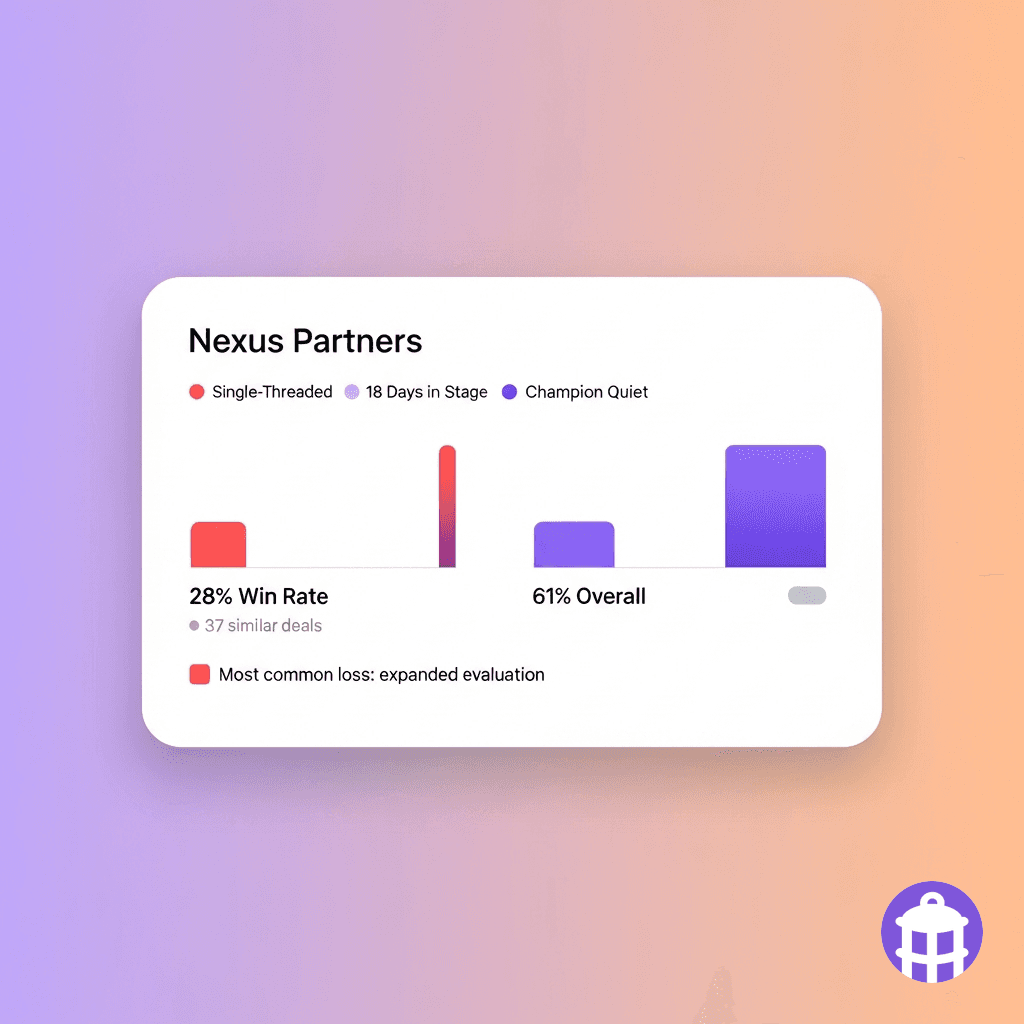
The agent compares each active deal against the historical patterns of similar won and lost deals: same deal size, same vertical, same competitive context, same deal stage. When the current deal shares characteristics with a cohort of lost deals — single-threaded contact, no economic buyer introduction, champion quiet for 10+ days — the agent surfaces the pattern with the historical loss rate for deals with those same attributes. The rep isn't told what to do; they're shown what typically happens to deals that look like theirs right now.

Nexus Partners: Current state — single-threaded (1 contact), Stage 3, 18 days in stage, champion quiet 12 days. Historical match: 37 deals with same profile. Win rate: 28% vs. 61% overall. Most common loss reason: lost to competitor after evaluation expanded to multiple stakeholders.

Analyzes deal patterns against historical win and loss profiles

The agent compares each active deal against the historical patterns of similar won and lost deals: same deal size, same vertical, same competitive context, same deal stage. When the current deal shares characteristics with a cohort of lost deals — single-threaded contact, no economic buyer introduction, champion quiet for 10+ days — the agent surfaces the pattern with the historical loss rate for deals with those same attributes. The rep isn't told what to do; they're shown what typically happens to deals that look like theirs right now.

Nexus Partners: Current state — single-threaded (1 contact), Stage 3, 18 days in stage, champion quiet 12 days. Historical match: 37 deals with same profile. Win rate: 28% vs. 61% overall. Most common loss reason: lost to competitor after evaluation expanded to multiple stakeholders.

Identifies the specific actions that high-win-rate reps take at this deal stage

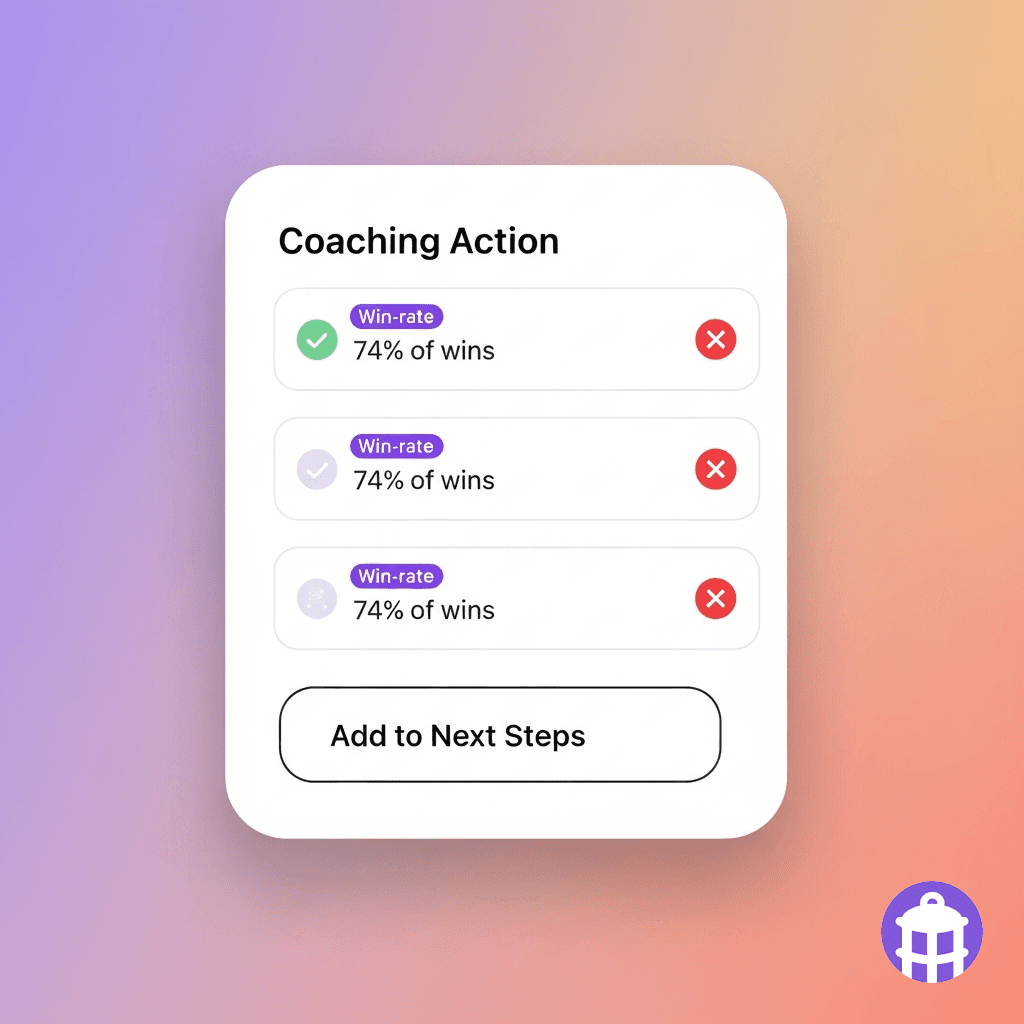
The difference between a 25% win rate rep and a 55% win rate rep often isn't skill — it's a set of specific behaviors at specific deal stages. The agent analyzes the activity patterns of top-performing reps in historical deals at the same stage, with the same deal profile, and surfaces the 2–3 actions they consistently take that lower performers don't: sending the security questionnaire before the champion raises it, introducing the economic buyer conversation in Stage 3 rather than waiting for Stage 4, sharing a case study from the matching vertical before the final presentation. These actions become coaching recommendations.

Top performer pattern — Stage 3, $100–200K deals: 1. CFO introduced via champion by Day 5 of Stage 3 (74% of wins). 2. Technical eval scheduled proactively (68% of wins). 3. Case study from matching vertical sent before final presentation (61% of wins). Jordan K. has done 1/3.

Identifies the specific actions that high-win-rate reps take at this deal stage

The difference between a 25% win rate rep and a 55% win rate rep often isn't skill — it's a set of specific behaviors at specific deal stages. The agent analyzes the activity patterns of top-performing reps in historical deals at the same stage, with the same deal profile, and surfaces the 2–3 actions they consistently take that lower performers don't: sending the security questionnaire before the champion raises it, introducing the economic buyer conversation in Stage 3 rather than waiting for Stage 4, sharing a case study from the matching vertical before the final presentation. These actions become coaching recommendations.

Top performer pattern — Stage 3, $100–200K deals: 1. CFO introduced via champion by Day 5 of Stage 3 (74% of wins). 2. Technical eval scheduled proactively (68% of wins). 3. Case study from matching vertical sent before final presentation (61% of wins). Jordan K. has done 1/3.

Surfaces objections detected in the deal and recommended responses

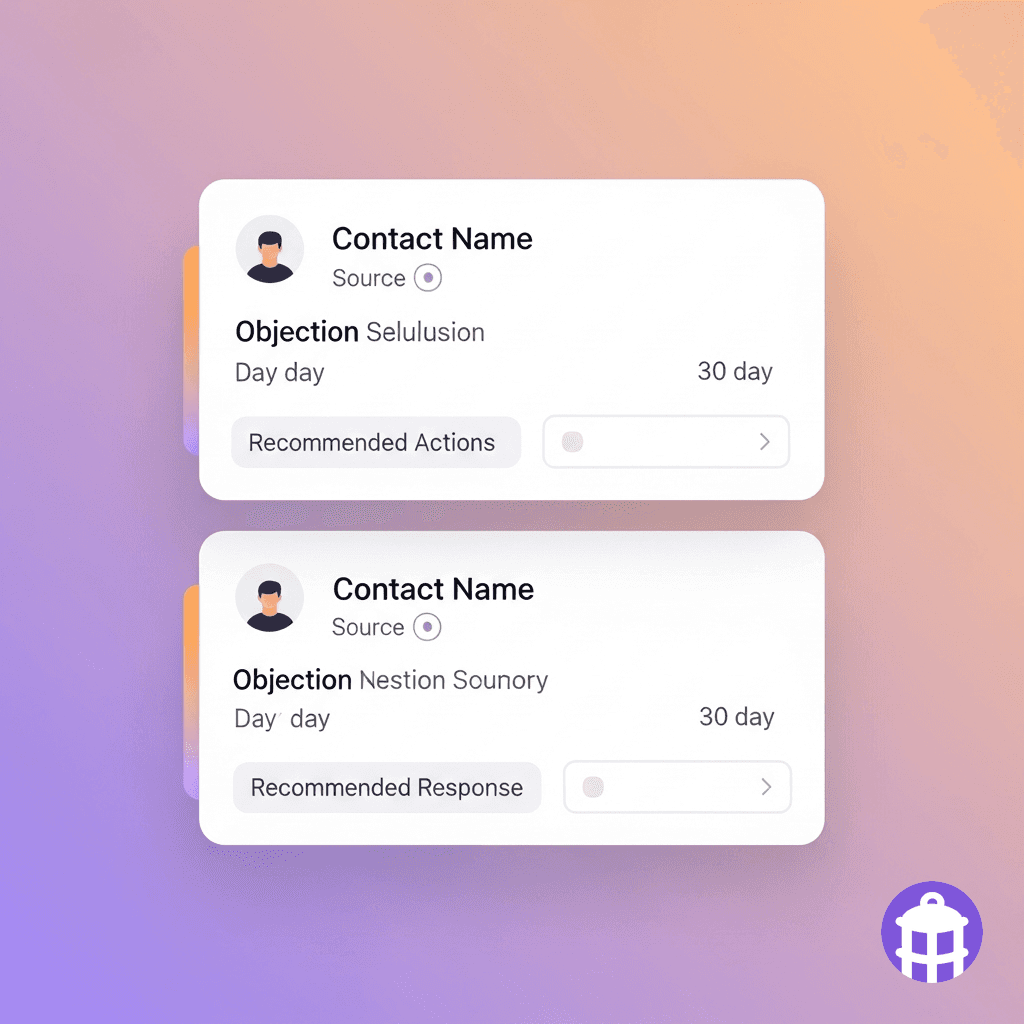
Objections that appear in call transcripts, email threads, or CRM notes that haven't been addressed are active liabilities in the deal. The agent scans deal activity for objection language — competitor mentions, price concerns, implementation timeline questions, integration complexity flags — and surfaces them with recommended responses calibrated to this specific deal context. If Marcus T. (IT Director) raised an integration timeline concern in call 2 and the rep hasn't followed up with integration documentation, the agent flags it and suggests the next action.

Unaddressed objections detected: 1. Marcus T. (IT): 'How long does implementation take?' — Call 2, no follow-up. 2. Jordan M.: 'What happens to our current data during migration?' — Email thread day 6, no response. Recommended: send integration timeline doc + migration FAQ to both contacts today.

Surfaces objections detected in the deal and recommended responses

Objections that appear in call transcripts, email threads, or CRM notes that haven't been addressed are active liabilities in the deal. The agent scans deal activity for objection language — competitor mentions, price concerns, implementation timeline questions, integration complexity flags — and surfaces them with recommended responses calibrated to this specific deal context. If Marcus T. (IT Director) raised an integration timeline concern in call 2 and the rep hasn't followed up with integration documentation, the agent flags it and suggests the next action.

Unaddressed objections detected: 1. Marcus T. (IT): 'How long does implementation take?' — Call 2, no follow-up. 2. Jordan M.: 'What happens to our current data during migration?' — Email thread day 6, no response. Recommended: send integration timeline doc + migration FAQ to both contacts today.

Delivers coaching in the deal view and before key calls

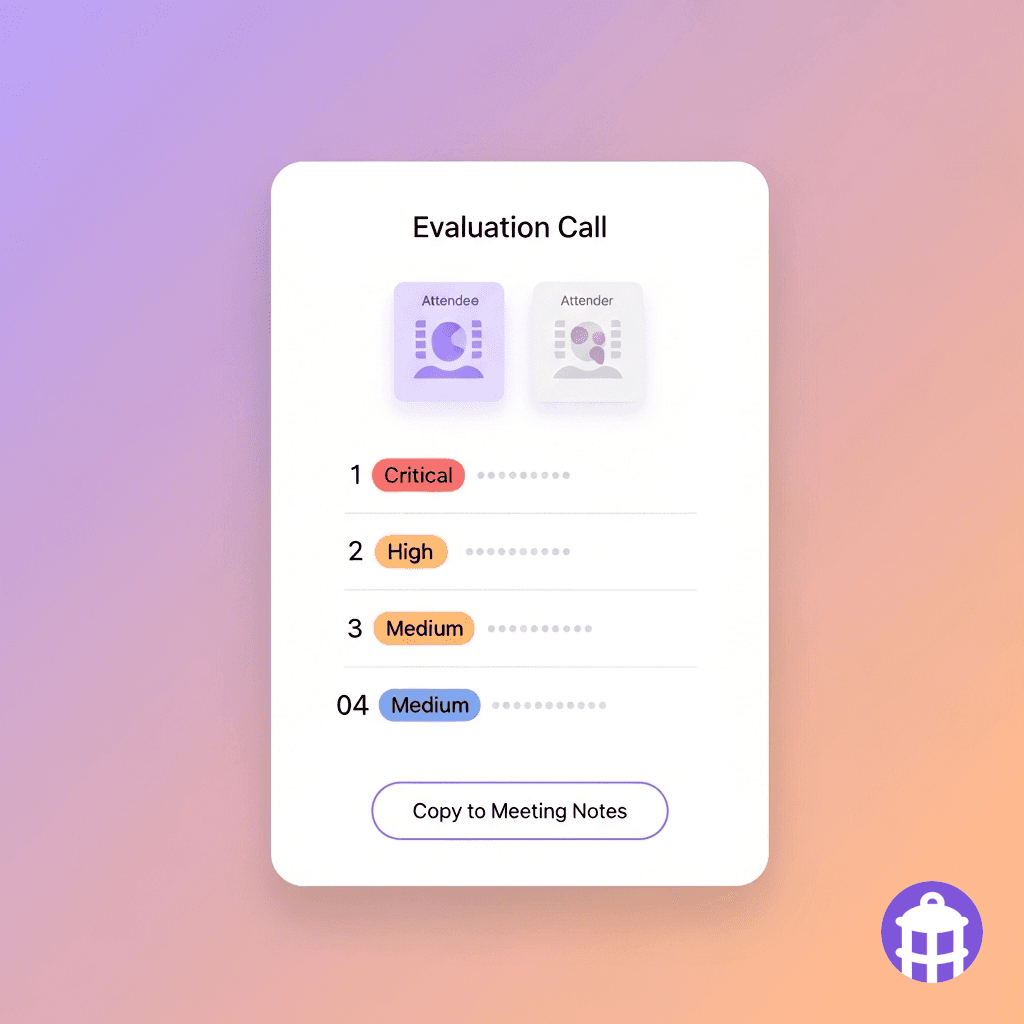
Coaching that sits in a separate tool doesn't get used. The agent surfaces deal coaching in the CRM deal view — the place the rep is already working — as a coaching card that's updated as the deal evolves. Before a key call (detected from the calendar), the coaching card is summarized into the meeting brief with the most relevant points for the upcoming conversation. After a call, the agent analyzes any transcript or CRM notes added and updates the coaching recommendations based on what was discussed. Coaching is contextual, continuous, and in the workflow.

Pre-call coaching (for tomorrow's evaluation call — Jordan M., Marcus T.): 1. Address integration timeline objection early. 2. Introduce CFO topic to Jordan M. — this is the right call. 3. Ask Marcus T. about current integration owner to identify blocker or ally.

Delivers coaching in the deal view and before key calls

Coaching that sits in a separate tool doesn't get used. The agent surfaces deal coaching in the CRM deal view — the place the rep is already working — as a coaching card that's updated as the deal evolves. Before a key call (detected from the calendar), the coaching card is summarized into the meeting brief with the most relevant points for the upcoming conversation. After a call, the agent analyzes any transcript or CRM notes added and updates the coaching recommendations based on what was discussed. Coaching is contextual, continuous, and in the workflow.

Pre-call coaching (for tomorrow's evaluation call — Jordan M., Marcus T.): 1. Address integration timeline objection early. 2. Introduce CFO topic to Jordan M. — this is the right call. 3. Ask Marcus T. about current integration owner to identify blocker or ally.

Today vs. with

Today vs. with

Coach Deal Strategy

Coach Deal Strategy

Today

Deal coaching happens in weekly pipeline review meetings — generic advice applied to whatever deal happens to come up in the call.

Reps don't know which behaviors at their current deal stage are most correlated with winning — they rely on experience and intuition.

Objections raised in calls and emails are noted but rarely systematically followed up on — they surface as deal risks weeks later.

With ABM Strategist

Coaching is specific to each active deal — comparing it to historical patterns, identifying missing actions, and surfacing unaddressed objections.

Top-performer behavior patterns at the specific deal stage and profile are surfaced with their historical win rate correlation — actionable, not anecdotal.

Unaddressed objections are detected in transcripts and CRM notes and flagged immediately with recommended responses — before they become deal liabilities.

Three layers, one platform by Lantern

Three layers, one platform by Lantern

Every agent runs on three layers: a unified data model, 150+ enrichment providers, and an open-source engine where every decision is auditable.

Every agent runs on three layers: a unified data model, 150+ enrichment providers, and an open-source engine where every decision is auditable.

Data Waterfall

150+ enrichment providers. Sequential routing optimized per segment. The best answer wins. No vendor lock-in.

Agent Engine

Open-source execution engine. Workflows defined in code. Human-in-the-loop checkpoints. Full audit trail on every action.

Revenue Ontology

Every data source normalized into one model. Entity resolution across systems. Relationships stored, not inferred. Schema that evolves with your business.

FAQ

FAQ

Does the coaching use call recording transcripts, or only CRM data?

Can managers see the coaching recommendations and override them?

How does the agent determine what 'top performer' behavior looks like?

Is coaching available for SDR prospecting activities, or only AE deal cycles?

The best coaching is specific, timely, and in the workflow. This agent delivers all three.

The best coaching is specific, timely, and in the workflow. This agent delivers all three.

USE CASES

Revenue Team

Marketing Team

Customer Success

PRICING

Pricing

RESOURCES

Blog

About Lantern

Status

Support

© LANTERN 2025

Terms

Privacy

Linkedin

USE CASES

Revenue Team

Marketing Team

Customer Success

PRICING

Pricing

RESOURCES

Blog

About Lantern

Status

Support

© LANTERN 2025

Terms

Privacy

Linkedin

USE CASES

Revenue Team

Marketing Team

Customer Success

PRICING

Pricing

RESOURCES

Blog

About Lantern

Status

Support

© LANTERN 2025

Terms

Privacy

Linkedin