
Find Buyers

Build Email Campaigns

Build Email Campaigns

Email campaigns that hit the right segment with the right message — built from your CRM, not a template.

Email campaigns that hit the right segment with the right message — built from your CRM, not a template.

higher reply rates from campaigns built on 6+ attribute segments vs. basic industry + size segmentation.

higher reply rates from campaigns built on 6+ attribute segments vs. basic industry + size segmentation.

THE brıef

Most email campaigns underperform because they're built on shallow segmentation: industry, company size, and a few custom fields. The agent builds campaigns from richer data — intent signals, engagement history, deal stage, tech stack, and lifecycle position — so each campaign reaches a segment that actually shares a common situation. The copy is written to match. The result is higher open rates, more replies, and less list fatigue from sending the same message to everyone.
Builds segments from enriched CRM and signal data

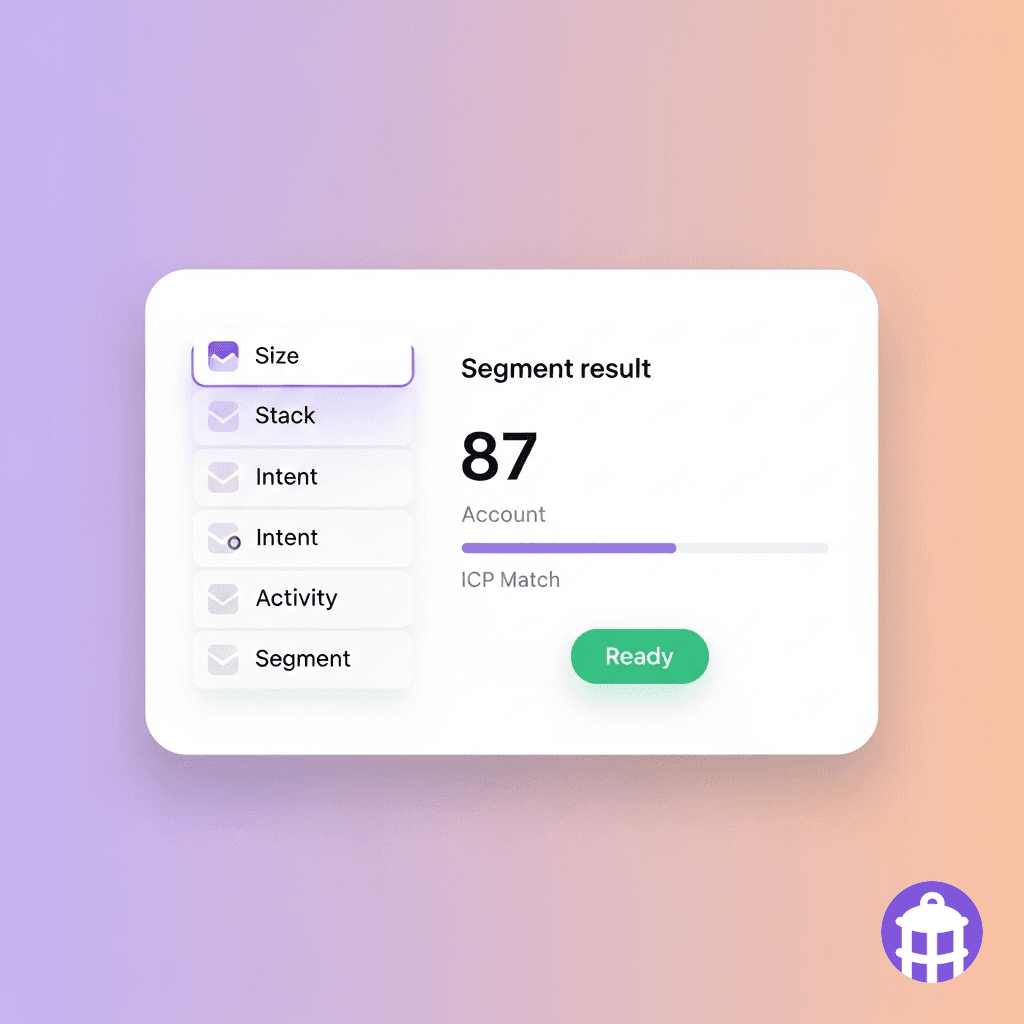
The agent pulls from your CRM, enrichment providers, and intent data to build segments that go beyond basic firmographic slices. A segment might be 'companies with 100–300 employees, Salesforce stack, no current enrichment tool, intent spike in the last 14 days' — a group of 87 accounts that share a specific situation. Each segment is defined by 4–8 attributes, verified against live data, and sized before campaign build begins. Segments built this way produce 2–3× higher engagement than broad firmographic sends.

Segment: 'RevOps leaders, 100–300 employees, Salesforce + HubSpot, no current enrichment, intent spike last 14 days.' Size: 87 accounts. Avg firmographic match: 94%. Ready for campaign.

Builds segments from enriched CRM and signal data

The agent pulls from your CRM, enrichment providers, and intent data to build segments that go beyond basic firmographic slices. A segment might be 'companies with 100–300 employees, Salesforce stack, no current enrichment tool, intent spike in the last 14 days' — a group of 87 accounts that share a specific situation. Each segment is defined by 4–8 attributes, verified against live data, and sized before campaign build begins. Segments built this way produce 2–3× higher engagement than broad firmographic sends.

Segment: 'RevOps leaders, 100–300 employees, Salesforce + HubSpot, no current enrichment, intent spike last 14 days.' Size: 87 accounts. Avg firmographic match: 94%. Ready for campaign.

Writes campaign copy matched to the segment's situation

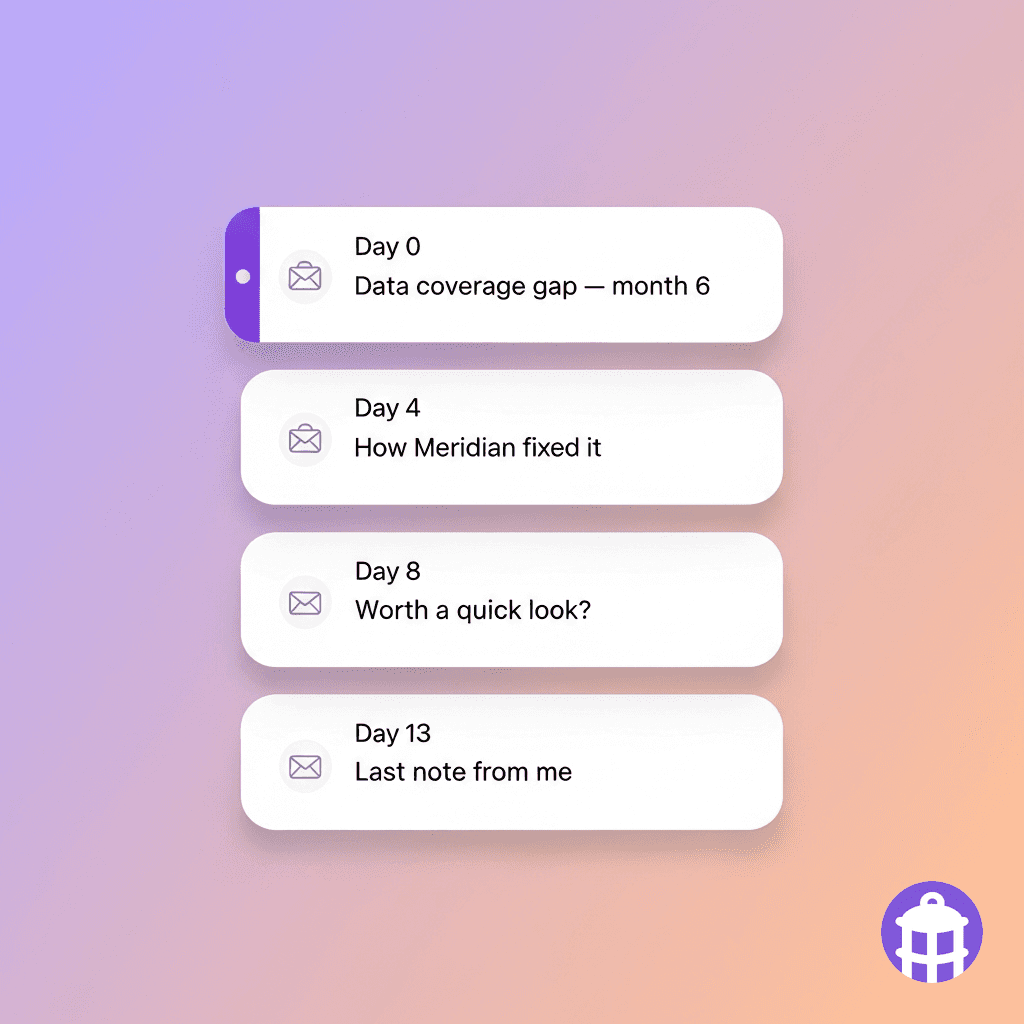
The copy isn't generic. The agent writes subject lines, email bodies, and CTAs that reference the attributes that define the segment: the specific tool stack they're on, the intent signal that triggered their inclusion, the lifecycle stage they're in. Each campaign has a 3–5 email sequence with spaced timing, varied angles, and escalating personalization. Email 1 opens with the situation. Email 2 leads with proof. Email 3 is a direct ask. Email 4 is a light break-up. The structure is built to maximize replies across the window, not burn the list on email 1.

Campaign: RevOps Enrichment — Email 1: 'Most RevOps teams on Salesforce + HubSpot hit a data coverage gap around month 6.' Email 2: Meridian case study. Email 3: Direct ask. Email 4: Break-up with value lead.

Writes campaign copy matched to the segment's situation

The copy isn't generic. The agent writes subject lines, email bodies, and CTAs that reference the attributes that define the segment: the specific tool stack they're on, the intent signal that triggered their inclusion, the lifecycle stage they're in. Each campaign has a 3–5 email sequence with spaced timing, varied angles, and escalating personalization. Email 1 opens with the situation. Email 2 leads with proof. Email 3 is a direct ask. Email 4 is a light break-up. The structure is built to maximize replies across the window, not burn the list on email 1.

Campaign: RevOps Enrichment — Email 1: 'Most RevOps teams on Salesforce + HubSpot hit a data coverage gap around month 6.' Email 2: Meridian case study. Email 3: Direct ask. Email 4: Break-up with value lead.

Manages delivery, timing, and list hygiene automatically

Sending a campaign is the easy part. Managing it is where most teams lose performance. The agent handles send time optimization (per-contact, not broadcast time), bounce management (hard and soft), unsubscribe suppression, and deliverability monitoring — open rates, spam rate, domain reputation. Contacts that reply are automatically paused from the sequence. Contacts that don't open 3+ emails are moved to a lower-frequency nurture segment. The list isn't burned by the campaign — it's maintained as a healthy, deliverable asset.

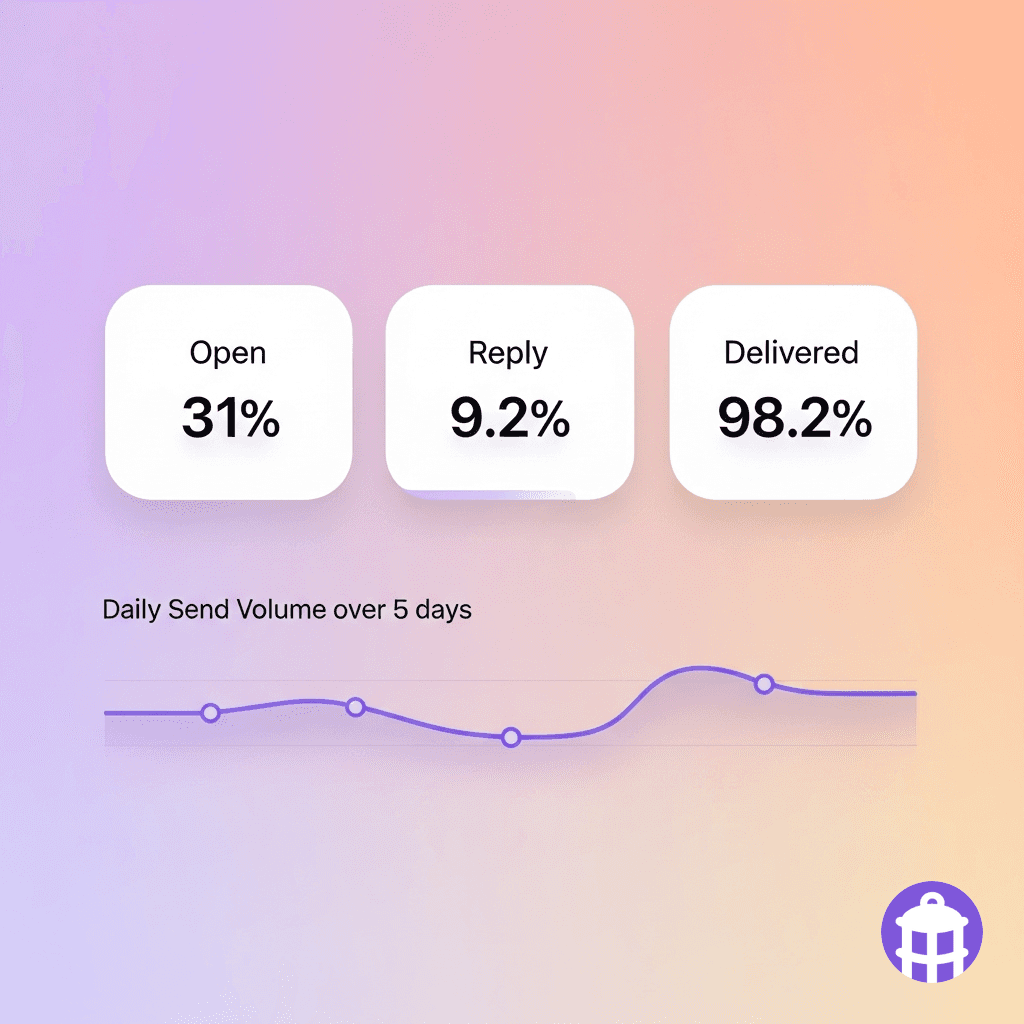
Campaign day 4 status: 87 contacts sent. 31% opened email 1 (above benchmark). 4 replied — removed from sequence. 3 hard bounces — suppressed. Deliverability: 98.2%. No spam complaints.

Manages delivery, timing, and list hygiene automatically

Sending a campaign is the easy part. Managing it is where most teams lose performance. The agent handles send time optimization (per-contact, not broadcast time), bounce management (hard and soft), unsubscribe suppression, and deliverability monitoring — open rates, spam rate, domain reputation. Contacts that reply are automatically paused from the sequence. Contacts that don't open 3+ emails are moved to a lower-frequency nurture segment. The list isn't burned by the campaign — it's maintained as a healthy, deliverable asset.

Campaign day 4 status: 87 contacts sent. 31% opened email 1 (above benchmark). 4 replied — removed from sequence. 3 hard bounces — suppressed. Deliverability: 98.2%. No spam complaints.

Reports campaign performance by segment and copy variant

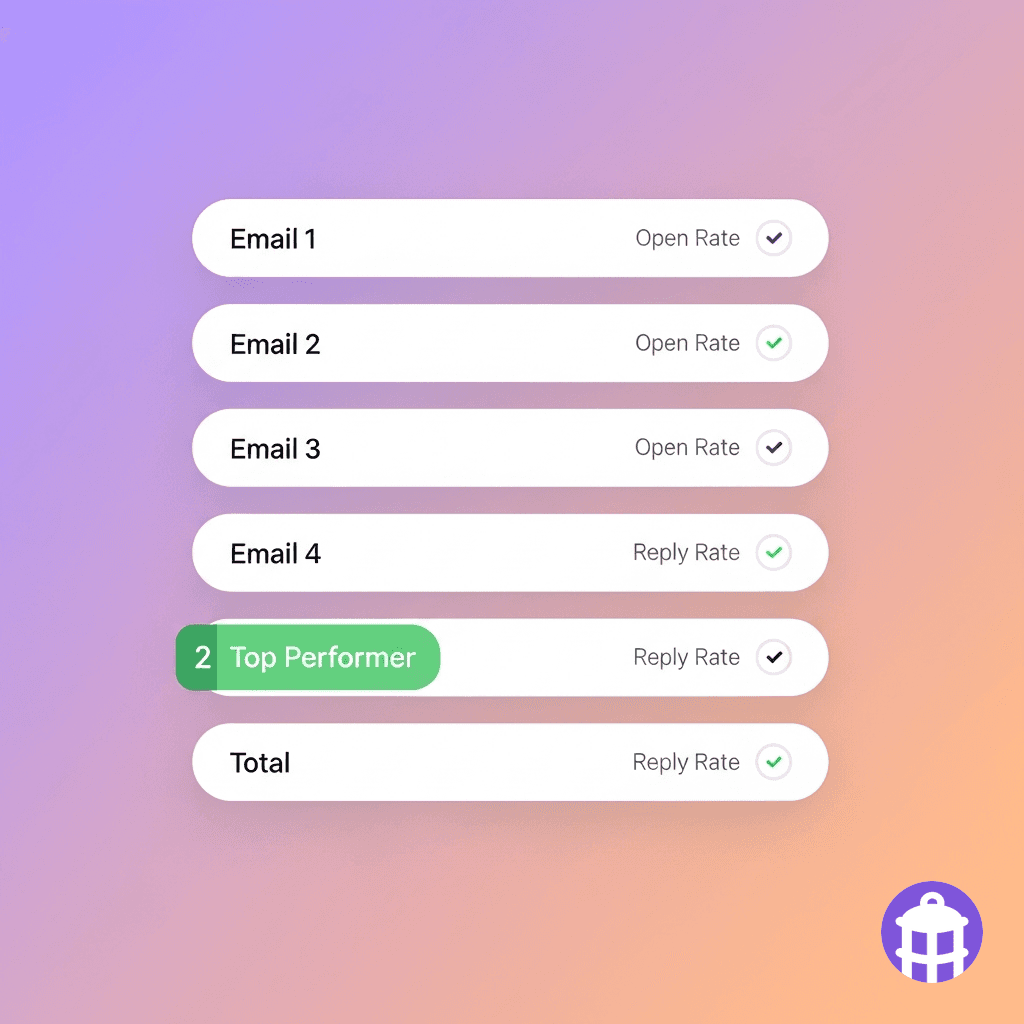
Every campaign run generates a performance report that breaks down results by segment, email step, subject line variant, and contact segment — not just aggregate open and reply rates. The report identifies which email in the sequence drove the most replies, which subject line variant outperformed, and which contact attributes correlated with higher engagement. These inputs feed the next campaign: better segments, better-calibrated copy, and a shorter path to the reply rate the team needs.

Campaign report: 87 sent, 31% open rate, 9.2% reply rate. Email 2 (case study) drove 60% of replies. Subject line B outperformed A by 2.1×. Best segment attribute: intent spike within 14 days.

Reports campaign performance by segment and copy variant

Every campaign run generates a performance report that breaks down results by segment, email step, subject line variant, and contact segment — not just aggregate open and reply rates. The report identifies which email in the sequence drove the most replies, which subject line variant outperformed, and which contact attributes correlated with higher engagement. These inputs feed the next campaign: better segments, better-calibrated copy, and a shorter path to the reply rate the team needs.

Campaign report: 87 sent, 31% open rate, 9.2% reply rate. Email 2 (case study) drove 60% of replies. Subject line B outperformed A by 2.1×. Best segment attribute: intent spike within 14 days.

Today vs. with

Today vs. with

Build Email Campaigns

Build Email Campaigns

Today

Email campaigns are built on broad segments (industry + company size), sent to thousands, and produce 1–2% reply rates.

Bounce management, unsubscribe suppression, and timing optimization are manual — or not done at all.

Campaign performance is reviewed as aggregate open/reply rates — no breakdown by email step or copy variant.

With ABM Strategist

Campaigns are built on rich 4–8 attribute segments, producing 6–10% reply rates from targeted lists that share an actual common situation.

Delivery management is automated end-to-end: send time optimization, bounce suppression, and deliverability monitoring maintained throughout.

Every campaign generates a structured performance report by step, variant, and segment attribute — feeding the next campaign's setup.

Three layers, one platform by Lantern

Three layers, one platform by Lantern

Every agent runs on three layers: a unified data model, 150+ enrichment providers, and an open-source engine where every decision is auditable.

Every agent runs on three layers: a unified data model, 150+ enrichment providers, and an open-source engine where every decision is auditable.

Data Waterfall

150+ enrichment providers. Sequential routing optimized per segment. The best answer wins. No vendor lock-in.

Agent Engine

Open-source execution engine. Workflows defined in code. Human-in-the-loop checkpoints. Full audit trail on every action.

Revenue Ontology

Every data source normalized into one model. Entity resolution across systems. Relationships stored, not inferred. Schema that evolves with your business.

FAQ

FAQ

Which email platforms does the agent integrate with?

Can we run A/B tests on subject lines and email copy?

How does it handle opt-outs and compliance across regions?

Can the agent build campaigns for existing customers as well as prospects?

Email campaign performance is a segmentation problem. This agent solves it at the data layer first.

Email campaign performance is a segmentation problem. This agent solves it at the data layer first.

USE CASES

Revenue Team

Marketing Team

Customer Success

PRICING

Pricing

RESOURCES

Blog

About Lantern

Status

Support

© LANTERN 2025

Terms

Privacy

Linkedin

USE CASES

Revenue Team

Marketing Team

Customer Success

PRICING

Pricing

RESOURCES

Blog

About Lantern

Status

Support

© LANTERN 2025

Terms

Privacy

Linkedin

USE CASES

Revenue Team

Marketing Team

Customer Success

PRICING

Pricing

RESOURCES

Blog

About Lantern

Status

Support

© LANTERN 2025

Terms

Privacy

Linkedin