
Operate

Build Google Ads

Build Google Ads

Search campaigns that capture demand at the moment of intent — built with the structure and copy that B2B buyers respond to.

Search campaigns that capture demand at the moment of intent — built with the structure and copy that B2B buyers respond to.

of B2B Google Ads accounts have no negative keyword list and are wasting budget on irrelevant queries — the single most common structural error in B2B paid search.

of B2B Google Ads accounts have no negative keyword list and are wasting budget on irrelevant queries — the single most common structural error in B2B paid search.

THE brıef

Google Search is the highest-intent paid channel available to B2B marketers — buyers actively searching for a solution are already in the market. But most B2B Google Ads accounts are built wrong: too few negative keywords, ad groups with too many unrelated terms, generic copy that doesn't match the specific query, and no strategy for the branded vs non-branded vs competitor keyword segments. The Build Google Ads agent structures campaigns properly from the start — keyword research, match type strategy, ad copy aligned to search intent, and bid strategy configured for B2B conversion cycles rather than e-commerce.
Builds keyword strategy and match type architecture

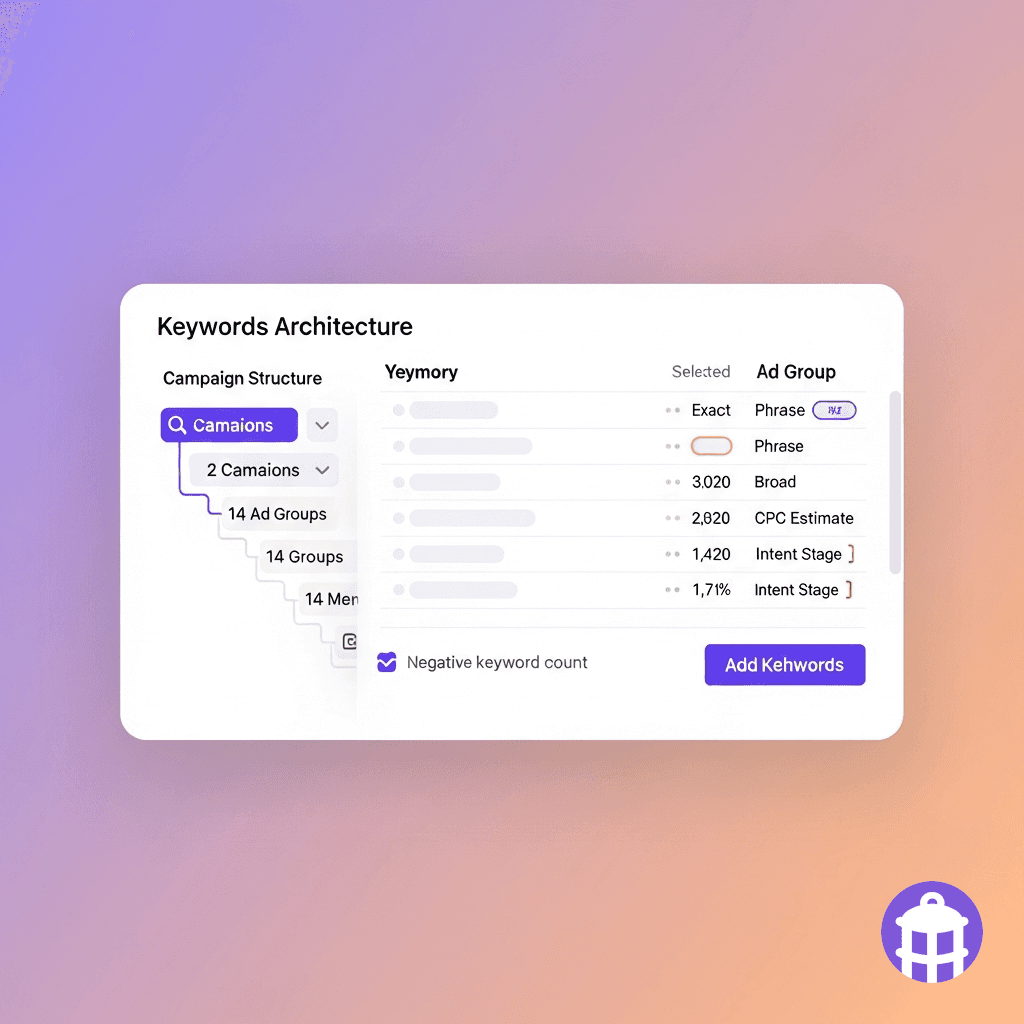
Keyword strategy in B2B Google Ads is more nuanced than most accounts reflect. The same concept — 'revenue operations software,' 'RevOps tools,' 'CRM data quality' — can indicate very different intent levels and funnel stages depending on the specific query. The agent builds keyword architecture organized by intent cluster: solution-aware queries (buyers who know the category exist and are comparing options), problem-aware queries (buyers who know they have a problem but haven't identified the solution category), and branded and competitor keywords (buyers already considering specific vendors). Match types are assigned based on intent clarity — exact match for high-intent solution queries, phrase for problem queries, and broad match modifier for discovery. Negative keyword lists are built from the start to block irrelevant traffic.

Keyword architecture: 4 campaigns, 14 ad groups. Solution-aware: 'crm data quality software' (exact), 'revenue operations platform' (exact), 'contact data enrichment tool' (phrase) — 47 terms, $0.80 avg target CPC. Problem-aware: 'fix crm data' (phrase), 'crm contacts outdated' (phrase) — 31 terms. Competitor: [Competitor brand] + comparison terms — 22 terms. Negative list: 230 terms including job-seeking, student, and free tool queries.

Builds keyword strategy and match type architecture

Keyword strategy in B2B Google Ads is more nuanced than most accounts reflect. The same concept — 'revenue operations software,' 'RevOps tools,' 'CRM data quality' — can indicate very different intent levels and funnel stages depending on the specific query. The agent builds keyword architecture organized by intent cluster: solution-aware queries (buyers who know the category exist and are comparing options), problem-aware queries (buyers who know they have a problem but haven't identified the solution category), and branded and competitor keywords (buyers already considering specific vendors). Match types are assigned based on intent clarity — exact match for high-intent solution queries, phrase for problem queries, and broad match modifier for discovery. Negative keyword lists are built from the start to block irrelevant traffic.

Keyword architecture: 4 campaigns, 14 ad groups. Solution-aware: 'crm data quality software' (exact), 'revenue operations platform' (exact), 'contact data enrichment tool' (phrase) — 47 terms, $0.80 avg target CPC. Problem-aware: 'fix crm data' (phrase), 'crm contacts outdated' (phrase) — 31 terms. Competitor: [Competitor brand] + comparison terms — 22 terms. Negative list: 230 terms including job-seeking, student, and free tool queries.

Writes Responsive Search Ad copy aligned to search intent

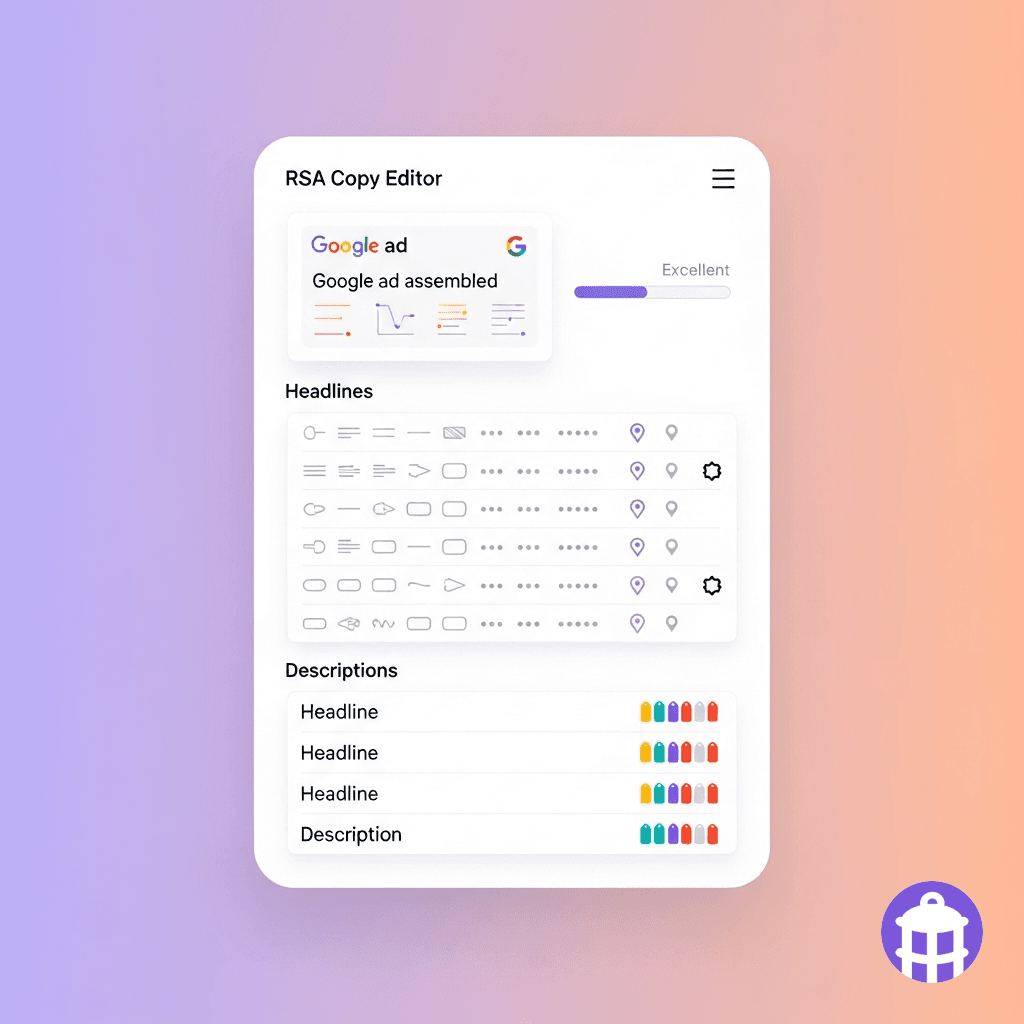
Responsive Search Ads require 15 headlines and 4 descriptions — but most accounts fill them with generic value propositions that are interchangeable regardless of what the user searched for. The agent writes RSA assets organized by intent cluster: headlines for solution-aware queries emphasize proof and specificity ('93% Contact Accuracy, Guaranteed'), headlines for problem-aware queries emphasize the cost of the problem ('Every Stale Record Is a Missed Deal'), and headlines for competitor queries emphasize differentiation. Each headline is written to complement the others when combined by Google's serving algorithm — avoiding redundancy, maintaining message coherence, and keeping copy within the character limits that preserve readability.

RSA copy for 'CRM Data Quality' ad group (15 headlines, 4 descriptions written). Top-performing headline predictions: 'Your CRM Is Lying to Your Reps' (high specificity, problem contrast), 'Stop Losing Deals to Bad Contact Data' (direct consequence framing), 'Waterfall Enrichment Across 150+ Providers' (proof-point specificity). Description 1: 'Lantern reverifies your full CRM database — contacts, companies, and deals — so your team works from accurate data.'

Writes Responsive Search Ad copy aligned to search intent

Responsive Search Ads require 15 headlines and 4 descriptions — but most accounts fill them with generic value propositions that are interchangeable regardless of what the user searched for. The agent writes RSA assets organized by intent cluster: headlines for solution-aware queries emphasize proof and specificity ('93% Contact Accuracy, Guaranteed'), headlines for problem-aware queries emphasize the cost of the problem ('Every Stale Record Is a Missed Deal'), and headlines for competitor queries emphasize differentiation. Each headline is written to complement the others when combined by Google's serving algorithm — avoiding redundancy, maintaining message coherence, and keeping copy within the character limits that preserve readability.

RSA copy for 'CRM Data Quality' ad group (15 headlines, 4 descriptions written). Top-performing headline predictions: 'Your CRM Is Lying to Your Reps' (high specificity, problem contrast), 'Stop Losing Deals to Bad Contact Data' (direct consequence framing), 'Waterfall Enrichment Across 150+ Providers' (proof-point specificity). Description 1: 'Lantern reverifies your full CRM database — contacts, companies, and deals — so your team works from accurate data.'

Configures bid strategy and conversion tracking for B2B cycles

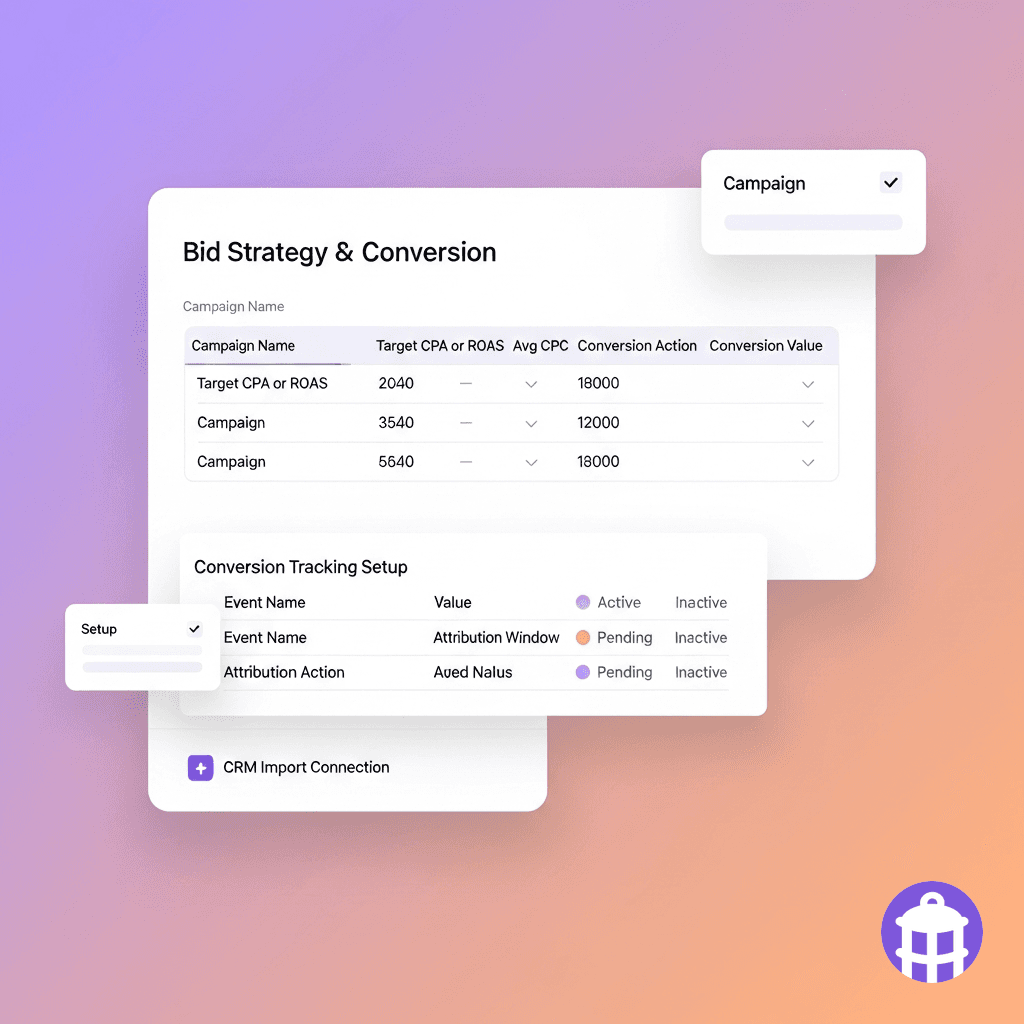
Google's smart bidding algorithms are optimized for e-commerce conversion cycles — fast, high-volume, value-homogeneous conversions. B2B paid programs have a different structure: fewer conversions, longer cycles, high ACV variance, and multiple conversion events (form fill, demo booked, opportunity created) with very different downstream values. The agent configures bid strategies appropriate for each campaign type and stage: Target CPA bidding for established campaigns with sufficient conversion history, Manual CPC with enhanced CPC for new campaigns building data, and Target ROAS bidding for campaigns connected to CRM pipeline value. Conversion tracking is configured to capture the full B2B conversion path — not just the form fill, but demo completion, opportunity creation, and closed-won events imported back from the CRM.

Bid strategy configuration: Solution-aware campaigns → Target CPA ($320, based on historical demo-to-pipeline rate). Problem-aware campaigns → Manual CPC + ECPC (building data, insufficient conversion volume for smart bidding). Conversion tracking: Form fill (value: $0), Demo booked (value: $120), Opp created (value: $800), Closed-won (value: imported from CRM). Primary optimization target: Opp created.

Configures bid strategy and conversion tracking for B2B cycles

Google's smart bidding algorithms are optimized for e-commerce conversion cycles — fast, high-volume, value-homogeneous conversions. B2B paid programs have a different structure: fewer conversions, longer cycles, high ACV variance, and multiple conversion events (form fill, demo booked, opportunity created) with very different downstream values. The agent configures bid strategies appropriate for each campaign type and stage: Target CPA bidding for established campaigns with sufficient conversion history, Manual CPC with enhanced CPC for new campaigns building data, and Target ROAS bidding for campaigns connected to CRM pipeline value. Conversion tracking is configured to capture the full B2B conversion path — not just the form fill, but demo completion, opportunity creation, and closed-won events imported back from the CRM.

Bid strategy configuration: Solution-aware campaigns → Target CPA ($320, based on historical demo-to-pipeline rate). Problem-aware campaigns → Manual CPC + ECPC (building data, insufficient conversion volume for smart bidding). Conversion tracking: Form fill (value: $0), Demo booked (value: $120), Opp created (value: $800), Closed-won (value: imported from CRM). Primary optimization target: Opp created.

Builds competitor and branded campaign structure

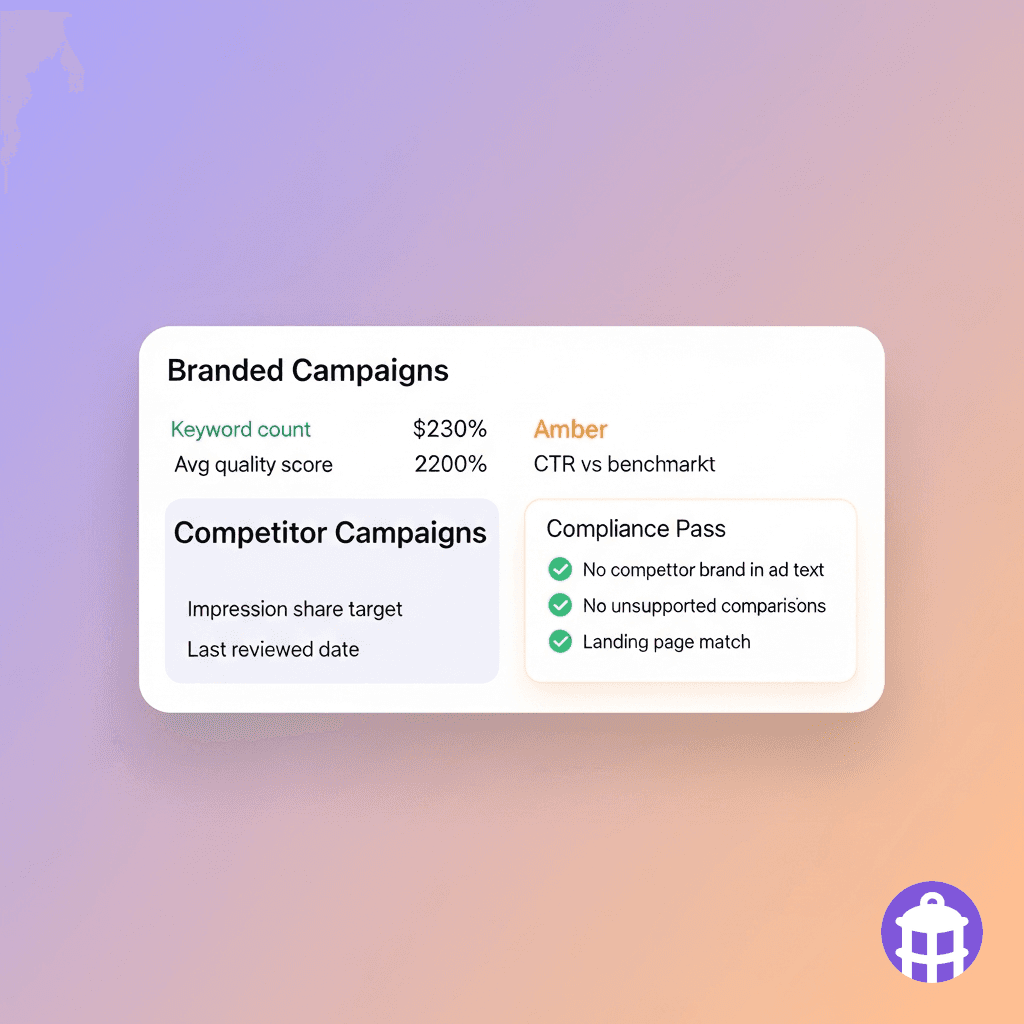
Branded and competitor keyword campaigns require distinct strategic approaches from generic solution and problem campaigns. For branded campaigns — queries including your company name — the agent sets up defensive campaigns with high quality scores to prevent competitor conquesting from driving up CPCs on your own branded terms. For competitor campaigns — queries including competitor brand names — the agent builds conquest ad groups with copy that introduces your brand as an alternative without making claims that violate advertising policies. Competitor campaigns are flagged with specific exclusion rules: no competitor brand names in ad copy, no comparative superlatives that can't be substantiated. Bid strategies for branded campaigns favor impression share over CPA, since branded queries represent buyers who already know you and should convert at low cost.

Branded campaign: 14 branded term variants, target impression share 95%, avg CPC $1.20, Quality Score 9/10. Competitor campaign: 3 competitor ad groups, conquest copy reviewed for policy compliance, CTR 3.1% above industry benchmark, 0 policy flags. Excluded: competitor brand names in ad text, comparative claims without data backing.

Builds competitor and branded campaign structure

Branded and competitor keyword campaigns require distinct strategic approaches from generic solution and problem campaigns. For branded campaigns — queries including your company name — the agent sets up defensive campaigns with high quality scores to prevent competitor conquesting from driving up CPCs on your own branded terms. For competitor campaigns — queries including competitor brand names — the agent builds conquest ad groups with copy that introduces your brand as an alternative without making claims that violate advertising policies. Competitor campaigns are flagged with specific exclusion rules: no competitor brand names in ad copy, no comparative superlatives that can't be substantiated. Bid strategies for branded campaigns favor impression share over CPA, since branded queries represent buyers who already know you and should convert at low cost.

Branded campaign: 14 branded term variants, target impression share 95%, avg CPC $1.20, Quality Score 9/10. Competitor campaign: 3 competitor ad groups, conquest copy reviewed for policy compliance, CTR 3.1% above industry benchmark, 0 policy flags. Excluded: competitor brand names in ad text, comparative claims without data backing.

Today vs. with

Today vs. with

Build Google Ads

Build Google Ads

Today

Google Ads account built once by an agency, never restructured — ad groups with dozens of unrelated terms, generic copy, and no negative keyword management

RSA headlines written as a list of value propositions — no strategy for how they combine, no alignment to the specific query that triggered the ad

Conversion tracking captures form fills only — no visibility into whether Google-sourced leads become pipeline or revenue, making optimization arbitrary

With ABM Strategist

Intent-clustered keyword architecture built from the start — ad groups with tight thematic relevance, copy matched to search intent, 230+ negative terms from day one

Headlines written by intent cluster with internal complementarity — solution proof, problem framing, and differentiation assets that work together regardless of how Google assembles them

Full conversion path tracked: form fill, demo booked, opportunity created, and closed-won imported from CRM — bid strategies optimized toward the conversion event that matters

Three layers, one platform by Lantern

Three layers, one platform by Lantern

Every agent runs on three layers: a unified data model, 150+ enrichment providers, and an open-source engine where every decision is auditable.

Every agent runs on three layers: a unified data model, 150+ enrichment providers, and an open-source engine where every decision is auditable.

Data Waterfall

150+ enrichment providers. Sequential routing optimized per segment. The best answer wins. No vendor lock-in.

Agent Engine

Open-source execution engine. Workflows defined in code. Human-in-the-loop checkpoints. Full audit trail on every action.

Revenue Ontology

Every data source normalized into one model. Entity resolution across systems. Relationships stored, not inferred. Schema that evolves with your business.

FAQ

FAQ

Does the agent handle Performance Max campaigns, or only Search?

How does competitor keyword bidding work without violating Google's policies?

What conversion volume is needed before switching to smart bidding?

Can existing Google Ads accounts be restructured using the agent, or only new builds?

Capture the buyers already searching for what you sell — before they find your competitor first.

Capture the buyers already searching for what you sell — before they find your competitor first.

USE CASES

Revenue Team

Marketing Team

Customer Success

PRICING

Pricing

RESOURCES

Blog

About Lantern

Status

Support

© LANTERN 2025

Terms

Privacy

Linkedin

USE CASES

Revenue Team

Marketing Team

Customer Success

PRICING

Pricing

RESOURCES

Blog

About Lantern

Status

Support

© LANTERN 2025

Terms

Privacy

Linkedin

USE CASES

Revenue Team

Marketing Team

Customer Success

PRICING

Pricing

RESOURCES

Blog

About Lantern

Status

Support

© LANTERN 2025

Terms

Privacy

Linkedin