
Grow Customers
Review Sales Performance
Review Sales Performance
A complete picture of team performance — without waiting for the end-of-month dashboard.
A complete picture of team performance — without waiting for the end-of-month dashboard.
of sales leadership teams report making key resourcing decisions based on month-end data that was already too late to act on.
of sales leadership teams report making key resourcing decisions based on month-end data that was already too late to act on.

THE brıef
Sales leadership makes better decisions when they have current data, not last week's report. The Review Sales Performance agent aggregates and analyzes the full team's performance metrics in real time — pipeline coverage, win rates, quota attainment, ramp time, stage conversion, and activity quality — and surfaces the insights that matter for this week's decisions, not just month-end summaries.
Aggregates pipeline and activity metrics across the team
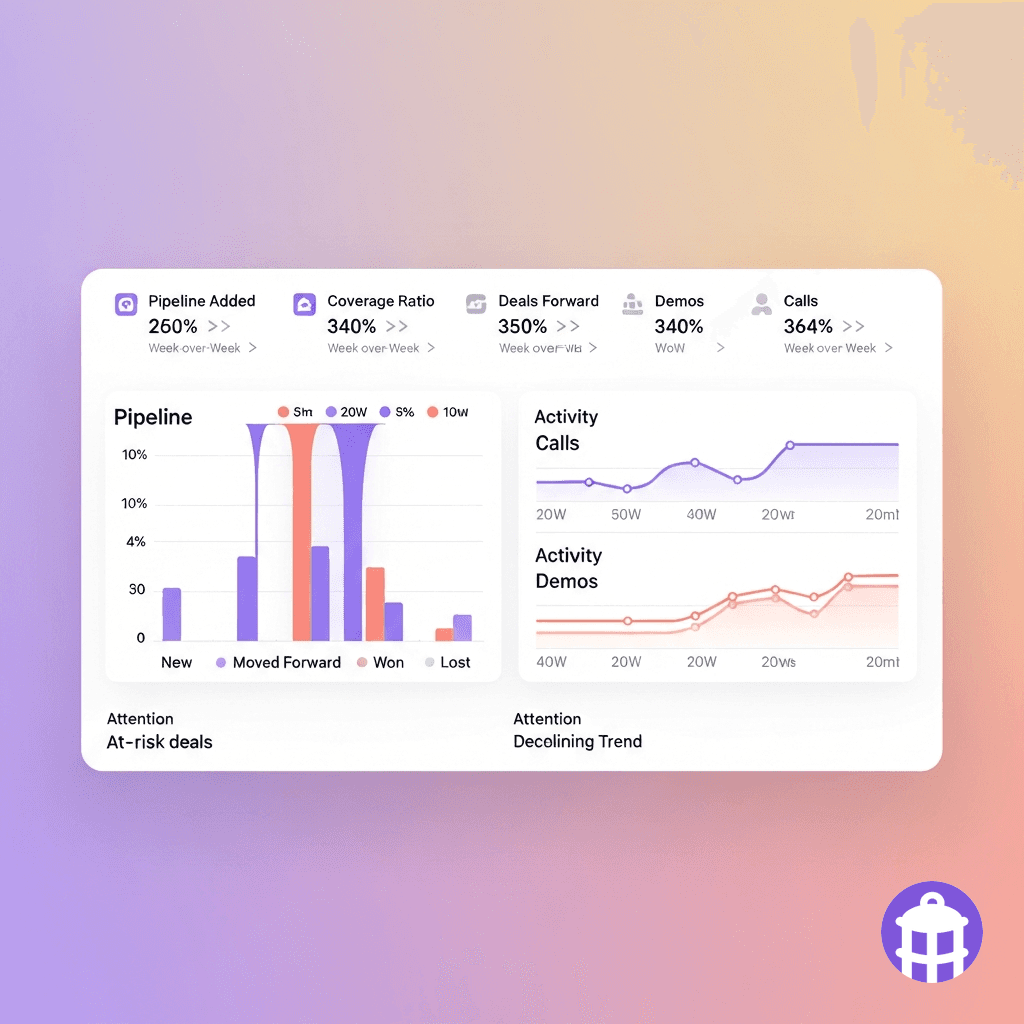
Most sales dashboards show what happened — this quarter's bookings, this month's pipeline. The agent adds the dimension of what's happening right now: how much qualified pipeline was created this week, how many deals moved forward, which deals went dark, what the current coverage ratio is against quota for the remaining period. Activity metrics are included alongside pipeline metrics because pipeline is a lagging indicator — call volume, meeting rate, and sequence launch rate are the leading indicators that predict pipeline health 3–4 weeks out. All of this is aggregated at the team level, the segment level, and the individual rep level, with breakdowns by territory, product line, and deal source.
Week of April 7 summary: 14 new qualified opps created ($1.1M pipeline added). Coverage ratio: 3.4× against remaining quota. 6 deals moved forward, 2 went dark (Apex Corp and Solis Group — both CSM follow-up required). Activity: 218 calls (↑12% WoW), 47 demos (↓8% WoW). Watch: demo rate declining 3 weeks running.
Aggregates pipeline and activity metrics across the team
Most sales dashboards show what happened — this quarter's bookings, this month's pipeline. The agent adds the dimension of what's happening right now: how much qualified pipeline was created this week, how many deals moved forward, which deals went dark, what the current coverage ratio is against quota for the remaining period. Activity metrics are included alongside pipeline metrics because pipeline is a lagging indicator — call volume, meeting rate, and sequence launch rate are the leading indicators that predict pipeline health 3–4 weeks out. All of this is aggregated at the team level, the segment level, and the individual rep level, with breakdowns by territory, product line, and deal source.
Week of April 7 summary: 14 new qualified opps created ($1.1M pipeline added). Coverage ratio: 3.4× against remaining quota. 6 deals moved forward, 2 went dark (Apex Corp and Solis Group — both CSM follow-up required). Activity: 218 calls (↑12% WoW), 47 demos (↓8% WoW). Watch: demo rate declining 3 weeks running.
Tracks win rates and stage conversion by segment
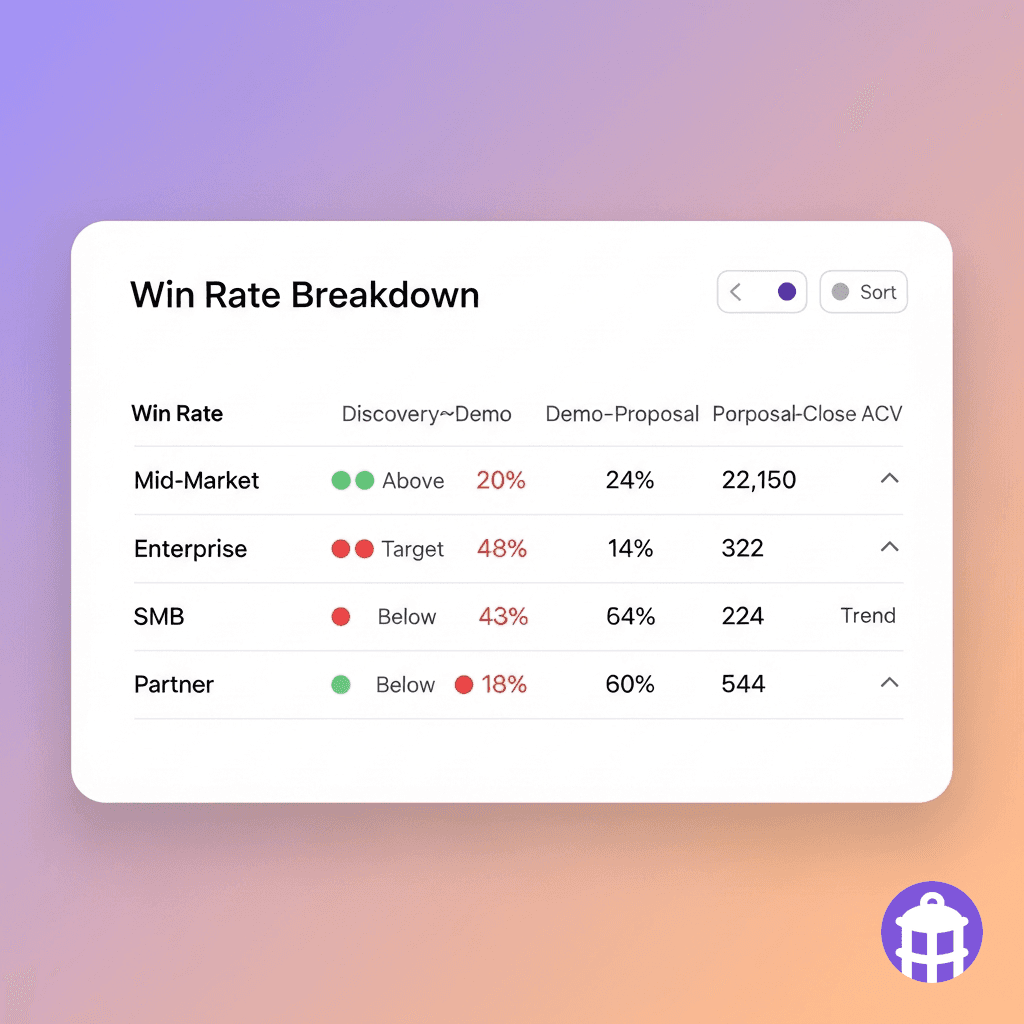
Win rate is a useful number until you disaggregate it. The agent breaks win rate down by deal source, deal size, segment, territory, and rep — revealing patterns that the aggregate number hides. A 23% win rate team average might contain an 18% win rate in the enterprise segment and a 31% win rate in the mid-market segment, driven by a qualification problem at the top of the enterprise funnel. Stage conversion breakdowns identify exactly where deals fall out — if 40% of qualified opportunities fail to advance from discovery to demo, that's a discovery conversation problem, not a proposal problem. This level of disaggregation is what converts sales data from a reporting exercise into a diagnostic tool.
Win rate analysis Q1: overall 24%. By segment — Mid-Market: 34%, Enterprise: 17%. By deal source — Inbound: 38%, Outbound: 18%, Partner: 29%. Stage drop: Discovery → Demo: 61% conversion (team avg last year: 71%). Likely cause: discovery qualification tightened in Q4 — fewer weak deals advancing, but conversion still below prior baseline.
Tracks win rates and stage conversion by segment
Win rate is a useful number until you disaggregate it. The agent breaks win rate down by deal source, deal size, segment, territory, and rep — revealing patterns that the aggregate number hides. A 23% win rate team average might contain an 18% win rate in the enterprise segment and a 31% win rate in the mid-market segment, driven by a qualification problem at the top of the enterprise funnel. Stage conversion breakdowns identify exactly where deals fall out — if 40% of qualified opportunities fail to advance from discovery to demo, that's a discovery conversation problem, not a proposal problem. This level of disaggregation is what converts sales data from a reporting exercise into a diagnostic tool.
Win rate analysis Q1: overall 24%. By segment — Mid-Market: 34%, Enterprise: 17%. By deal source — Inbound: 38%, Outbound: 18%, Partner: 29%. Stage drop: Discovery → Demo: 61% conversion (team avg last year: 71%). Likely cause: discovery qualification tightened in Q4 — fewer weak deals advancing, but conversion still below prior baseline.
Monitors quota attainment and ramp progress
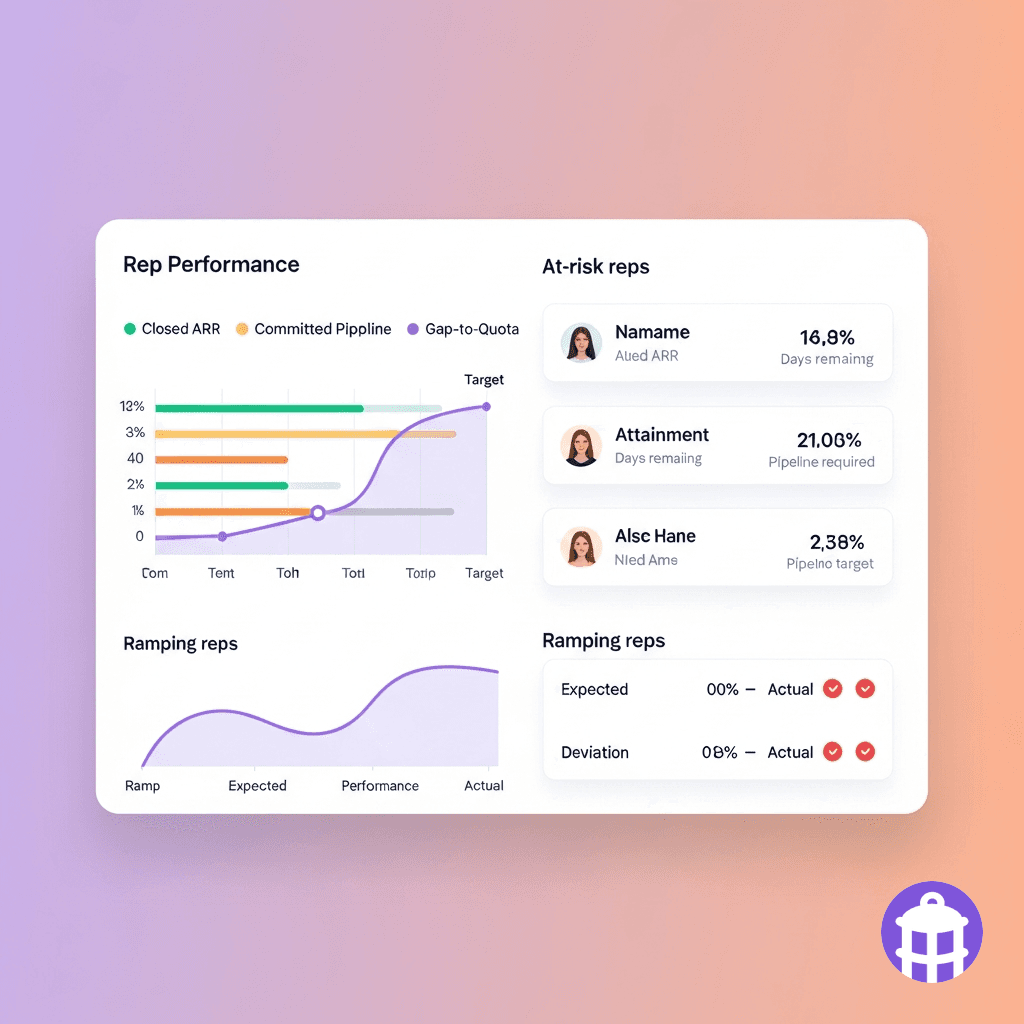
Quota attainment visibility should not require waiting until the end of the month. The agent maintains a running attainment view for every rep — current closed ARR, committed forecast, best-case pipeline, and what it would take to hit quota given the days remaining. For ramping reps, the view adjusts expectations to the ramp curve: a rep in month 3 of a 6-month ramp is measured against the expected attainment for their ramp stage, not the full quota. Ramp deviation alerts fire when a rep is tracking below the expected ramp curve by more than one standard deviation — so a rep who is going to miss their ramp milestone gets a coaching intervention before month-end, not after.
Attainment snapshot: April 7. 8 of 12 reps on track for quota. At-risk: Casey W. ($34K closed / $120K target, 28% attained, 19 days remaining — needs $86K in the next 19 days, pipeline: $110K, 78% required coverage). Ramp alert: Priya M. (month 4 of 6, tracking 22% below expected ramp curve).
Monitors quota attainment and ramp progress
Quota attainment visibility should not require waiting until the end of the month. The agent maintains a running attainment view for every rep — current closed ARR, committed forecast, best-case pipeline, and what it would take to hit quota given the days remaining. For ramping reps, the view adjusts expectations to the ramp curve: a rep in month 3 of a 6-month ramp is measured against the expected attainment for their ramp stage, not the full quota. Ramp deviation alerts fire when a rep is tracking below the expected ramp curve by more than one standard deviation — so a rep who is going to miss their ramp milestone gets a coaching intervention before month-end, not after.
Attainment snapshot: April 7. 8 of 12 reps on track for quota. At-risk: Casey W. ($34K closed / $120K target, 28% attained, 19 days remaining — needs $86K in the next 19 days, pipeline: $110K, 78% required coverage). Ramp alert: Priya M. (month 4 of 6, tracking 22% below expected ramp curve).
Surfaces the three things leadership should focus on this week
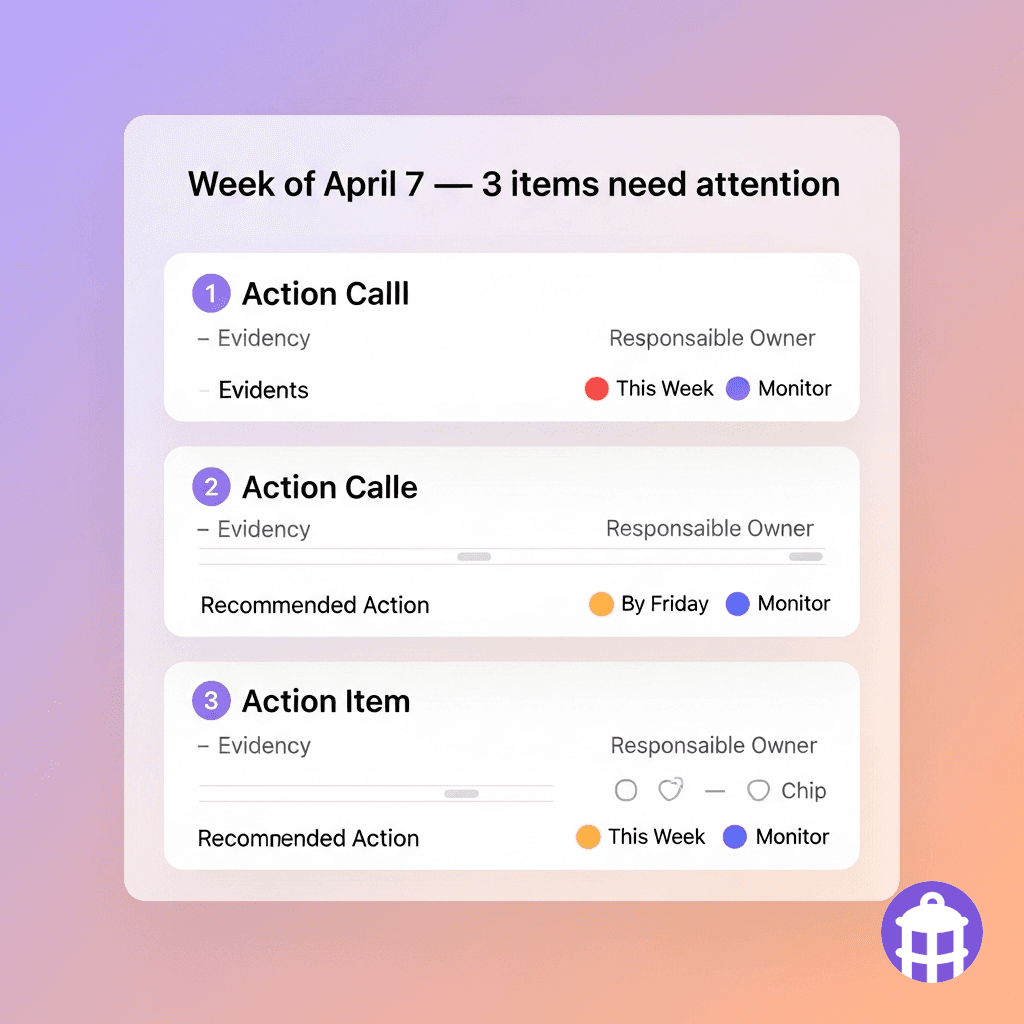
Data-rich dashboards can create analysis paralysis as easily as they can create clarity. The agent synthesizes the week's performance data into a prioritized list of 3–5 specific actions for sales leadership: which deals need attention, which rep needs a coaching conversation, which metric is trending in the wrong direction for three or more weeks. The synthesis isn't algorithmic pattern matching — it's opinionated prioritization that identifies what a competent sales leader would notice if they reviewed all of the data themselves. The weekly summary is delivered as a brief that takes 10 minutes to read and replaces 2 hours of dashboard review.
Leadership focus brief — Week of April 7: (1) Demo rate down 3 consecutive weeks — likely driven by Kyle R. and Priya M. activity drop. Action: manager review of call-to-demo conversion this week. (2) Apex Corp and Solis Group went dark — combined $280K. Action: CSM outreach by Friday. (3) Enterprise win rate at 17% — 7 points below target. Dig into discovery → demo drop-off before board review.
Surfaces the three things leadership should focus on this week
Data-rich dashboards can create analysis paralysis as easily as they can create clarity. The agent synthesizes the week's performance data into a prioritized list of 3–5 specific actions for sales leadership: which deals need attention, which rep needs a coaching conversation, which metric is trending in the wrong direction for three or more weeks. The synthesis isn't algorithmic pattern matching — it's opinionated prioritization that identifies what a competent sales leader would notice if they reviewed all of the data themselves. The weekly summary is delivered as a brief that takes 10 minutes to read and replaces 2 hours of dashboard review.
Leadership focus brief — Week of April 7: (1) Demo rate down 3 consecutive weeks — likely driven by Kyle R. and Priya M. activity drop. Action: manager review of call-to-demo conversion this week. (2) Apex Corp and Solis Group went dark — combined $280K. Action: CSM outreach by Friday. (3) Enterprise win rate at 17% — 7 points below target. Dig into discovery → demo drop-off before board review.
Today vs. with
Today vs. with
Review Sales Performance
Review Sales Performance
Today
Performance review happens monthly from a static CRM report — by then, at-risk reps are a full month behind.
Win rate is a single number — no visibility into whether the gap is in prospecting, discovery, demo, or close.
Sales leadership spends 2 hours preparing for the Monday pipeline review by pulling and formatting CRM data.

With ABM Strategist
Running attainment view with ramp deviation alerts fires mid-month when there's still time to intervene.
Win rate disaggregated by segment, deal source, rep, and stage — specific enough to drive a targeted intervention.
Weekly brief delivered automatically with prioritized actions and supporting evidence — ready to act, not just to read.
Works with
Works with
Coach Sales Reps
Team-level performance gaps identified in the review flow into individual rep coaching recommendations — the two agents share the same activity data.
Analyze Sequence Performance
Outbound activity metrics in the team review link to sequence-level performance data — declining meeting rates have a traceable cause in sequence analytics.
Coach Sales Reps
Team-level performance gaps identified in the review flow into individual rep coaching recommendations — the two agents share the same activity data.
Forecast Pipeline
Sales performance review informs the forecast — coverage ratios, stage conversion rates, and rep attainment patterns feed directly into pipeline projections.
Analyze Sequence Performance
Outbound activity metrics in the team review link to sequence-level performance data — declining meeting rates have a traceable cause in sequence analytics.
Three layers, one platform by Lantern
Three layers, one platform by Lantern
Every agent runs on three layers: a unified data model, 150+ enrichment providers, and an open-source engine where every decision is auditable.
Every agent runs on three layers: a unified data model, 150+ enrichment providers, and an open-source engine where every decision is auditable.
Data Waterfall
150+ enrichment providers. Sequential routing optimized per segment. The best answer wins. No vendor lock-in.

Agent Engine
Open-source execution engine. Workflows defined in code. Human-in-the-loop checkpoints. Full audit trail on every action.

Revenue Ontology
Every data source normalized into one model. Entity resolution across systems. Relationships stored, not inferred. Schema that evolves with your business.
FAQ
FAQ
What CRM and sales engagement platforms does this integrate with?
Can we customize what's included in the weekly brief?
How does the agent handle teams with different quota structures?
Is this a replacement for our BI tool or CRM dashboards?

The data was always there — the question is whether anyone's reading it before it's too late.
The data was always there — the question is whether anyone's reading it before it's too late.