
Operate

Mine Ad Angles

Mine Ad Angles

Extract the angles that resonate with your buyers — from the places your buyers already write about them.

Extract the angles that resonate with your buyers — from the places your buyers already write about them.

higher engagement rate for B2B ad creative that uses buyer-verbatim language versus internally-generated value propositions — according to creative performance analysis across 200+ B2B campaigns.

higher engagement rate for B2B ad creative that uses buyer-verbatim language versus internally-generated value propositions — according to creative performance analysis across 200+ B2B campaigns.

THE brıef

The best ad creative angles come from customers, not copywriters. They live in G2 reviews, Reddit threads, LinkedIn posts, community forums, and customer calls — the places where buyers describe their actual problems in their own language. The Mine Ad Angles agent systematically surfaces those angles from across the web and transforms them into structured creative briefs, so every campaign starts from a real buyer insight rather than an internal value proposition that only makes sense inside your company.
Extracts angles from customer reviews and testimonials

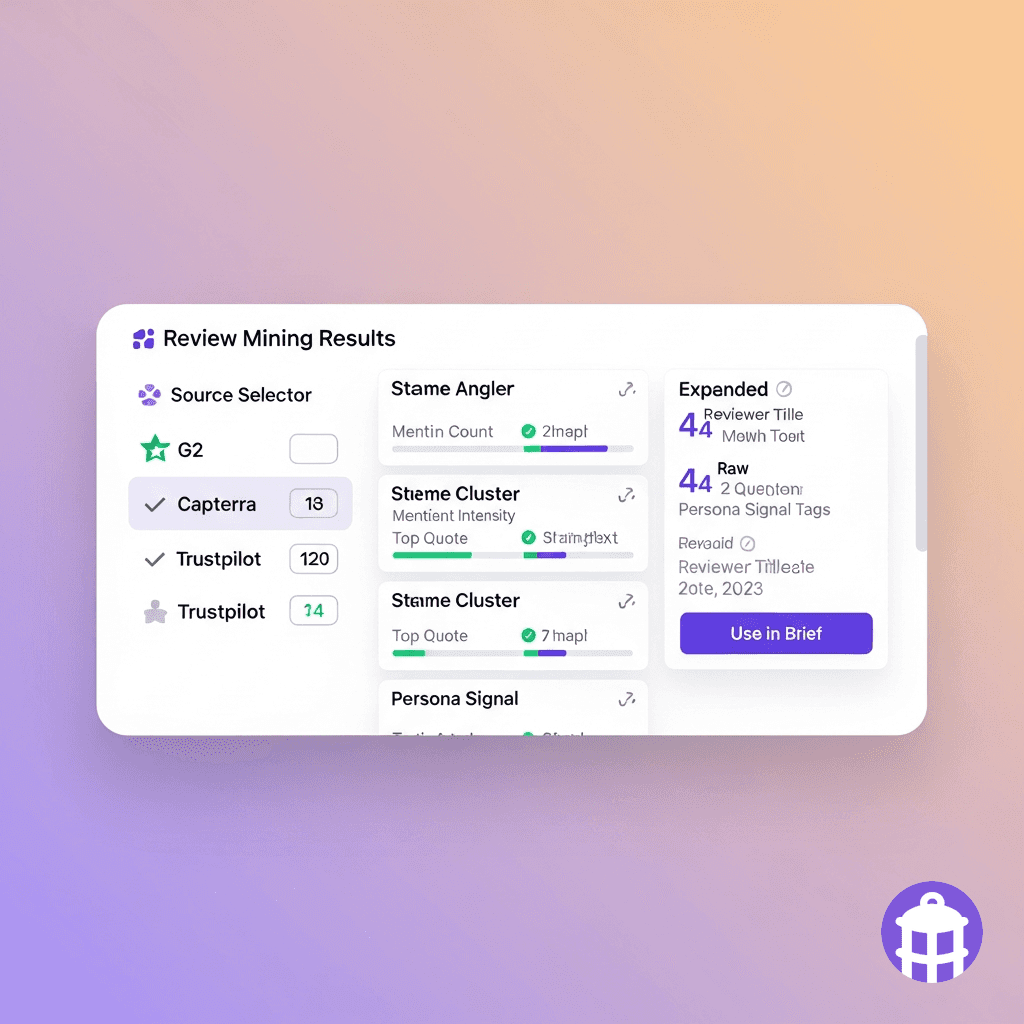
G2, Capterra, Trustpilot, and product-specific review sites are repositories of buyer language — the exact phrases, frustrations, and desired outcomes that caused real customers to seek out and evaluate a solution. The agent continuously monitors these sources for the product category, extracting specific pain-point language, switching triggers (the event that caused them to start looking), and outcome language (what they hoped to achieve). Angles are tagged by theme, buyer persona signal (based on reviewer job title), and sentiment intensity. The output is a ranked library of raw insight material, grouped by angle theme, that a copywriter or creative strategist can use as source material for headline ideation.

G2 review mining for 'revenue operations platform' (87 reviews analyzed): Top pain theme: 'CRM data we can't trust' (31 mentions). Top switching trigger: 'lost a deal because the contact info was wrong' (17 mentions). Top outcome language: 'finally know which accounts to focus on' (22 mentions). Sample raw angle: 'We were prioritizing accounts based on data that hadn't been updated in 8 months. We had no idea.'

Extracts angles from customer reviews and testimonials

G2, Capterra, Trustpilot, and product-specific review sites are repositories of buyer language — the exact phrases, frustrations, and desired outcomes that caused real customers to seek out and evaluate a solution. The agent continuously monitors these sources for the product category, extracting specific pain-point language, switching triggers (the event that caused them to start looking), and outcome language (what they hoped to achieve). Angles are tagged by theme, buyer persona signal (based on reviewer job title), and sentiment intensity. The output is a ranked library of raw insight material, grouped by angle theme, that a copywriter or creative strategist can use as source material for headline ideation.

G2 review mining for 'revenue operations platform' (87 reviews analyzed): Top pain theme: 'CRM data we can't trust' (31 mentions). Top switching trigger: 'lost a deal because the contact info was wrong' (17 mentions). Top outcome language: 'finally know which accounts to focus on' (22 mentions). Sample raw angle: 'We were prioritizing accounts based on data that hadn't been updated in 8 months. We had no idea.'

Monitors competitor positioning for differentiation angles

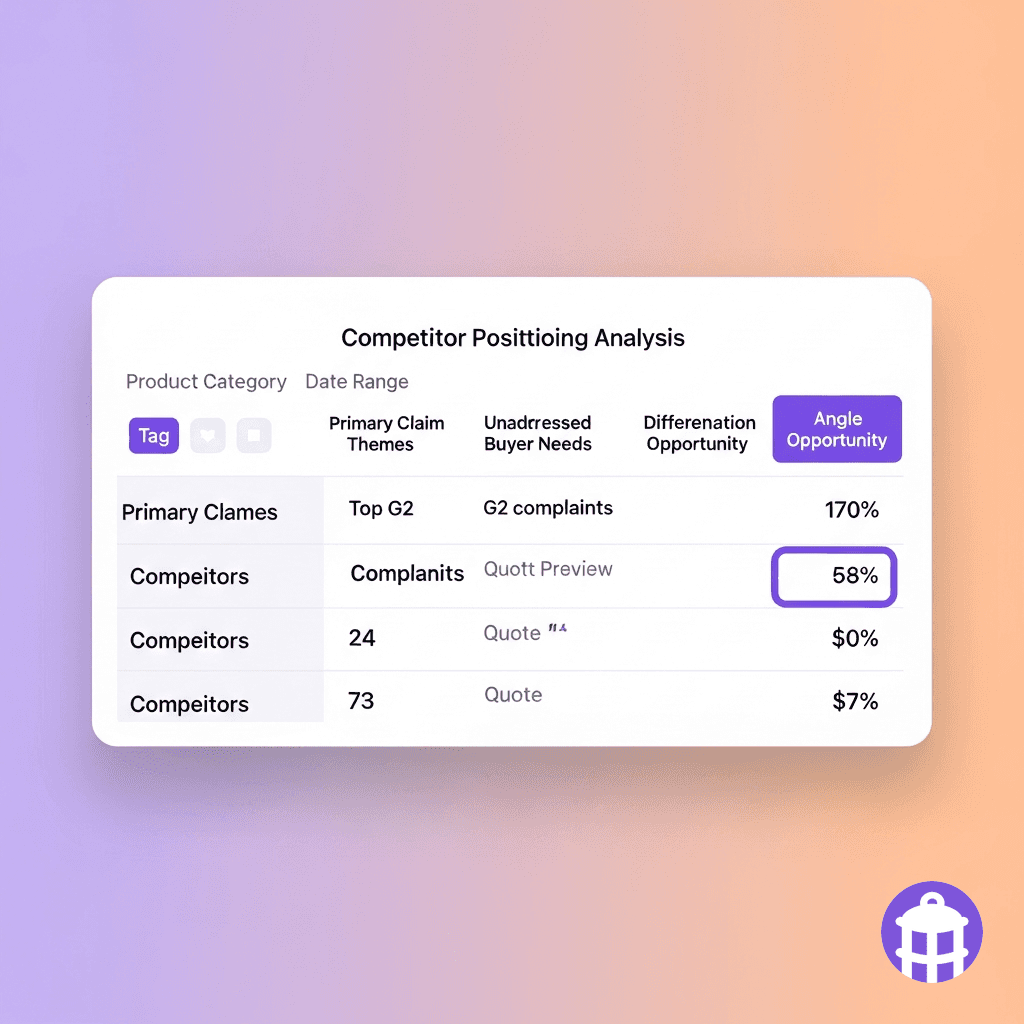
Understanding how competitors position themselves is table stakes. Understanding how buyers talk about competitors in reviews, in complaints, and in comparisons is a richer source of creative angles — because it reveals the gaps and frustrations that your product can credibly position against. The agent monitors competitor G2 reviews, competitor LinkedIn ad copy, competitor pricing page messaging, and head-to-head comparison threads to identify recurring positioning claims, common buyer objections to competitor products, and the specific terms competitors use that you can absorb, reframe, or contrast against. The output is a structured competitor angle brief that identifies where differentiation language is grounded in real buyer behavior, not just internal perception.

Competitor angle analysis: 3 primary competitors monitored. Common G2 complaints about Competitor A: 'expensive for the data quality you get' (24 mentions), 'support is slow when something breaks' (19 mentions). Competitor B LinkedIn ad themes: 'AI-powered enrichment', 'single source of truth'. Differentiation angle opportunity: position on data accuracy and speed-to-value — themes competitors are not claiming and buyers are asking for.

Monitors competitor positioning for differentiation angles

Understanding how competitors position themselves is table stakes. Understanding how buyers talk about competitors in reviews, in complaints, and in comparisons is a richer source of creative angles — because it reveals the gaps and frustrations that your product can credibly position against. The agent monitors competitor G2 reviews, competitor LinkedIn ad copy, competitor pricing page messaging, and head-to-head comparison threads to identify recurring positioning claims, common buyer objections to competitor products, and the specific terms competitors use that you can absorb, reframe, or contrast against. The output is a structured competitor angle brief that identifies where differentiation language is grounded in real buyer behavior, not just internal perception.

Competitor angle analysis: 3 primary competitors monitored. Common G2 complaints about Competitor A: 'expensive for the data quality you get' (24 mentions), 'support is slow when something breaks' (19 mentions). Competitor B LinkedIn ad themes: 'AI-powered enrichment', 'single source of truth'. Differentiation angle opportunity: position on data accuracy and speed-to-value — themes competitors are not claiming and buyers are asking for.

Surfaces angles from community and social conversations

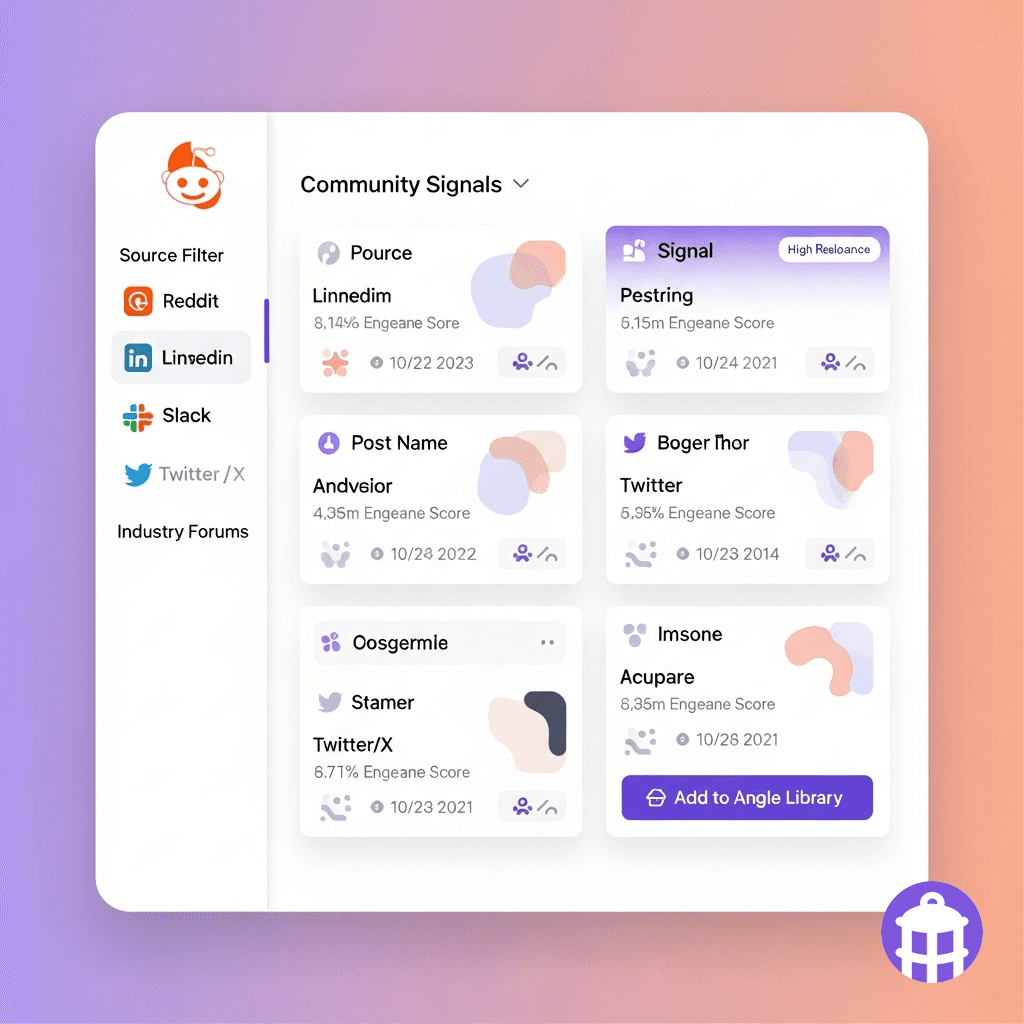
LinkedIn posts, Reddit communities, Slack groups, and industry forums are real-time windows into what buyers are actively discussing, complaining about, and seeking advice on. The agent monitors relevant communities and social platforms for conversations that signal active pain in your product category — posts asking for tool recommendations, threads about frustrations with current solutions, discussion threads where multiple practitioners share a common challenge. These conversations are mined for the specific language used to describe the problem, the context that triggered the conversation, and the solutions being considered. Community-sourced angles often have higher resonance because they reflect current, unsolicited buyer sentiment rather than survey-mediated feedback.

Community angle mining (past 30 days): r/sales: 'We have 18,000 contacts in our CRM and I don't trust any of them' (847 upvotes). LinkedIn: RevOps Collective thread — 'how does everyone handle data decay from job changes?' (142 comments). Slack community: 6 separate discussions this month about 'outbound not booking because the email is wrong'. Angle: data decay as the invisible pipeline killer — specific, emotionally resonant, currently top-of-mind.

Surfaces angles from community and social conversations

LinkedIn posts, Reddit communities, Slack groups, and industry forums are real-time windows into what buyers are actively discussing, complaining about, and seeking advice on. The agent monitors relevant communities and social platforms for conversations that signal active pain in your product category — posts asking for tool recommendations, threads about frustrations with current solutions, discussion threads where multiple practitioners share a common challenge. These conversations are mined for the specific language used to describe the problem, the context that triggered the conversation, and the solutions being considered. Community-sourced angles often have higher resonance because they reflect current, unsolicited buyer sentiment rather than survey-mediated feedback.

Community angle mining (past 30 days): r/sales: 'We have 18,000 contacts in our CRM and I don't trust any of them' (847 upvotes). LinkedIn: RevOps Collective thread — 'how does everyone handle data decay from job changes?' (142 comments). Slack community: 6 separate discussions this month about 'outbound not booking because the email is wrong'. Angle: data decay as the invisible pipeline killer — specific, emotionally resonant, currently top-of-mind.

Packages angles into structured creative briefs

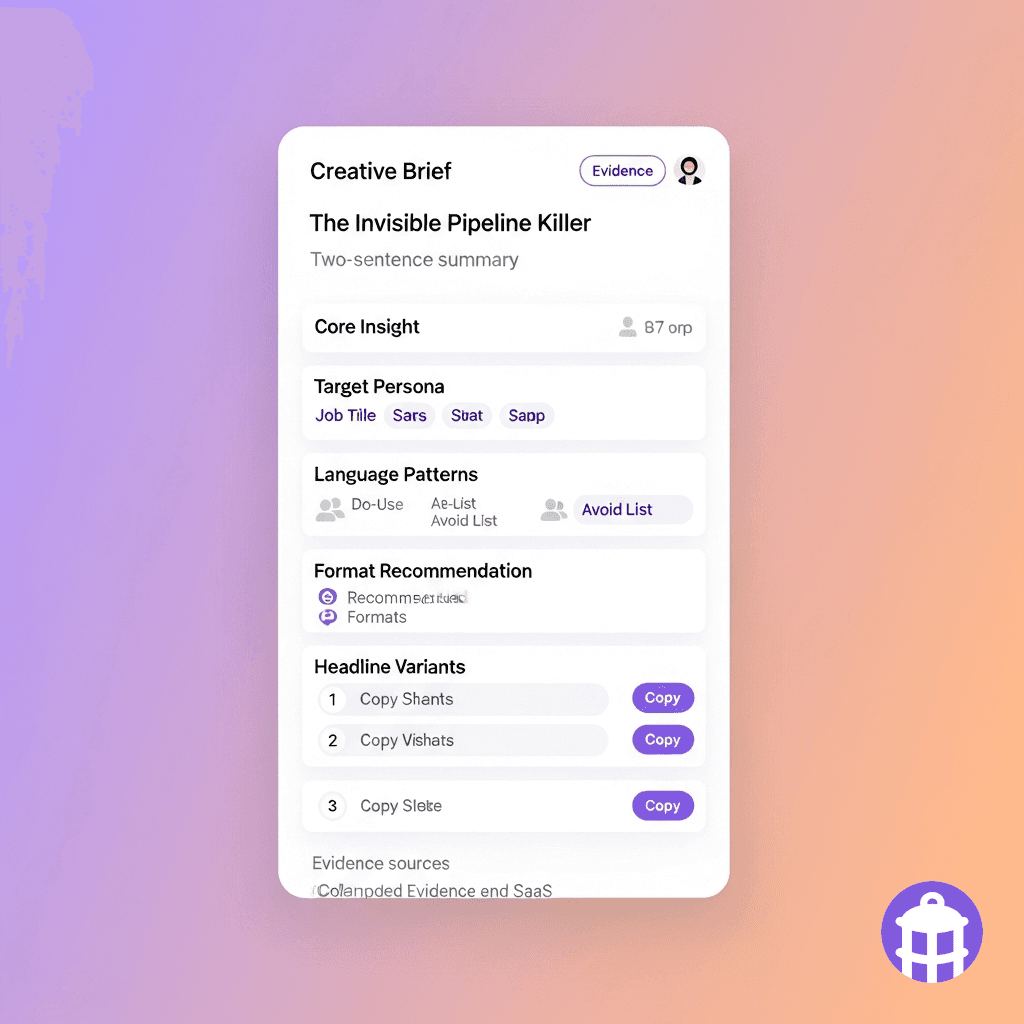
Raw insight material only creates value when it becomes an actionable creative brief that a copywriter, designer, or media buyer can execute against without additional context. The agent transforms mined angles into structured briefs: the core insight (the buyer truth the angle is built on), the target persona (whose pain this speaks to), the specific language patterns to use and avoid, the format recommendation (what this angle works best as — LinkedIn text post, short-form video hook, static ad), and 3–5 headline variants demonstrating how the angle would be expressed in copy. Each brief is tagged with the evidence base — specific reviews, posts, or community quotes that substantiate the angle — so the creative team can trace it back to the original source.

Creative brief generated: 'The Invisible Pipeline Killer' angle. Core insight: outdated CRM contact data causes deal loss that reps attribute to other reasons — the real cost is invisible because it shows up as no-reply, not as a data problem. Target persona: RevOps leaders, sales managers. Headline variants: (1) 'Your Pipeline Is Leaking Through Bad Email Addresses', (2) 'Every Wrong Phone Number Is a Deal You Won't Know You Lost', (3) 'The Rep Said the Deal Went Cold. The CRM Said the Contact Left 6 Months Ago.'

Packages angles into structured creative briefs

Raw insight material only creates value when it becomes an actionable creative brief that a copywriter, designer, or media buyer can execute against without additional context. The agent transforms mined angles into structured briefs: the core insight (the buyer truth the angle is built on), the target persona (whose pain this speaks to), the specific language patterns to use and avoid, the format recommendation (what this angle works best as — LinkedIn text post, short-form video hook, static ad), and 3–5 headline variants demonstrating how the angle would be expressed in copy. Each brief is tagged with the evidence base — specific reviews, posts, or community quotes that substantiate the angle — so the creative team can trace it back to the original source.

Creative brief generated: 'The Invisible Pipeline Killer' angle. Core insight: outdated CRM contact data causes deal loss that reps attribute to other reasons — the real cost is invisible because it shows up as no-reply, not as a data problem. Target persona: RevOps leaders, sales managers. Headline variants: (1) 'Your Pipeline Is Leaking Through Bad Email Addresses', (2) 'Every Wrong Phone Number Is a Deal You Won't Know You Lost', (3) 'The Rep Said the Deal Went Cold. The CRM Said the Contact Left 6 Months Ago.'

Today vs. with

Today vs. with

Mine Ad Angles

Mine Ad Angles

Today

Creative briefs written based on product messaging frameworks developed internally — rarely informed by how buyers actually describe the problem

Competitive intelligence gathered ad hoc when someone notices a competitor ad — no systematic monitoring of what competitors are claiming or where they're vulnerable

Creative teams asked to generate fresh angles without a structured input process — ideation sessions rely on memory and gut rather than systematic insight

With ABM Strategist

Angles extracted directly from buyer reviews, community posts, and competitor complaints — creative starts from the words real buyers use, not internal positioning

Continuous competitor positioning monitoring across G2, LinkedIn ads, and comparison content — differentiation angles identified where buyers are dissatisfied and competitors are silent

Structured creative briefs with headline variants, evidence sources, and persona guidance delivered from the angle library — ideation starts from evidence, not a blank page

Three layers, one platform by Lantern

Three layers, one platform by Lantern

Every agent runs on three layers: a unified data model, 150+ enrichment providers, and an open-source engine where every decision is auditable.

Every agent runs on three layers: a unified data model, 150+ enrichment providers, and an open-source engine where every decision is auditable.

Data Waterfall

150+ enrichment providers. Sequential routing optimized per segment. The best answer wins. No vendor lock-in.

Agent Engine

Open-source execution engine. Workflows defined in code. Human-in-the-loop checkpoints. Full audit trail on every action.

Revenue Ontology

Every data source normalized into one model. Entity resolution across systems. Relationships stored, not inferred. Schema that evolves with your business.

FAQ

FAQ

Does the agent scrape reviews and content in violation of platform terms of service?

How often does the angle library update?

Can we add our own customer call transcripts or survey data as a source?

How specific are the competitor angle opportunities — does it just show generic positioning gaps?


The best copy was already written by your buyers — go find it.

The best copy was already written by your buyers — go find it.

USE CASES

Revenue Team

Marketing Team

Customer Success

PRICING

Pricing

RESOURCES

Blog

About Lantern

Status

Support

© LANTERN 2025

Terms

Privacy

Linkedin

USE CASES

Revenue Team

Marketing Team

Customer Success

PRICING

Pricing

RESOURCES

Blog

About Lantern

Status

Support

© LANTERN 2025

Terms

Privacy

Linkedin

USE CASES

Revenue Team

Marketing Team

Customer Success

PRICING

Pricing

RESOURCES

Blog

About Lantern

Status

Support

© LANTERN 2025

Terms

Privacy

Linkedin