
Operate

Reverse ETL

Reverse ETL

Your warehouse knows more than your CRM — push that intelligence where reps actually work.

Your warehouse knows more than your CRM — push that intelligence where reps actually work.

of B2B companies have data science models in their warehouse that have never been operationalized into the CRM or tools their go-to-market team uses.

of B2B companies have data science models in their warehouse that have never been operationalized into the CRM or tools their go-to-market team uses.

THE brıef

Data warehouses hold the richest version of every customer and prospect record — usage data, product signals, event history, enriched firmographics, and ML model outputs. But reps work in Salesforce and Outreach, not Snowflake. Reverse ETL closes the gap: continuously syncing enriched, analytics-ready data from the warehouse back into the CRM and sales engagement tools your team uses every day. Product-qualified leads surface in Salesforce. Usage health scores appear on account records. Churn risk flags show up before the CSM notices the behavior.
Defines sync models without engineering tickets

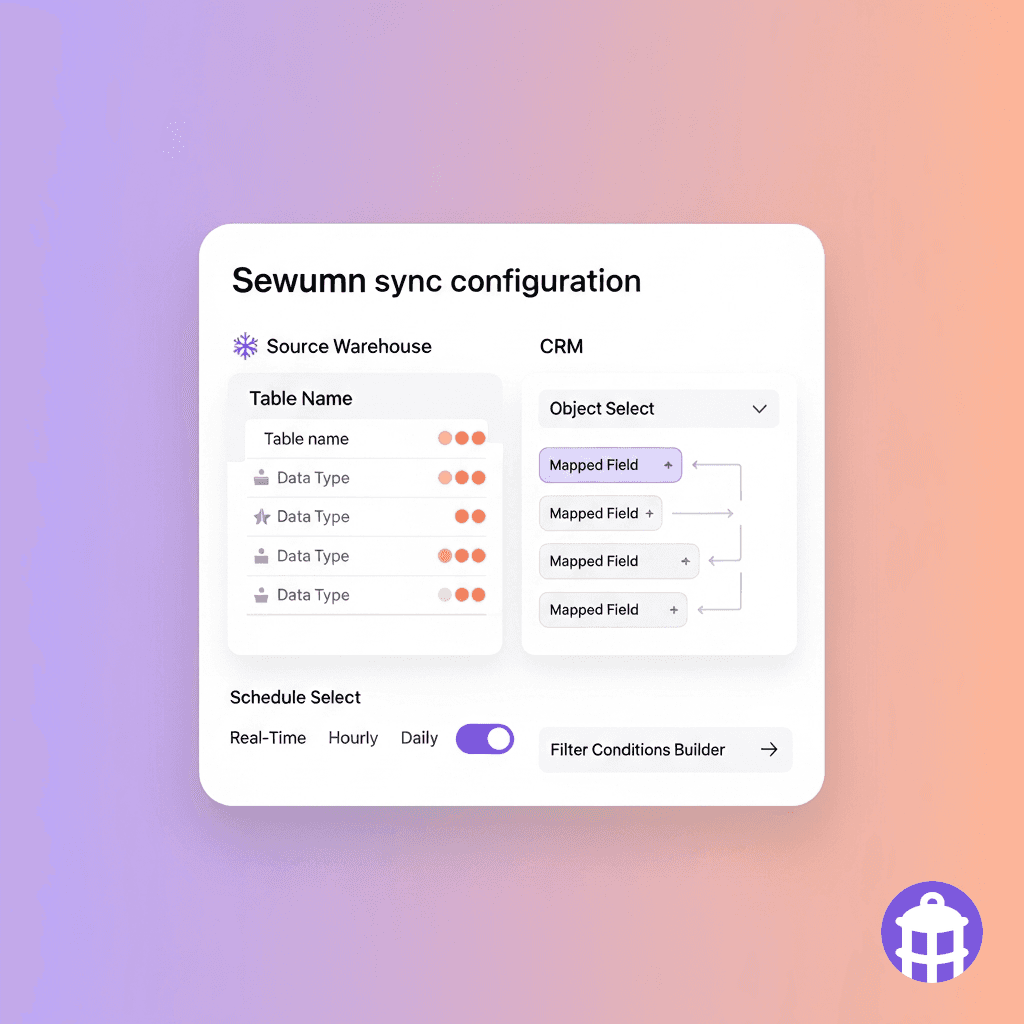
Traditional reverse ETL requires data engineers to write and maintain SQL models for every sync — every change to what gets pushed requires a ticket, a review, and a deploy cycle. The agent allows RevOps and marketing teams to define sync models through a guided interface: select the source table or view in the warehouse, map fields to CRM destination objects, and configure the sync schedule and trigger conditions. Complex transformations — like rolling up user-level product usage to the account level, or deriving a health score from raw event data — are configured as model steps without requiring SQL expertise or engineering involvement for every iteration.

Sync model: product_usage_rollup → Salesforce Account. Source: Snowflake view (product_usage_30d). Mapped fields: DAU_last_30d → Product_Activity__c, feature_adoption_score → Feature_Score__c, last_active_date → Last_Product_Login__c. Schedule: daily at 6:00 AM UTC. Records in scope: 4,210 active accounts.

Defines sync models without engineering tickets

Traditional reverse ETL requires data engineers to write and maintain SQL models for every sync — every change to what gets pushed requires a ticket, a review, and a deploy cycle. The agent allows RevOps and marketing teams to define sync models through a guided interface: select the source table or view in the warehouse, map fields to CRM destination objects, and configure the sync schedule and trigger conditions. Complex transformations — like rolling up user-level product usage to the account level, or deriving a health score from raw event data — are configured as model steps without requiring SQL expertise or engineering involvement for every iteration.

Sync model: product_usage_rollup → Salesforce Account. Source: Snowflake view (product_usage_30d). Mapped fields: DAU_last_30d → Product_Activity__c, feature_adoption_score → Feature_Score__c, last_active_date → Last_Product_Login__c. Schedule: daily at 6:00 AM UTC. Records in scope: 4,210 active accounts.

Surfaces product signals on CRM and sales engagement records

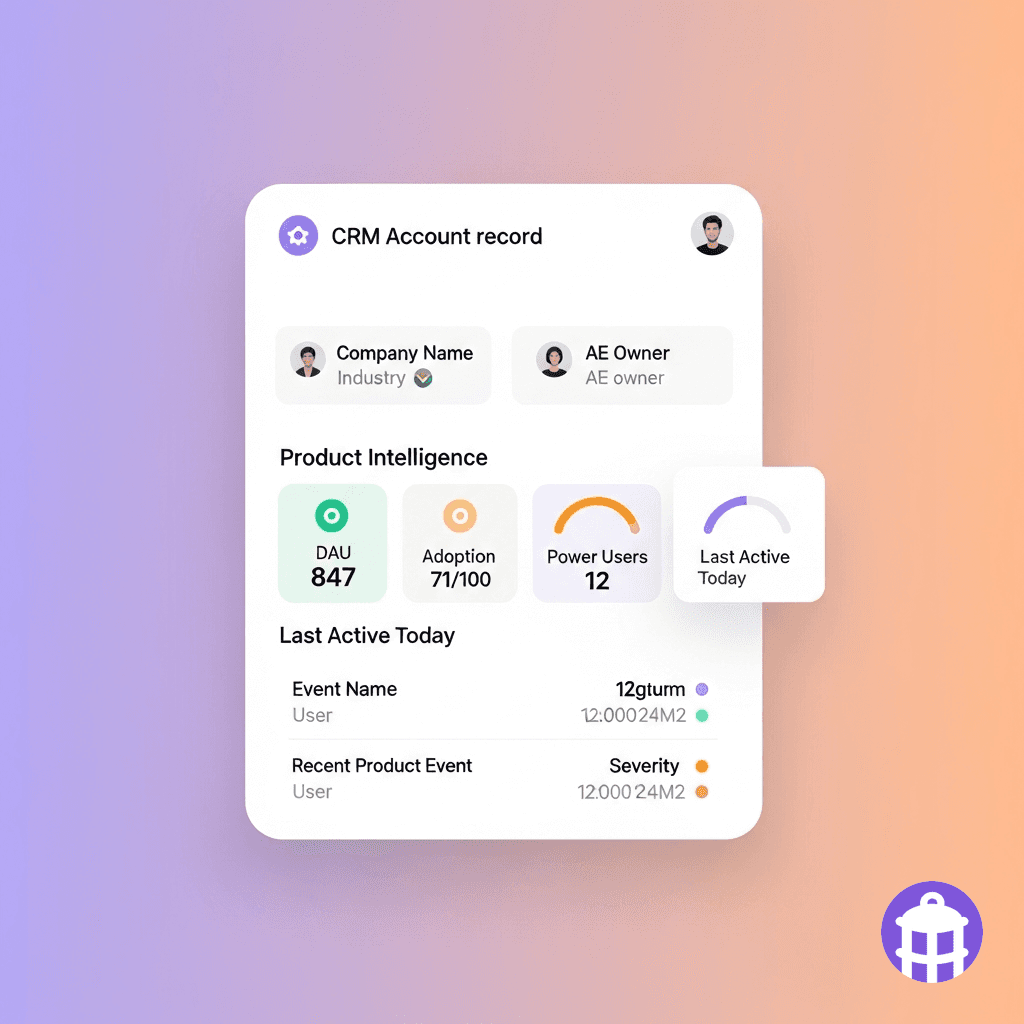
The most valuable signals for sales and CS teams live in the product database — which features an account has adopted, how many seats are active, when engagement dropped, which users are power users versus dormant. The agent syncs these signals onto the CRM records where reps and CSMs spend their day. A Salesforce account view shows product usage, feature scores, and last-active dates without the rep ever opening a BI tool. An Outreach sequence can branch on product activity level. A CSM's HubSpot view shows an account health score derived from actual behavioral data, not manual RAG status updates.

Cascade Payments — Salesforce Account: DAU (30d): 847 active users, Feature Adoption Score: 71/100, Power Users: 12, Last Login: Today, Expansion Signal: High (3 users on free tier hitting usage cap this week).

Surfaces product signals on CRM and sales engagement records

The most valuable signals for sales and CS teams live in the product database — which features an account has adopted, how many seats are active, when engagement dropped, which users are power users versus dormant. The agent syncs these signals onto the CRM records where reps and CSMs spend their day. A Salesforce account view shows product usage, feature scores, and last-active dates without the rep ever opening a BI tool. An Outreach sequence can branch on product activity level. A CSM's HubSpot view shows an account health score derived from actual behavioral data, not manual RAG status updates.

Cascade Payments — Salesforce Account: DAU (30d): 847 active users, Feature Adoption Score: 71/100, Power Users: 12, Last Login: Today, Expansion Signal: High (3 users on free tier hitting usage cap this week).

Syncs ML model outputs back to operational tools

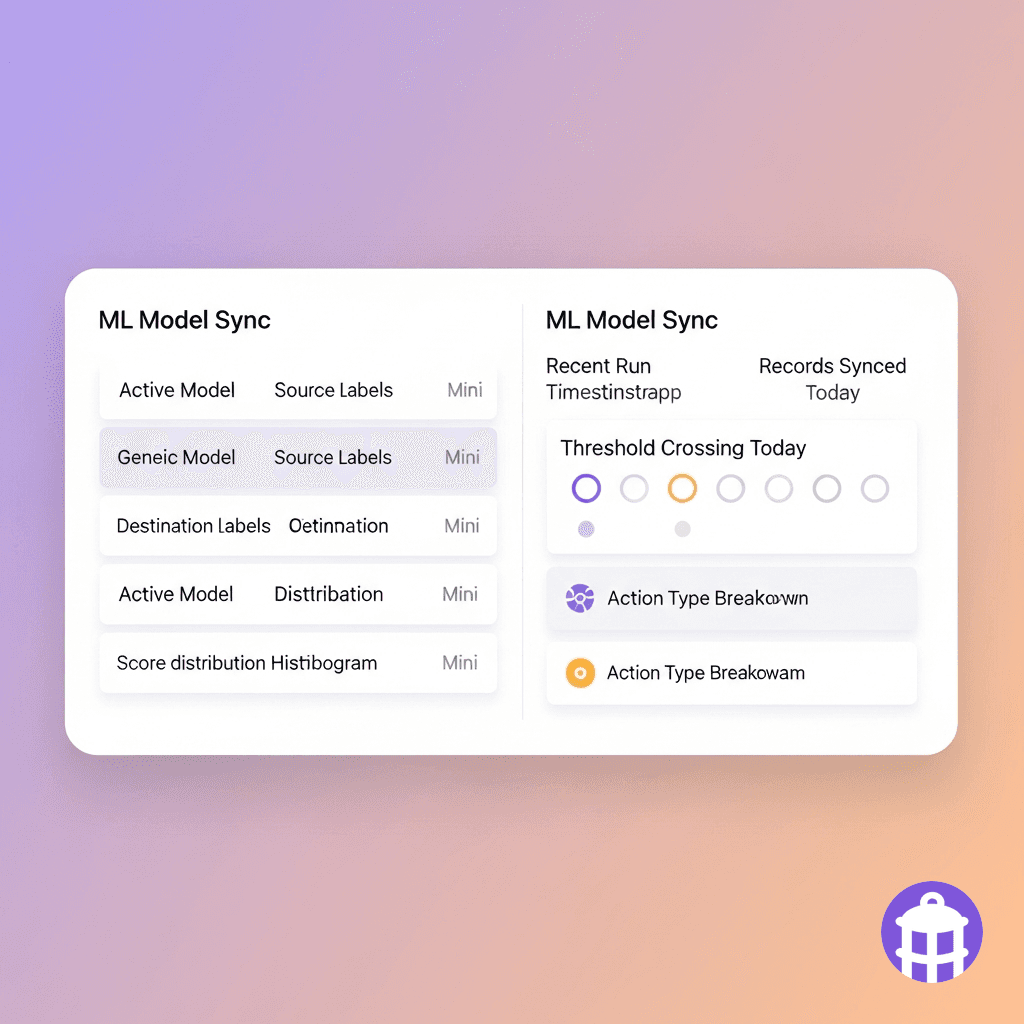
Data science teams build churn prediction models, propensity-to-expand scores, and ICP fit classifiers in the warehouse — but these outputs rarely make it back to the people who can act on them. The agent continuously syncs model outputs from the warehouse to CRM fields, triggering workflows downstream: a high churn-risk score on an account automatically creates a task for the CSM and enrolls the account in a retention sequence. A high expansion-propensity score surfaces the account in the AE's expansion pipeline view. The intelligence built by the data team becomes operationalized in the tools the go-to-market team actually uses.

Model sync: churn_risk_model_v3 → HubSpot. Output field: Churn_Risk_Score synced to 6,420 accounts. Accounts above 0.75 threshold: 183 — automatically enrolled in 'At-Risk Intervention' sequence. CSM task created for each. Sync latency: <4 minutes.

Syncs ML model outputs back to operational tools

Data science teams build churn prediction models, propensity-to-expand scores, and ICP fit classifiers in the warehouse — but these outputs rarely make it back to the people who can act on them. The agent continuously syncs model outputs from the warehouse to CRM fields, triggering workflows downstream: a high churn-risk score on an account automatically creates a task for the CSM and enrolls the account in a retention sequence. A high expansion-propensity score surfaces the account in the AE's expansion pipeline view. The intelligence built by the data team becomes operationalized in the tools the go-to-market team actually uses.

Model sync: churn_risk_model_v3 → HubSpot. Output field: Churn_Risk_Score synced to 6,420 accounts. Accounts above 0.75 threshold: 183 — automatically enrolled in 'At-Risk Intervention' sequence. CSM task created for each. Sync latency: <4 minutes.

Maintains sync reliability with monitoring and alerting

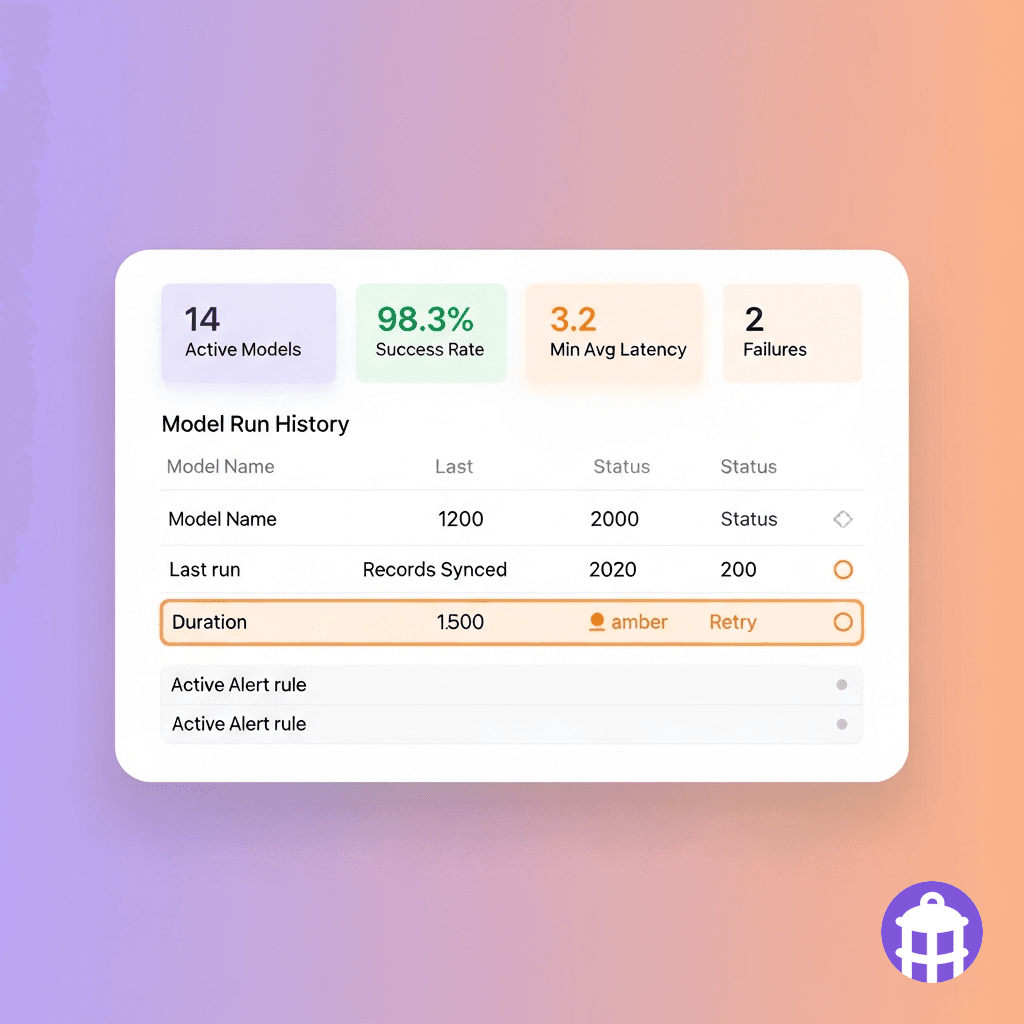
Reverse ETL syncs fail silently more often than anyone admits — the warehouse query times out, a schema change breaks the model, a CRM API rate limit interrupts the write, and reps spend weeks working from stale data without knowing it. The agent monitors every sync run: records processed, records failed, latency per run, and error types when failures occur. Alerting fires when a sync fails, when error rates exceed configured thresholds, or when a sync hasn't run within its expected window. Every sync event is logged with a full audit trail — what was pushed, when, to which records, and what the result was.

Sync health: 14 active models. Last 7-day run summary: 98.3% success rate. 2 failures (Snowflake timeout, Apr 4 — auto-retried, resolved). Average sync latency: 3.2 minutes. 0 models overdue. Next runs scheduled: 6:00 AM UTC.

Maintains sync reliability with monitoring and alerting

Reverse ETL syncs fail silently more often than anyone admits — the warehouse query times out, a schema change breaks the model, a CRM API rate limit interrupts the write, and reps spend weeks working from stale data without knowing it. The agent monitors every sync run: records processed, records failed, latency per run, and error types when failures occur. Alerting fires when a sync fails, when error rates exceed configured thresholds, or when a sync hasn't run within its expected window. Every sync event is logged with a full audit trail — what was pushed, when, to which records, and what the result was.

Sync health: 14 active models. Last 7-day run summary: 98.3% success rate. 2 failures (Snowflake timeout, Apr 4 — auto-retried, resolved). Average sync latency: 3.2 minutes. 0 models overdue. Next runs scheduled: 6:00 AM UTC.

Today vs. with

Today vs. with

Reverse ETL

Reverse ETL

Today

Product usage, health scores, and ML model outputs live in the warehouse — accessible only to analysts, invisible to reps and CSMs who need them

Every new data sync requires a data engineering ticket, SQL review, and deploy cycle — weeks of lead time per business request

Sync failures are invisible until reps notice stale data — no monitoring, no alerting, no audit trail for what was pushed and when

With ABM Strategist

Warehouse signals synced continuously to CRM records and sales tools — reps see product activity, health scores, and churn flags without leaving Salesforce

RevOps configures sync models through a guided interface — field mappings, transformations, and schedules defined without writing SQL or opening a ticket

Every sync run monitored with real-time alerting on failures, latency thresholds, and overdue syncs — full audit log per record

Three layers, one platform by Lantern

Three layers, one platform by Lantern

Every agent runs on three layers: a unified data model, 150+ enrichment providers, and an open-source engine where every decision is auditable.

Every agent runs on three layers: a unified data model, 150+ enrichment providers, and an open-source engine where every decision is auditable.

Data Waterfall

150+ enrichment providers. Sequential routing optimized per segment. The best answer wins. No vendor lock-in.

Agent Engine

Open-source execution engine. Workflows defined in code. Human-in-the-loop checkpoints. Full audit trail on every action.
Revenue Ontology

Every data source normalized into one model. Entity resolution across systems. Relationships stored, not inferred. Schema that evolves with your business.

FAQ

FAQ

Do we need a data engineer to set up sync models?

How does the agent handle record matching between warehouse and CRM?

What's the sync latency for high-priority signals like churn risk?

How does this compare to Census or Hightouch?

The intelligence is already in your warehouse — get it in front of the people who can act on it.

The intelligence is already in your warehouse — get it in front of the people who can act on it.

USE CASES

Revenue Team

Marketing Team

Customer Success

PRICING

Pricing

RESOURCES

Blog

About Lantern

Status

Support

© LANTERN 2025

Terms

Privacy

Linkedin

USE CASES

Revenue Team

Marketing Team

Customer Success

PRICING

Pricing

RESOURCES

Blog

About Lantern

Status

Support

© LANTERN 2025

Terms

Privacy

Linkedin

USE CASES

Revenue Team

Marketing Team

Customer Success

PRICING

Pricing

RESOURCES

Blog

About Lantern

Status

Support

© LANTERN 2025

Terms

Privacy

Linkedin