
Operate

Analyze GTM Performance

Analyze GTM Performance

Full-funnel GTM visibility — from first touch to closed revenue — with the answer to which motions actually work.

Full-funnel GTM visibility — from first touch to closed revenue — with the answer to which motions actually work.

of B2B GTM teams cannot accurately attribute closed revenue to the channels and campaigns that sourced it — making budget allocation a guessing exercise.

of B2B GTM teams cannot accurately attribute closed revenue to the channels and campaigns that sourced it — making budget allocation a guessing exercise.

THE brıef

Most GTM teams have data but not clarity. They can pull a pipeline report. They can see channel spend. They can measure close rates. What they can't do is connect all three into a coherent answer to the question that matters: which segments, channels, and motions are generating revenue efficiently, and which are consuming budget while producing noise? The Analyze GTM Performance agent builds that view — continuously, across the full funnel, with attribution logic that reflects how deals actually happen.
Measures the full funnel from lead to revenue

Funnel measurement breaks when it's done piecemeal — marketing measures MQLs, sales measures pipeline, finance measures revenue, and nobody sees the connection. The agent builds a unified funnel model that traces every opportunity from first touch through every stage to closed-won or closed-lost, regardless of how many channels, campaigns, or touches were involved. Conversion rates are calculated at every stage transition — not just lead-to-opportunity or opportunity-to-close, but every micro-conversion in between. Stage velocity is tracked alongside conversion rates, so a bottleneck that's dragging deal length is visible even when conversion rate looks healthy.

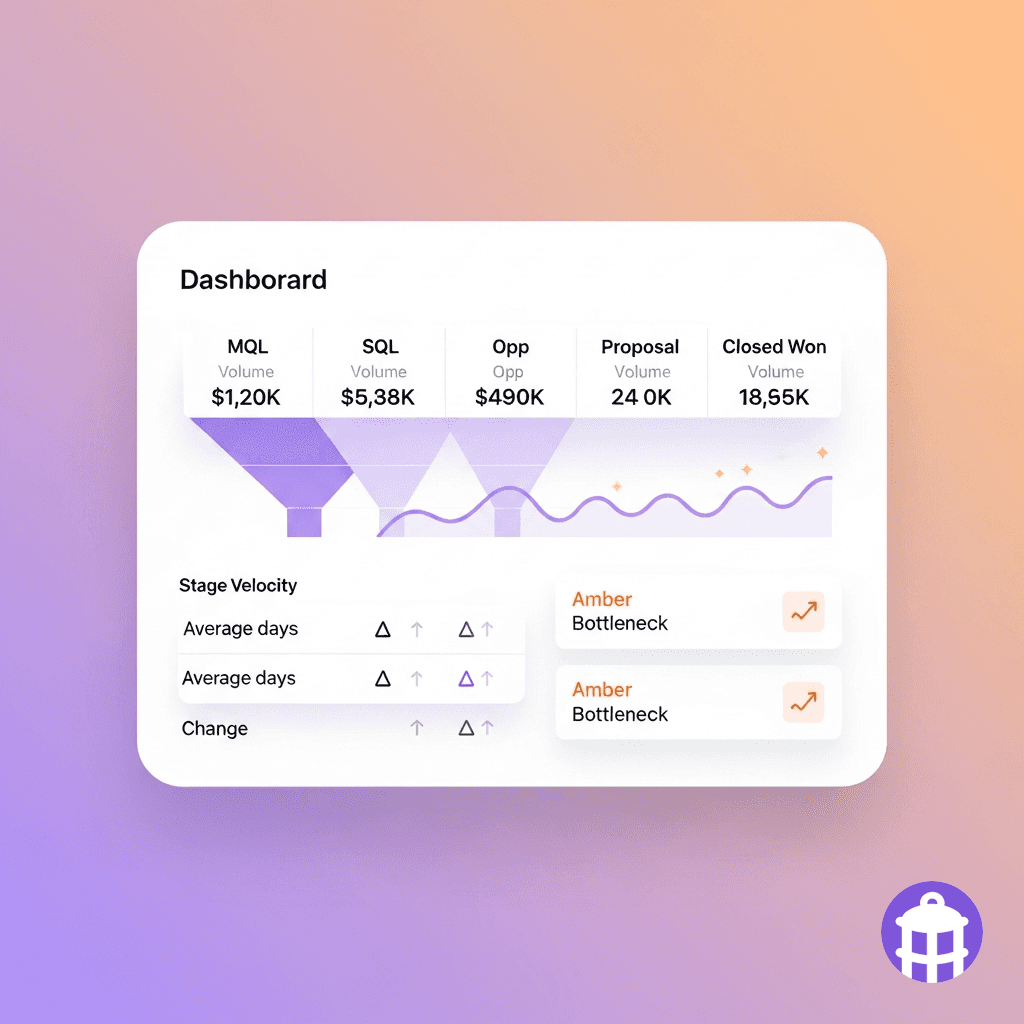
Q1 2026 GTM funnel: 3,847 MQLs → 1,204 SQLs (31.3%) → 312 Opportunities → 89 Closed Won (28.5% win rate). Stage velocity: Opp → Proposal avg 18.4 days (↑ 3.2 days vs Q4). Biggest drop-off: SQL → Opp at 25.9% — down from 31.2% in Q4.

Measures the full funnel from lead to revenue

Funnel measurement breaks when it's done piecemeal — marketing measures MQLs, sales measures pipeline, finance measures revenue, and nobody sees the connection. The agent builds a unified funnel model that traces every opportunity from first touch through every stage to closed-won or closed-lost, regardless of how many channels, campaigns, or touches were involved. Conversion rates are calculated at every stage transition — not just lead-to-opportunity or opportunity-to-close, but every micro-conversion in between. Stage velocity is tracked alongside conversion rates, so a bottleneck that's dragging deal length is visible even when conversion rate looks healthy.

Q1 2026 GTM funnel: 3,847 MQLs → 1,204 SQLs (31.3%) → 312 Opportunities → 89 Closed Won (28.5% win rate). Stage velocity: Opp → Proposal avg 18.4 days (↑ 3.2 days vs Q4). Biggest drop-off: SQL → Opp at 25.9% — down from 31.2% in Q4.

Attributes revenue across channels and campaigns

Last-touch attribution is easy to implement and almost always wrong. A deal that took six months and a dozen touches doesn't owe its existence to the last LinkedIn ad the champion clicked. The agent supports configurable multi-touch attribution models — linear, time-decay, W-shaped, and custom weighting — applied consistently across all channel data connected to Lantern. Revenue credit is distributed across every tracked touchpoint in the path, giving a defensible answer to which channels and campaigns contributed to closed deals rather than which ones happened to touch them last. Attribution data feeds directly into the budget allocation and channel prioritization views.

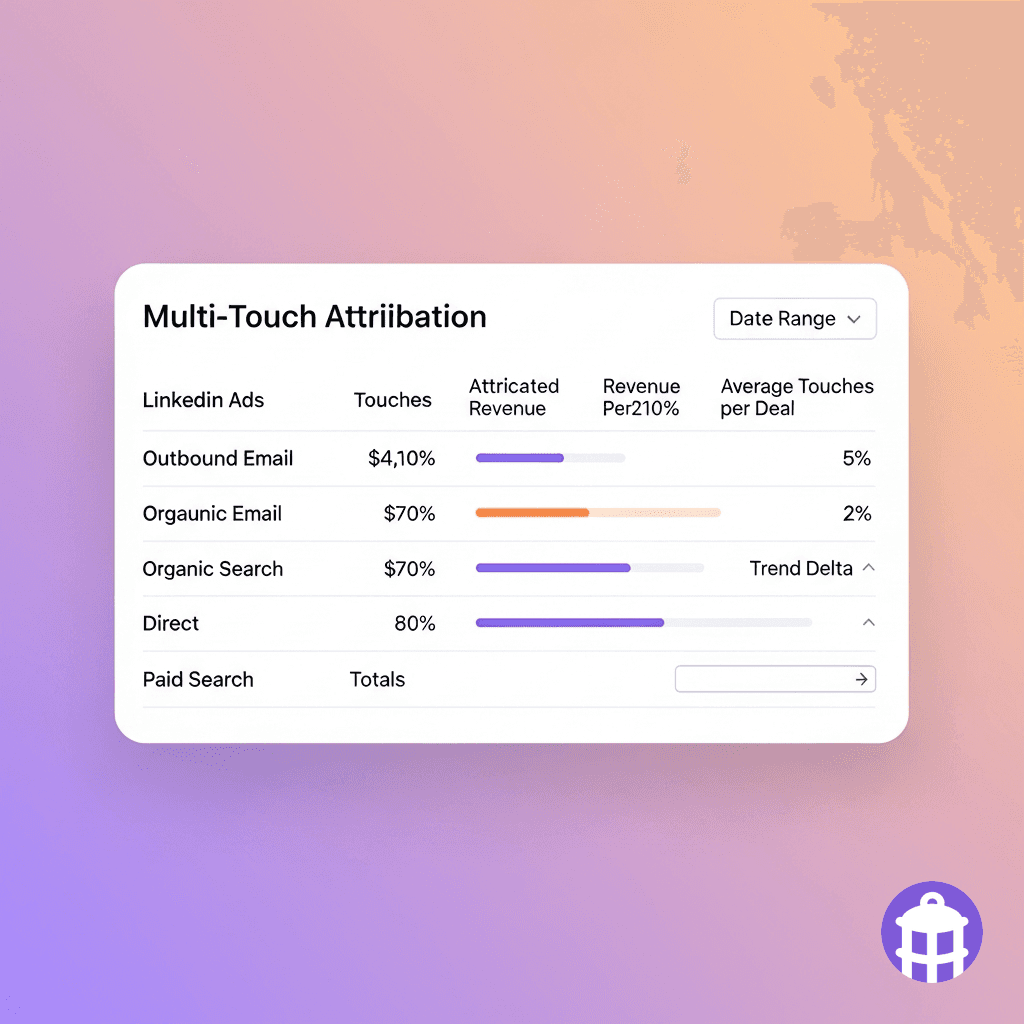
W-shaped attribution, Q1 2026 closed-won ($2.4M): LinkedIn Ads 31% ($744K), Outbound Email 24% ($576K), Organic Search 19% ($456K), Direct/None 14% ($336K), Paid Search 12% ($288K). Top-performing campaign: 'RevOps Efficiency' LinkedIn — $312K attributed.

Attributes revenue across channels and campaigns

Last-touch attribution is easy to implement and almost always wrong. A deal that took six months and a dozen touches doesn't owe its existence to the last LinkedIn ad the champion clicked. The agent supports configurable multi-touch attribution models — linear, time-decay, W-shaped, and custom weighting — applied consistently across all channel data connected to Lantern. Revenue credit is distributed across every tracked touchpoint in the path, giving a defensible answer to which channels and campaigns contributed to closed deals rather than which ones happened to touch them last. Attribution data feeds directly into the budget allocation and channel prioritization views.

W-shaped attribution, Q1 2026 closed-won ($2.4M): LinkedIn Ads 31% ($744K), Outbound Email 24% ($576K), Organic Search 19% ($456K), Direct/None 14% ($336K), Paid Search 12% ($288K). Top-performing campaign: 'RevOps Efficiency' LinkedIn — $312K attributed.

Segments performance by ICP dimension and GTM motion

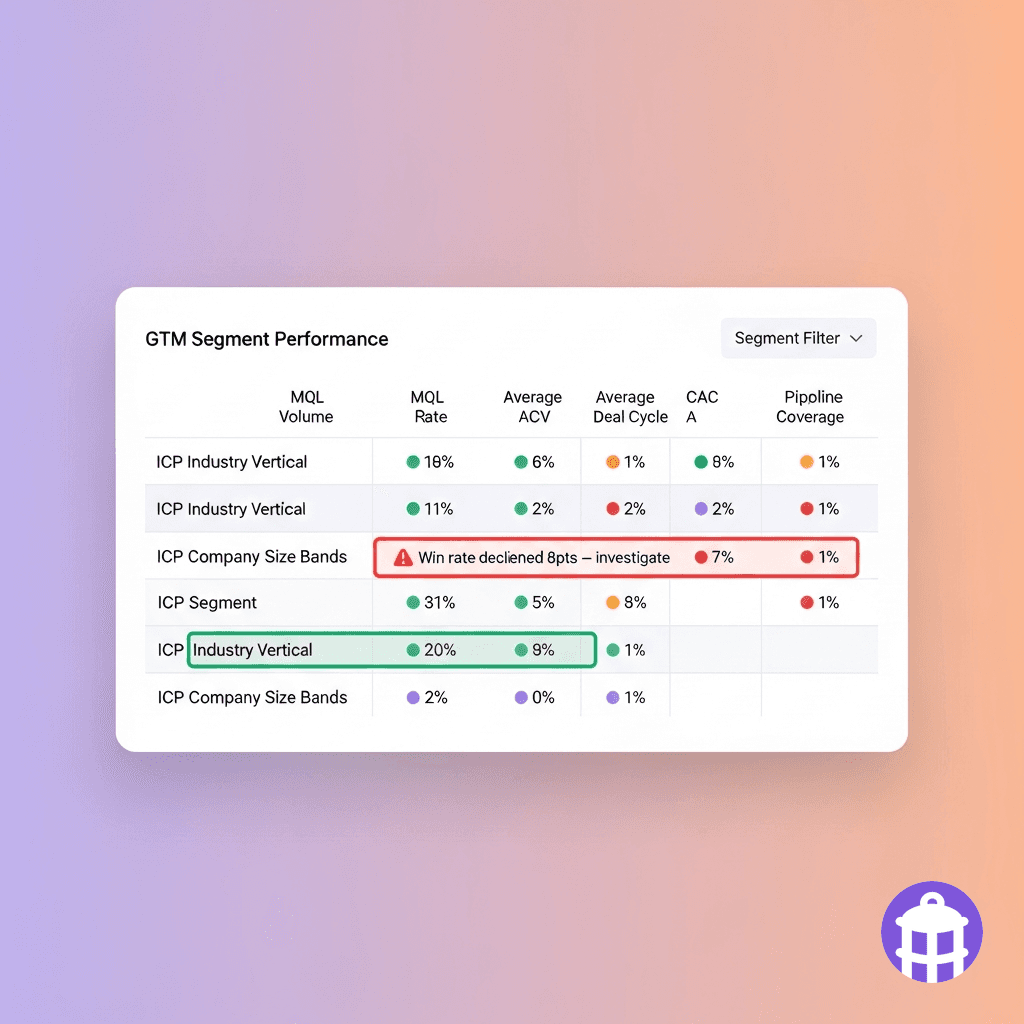
Aggregate funnel metrics hide the heterogeneity that makes GTM analysis actionable. A 28% win rate across all opportunities is a very different story if mid-market deals close at 42% and enterprise deals close at 14%. The agent slices every funnel metric by configurable dimensions — industry vertical, company size band, ACV tier, geographic region, GTM motion (inbound vs outbound vs PLG), and sales rep. Segment views reveal which ICP segments are the most efficient to acquire, which motions are working by segment, and where resources are concentrated versus where they generate the most revenue. Insights are surfaced automatically as anomalies rather than requiring manual cross-tab analysis.

Segment analysis: Mid-market (100–500 employees) win rate 41% vs Enterprise (500+) 17%. Outbound-sourced deals average 63 days to close vs Inbound-sourced 38 days. Top-performing vertical by CAC efficiency: Financial Services ($8,200 CAC, $94K ACV). Flagged anomaly: SaaS vertical win rate declined 8 points in 60 days.

Segments performance by ICP dimension and GTM motion

Aggregate funnel metrics hide the heterogeneity that makes GTM analysis actionable. A 28% win rate across all opportunities is a very different story if mid-market deals close at 42% and enterprise deals close at 14%. The agent slices every funnel metric by configurable dimensions — industry vertical, company size band, ACV tier, geographic region, GTM motion (inbound vs outbound vs PLG), and sales rep. Segment views reveal which ICP segments are the most efficient to acquire, which motions are working by segment, and where resources are concentrated versus where they generate the most revenue. Insights are surfaced automatically as anomalies rather than requiring manual cross-tab analysis.

Segment analysis: Mid-market (100–500 employees) win rate 41% vs Enterprise (500+) 17%. Outbound-sourced deals average 63 days to close vs Inbound-sourced 38 days. Top-performing vertical by CAC efficiency: Financial Services ($8,200 CAC, $94K ACV). Flagged anomaly: SaaS vertical win rate declined 8 points in 60 days.

Surfaces actionable insights and trend alerts automatically

A performance analysis tool that requires a weekly manual review meeting to produce insights isn't a system — it's a reporting layer. The agent monitors GTM metrics continuously and surfaces anomalies, trend breaks, and optimization opportunities as they emerge. When a channel's CAC spikes 40% in a two-week window, the relevant team gets an alert with context — which campaigns, which segments, and what changed. When a deal stage conversion rate drops below the historical baseline, the alert includes the segment breakdown so the owner can diagnose whether it's a rep performance issue, a product-market fit gap, or a campaign targeting problem. Insights arrive as actionable observations, not raw numbers.

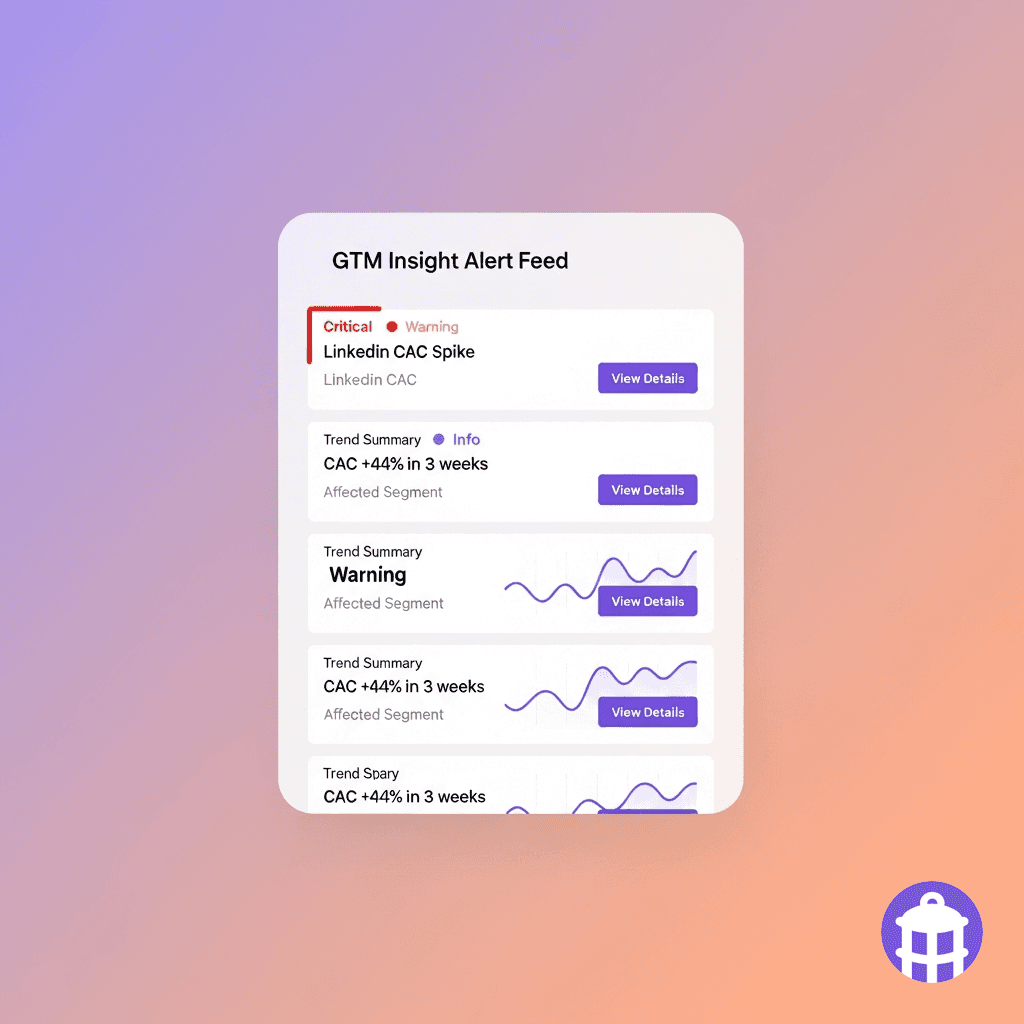
GTM alert (Apr 4): LinkedIn Ads CAC increased 44% in past 3 weeks ($6,200 → $8,940). Driven by: Mid-market segment CPL increase (+61%). Top affected campaigns: 'Q1 Pipeline Push' and 'RevOps Buyer'. Recommended action: pause underperforming ad sets, shift budget to 'Data Quality' campaign (+23% ROAS).

Surfaces actionable insights and trend alerts automatically

A performance analysis tool that requires a weekly manual review meeting to produce insights isn't a system — it's a reporting layer. The agent monitors GTM metrics continuously and surfaces anomalies, trend breaks, and optimization opportunities as they emerge. When a channel's CAC spikes 40% in a two-week window, the relevant team gets an alert with context — which campaigns, which segments, and what changed. When a deal stage conversion rate drops below the historical baseline, the alert includes the segment breakdown so the owner can diagnose whether it's a rep performance issue, a product-market fit gap, or a campaign targeting problem. Insights arrive as actionable observations, not raw numbers.

GTM alert (Apr 4): LinkedIn Ads CAC increased 44% in past 3 weeks ($6,200 → $8,940). Driven by: Mid-market segment CPL increase (+61%). Top affected campaigns: 'Q1 Pipeline Push' and 'RevOps Buyer'. Recommended action: pause underperforming ad sets, shift budget to 'Data Quality' campaign (+23% ROAS).

Today vs. with

Today vs. with

Analyze GTM Performance

Analyze GTM Performance

Today

Marketing, sales, and finance each have their own pipeline and revenue reports — nobody agrees on the numbers and nobody can reconcile them

Attribution is last-touch by default — the last channel before a deal closes gets credit for everything, distorting budget decisions

Performance analysis happens in weekly review meetings where someone pulled the report an hour before — insights are reactive and slow

With ABM Strategist

Unified funnel model traces every deal from first touch to closed revenue with consistent definitions and a single source of truth across all teams

Multi-touch attribution with configurable models (W-shaped, time-decay, linear) distributes revenue credit across every touchpoint in the deal path

Continuous automated monitoring with anomaly detection alerts the right person the moment a metric breaks from its historical pattern

Three layers, one platform by Lantern

Three layers, one platform by Lantern

Every agent runs on three layers: a unified data model, 150+ enrichment providers, and an open-source engine where every decision is auditable.

Every agent runs on three layers: a unified data model, 150+ enrichment providers, and an open-source engine where every decision is auditable.

Data Waterfall

150+ enrichment providers. Sequential routing optimized per segment. The best answer wins. No vendor lock-in.

Agent Engine

Open-source execution engine. Workflows defined in code. Human-in-the-loop checkpoints. Full audit trail on every action.

Revenue Ontology

Every data source normalized into one model. Entity resolution across systems. Relationships stored, not inferred. Schema that evolves with your business.

FAQ

FAQ

Does setup require a data engineering team?

Which attribution models are supported?

How does it handle offline touches like in-person events or phone calls?

How far back does historical analysis go?

Stop allocating budget on instinct — know exactly which motions generate revenue and which ones generate noise.

Stop allocating budget on instinct — know exactly which motions generate revenue and which ones generate noise.

USE CASES

Revenue Team

Marketing Team

Customer Success

PRICING

Pricing

RESOURCES

Blog

About Lantern

Status

Support

© LANTERN 2025

Terms

Privacy

Linkedin

USE CASES

Revenue Team

Marketing Team

Customer Success

PRICING

Pricing

RESOURCES

Blog

About Lantern

Status

Support

© LANTERN 2025

Terms

Privacy

Linkedin

USE CASES

Revenue Team

Marketing Team

Customer Success

PRICING

Pricing

RESOURCES

Blog

About Lantern

Status

Support

© LANTERN 2025

Terms

Privacy

Linkedin