
Operate
Spy on Programmatic SEO
Spy on Programmatic SEO
See exactly how competitors are scaling organic traffic programmatically — and where their programs are vulnerable.
See exactly how competitors are scaling organic traffic programmatically — and where their programs are vulnerable.
Distinct programmatic SEO programs the average B2B SaaS competitor is running — most hidden in plain sight until you know what signals to look for.
Distinct programmatic SEO programs the average B2B SaaS competitor is running — most hidden in plain sight until you know what signals to look for.

THE brıef
The fastest way to design a winning programmatic SEO program is to study the ones already working in your category. The Spy on Programmatic SEO agent reverse-engineers competitor programmatic SEO efforts — identifying which templates they're using, which keyword patterns drive traffic, estimated page counts, content structure, data sources, and where their programs have quality gaps your program can exploit.
Detects and catalogs competitor programmatic programs
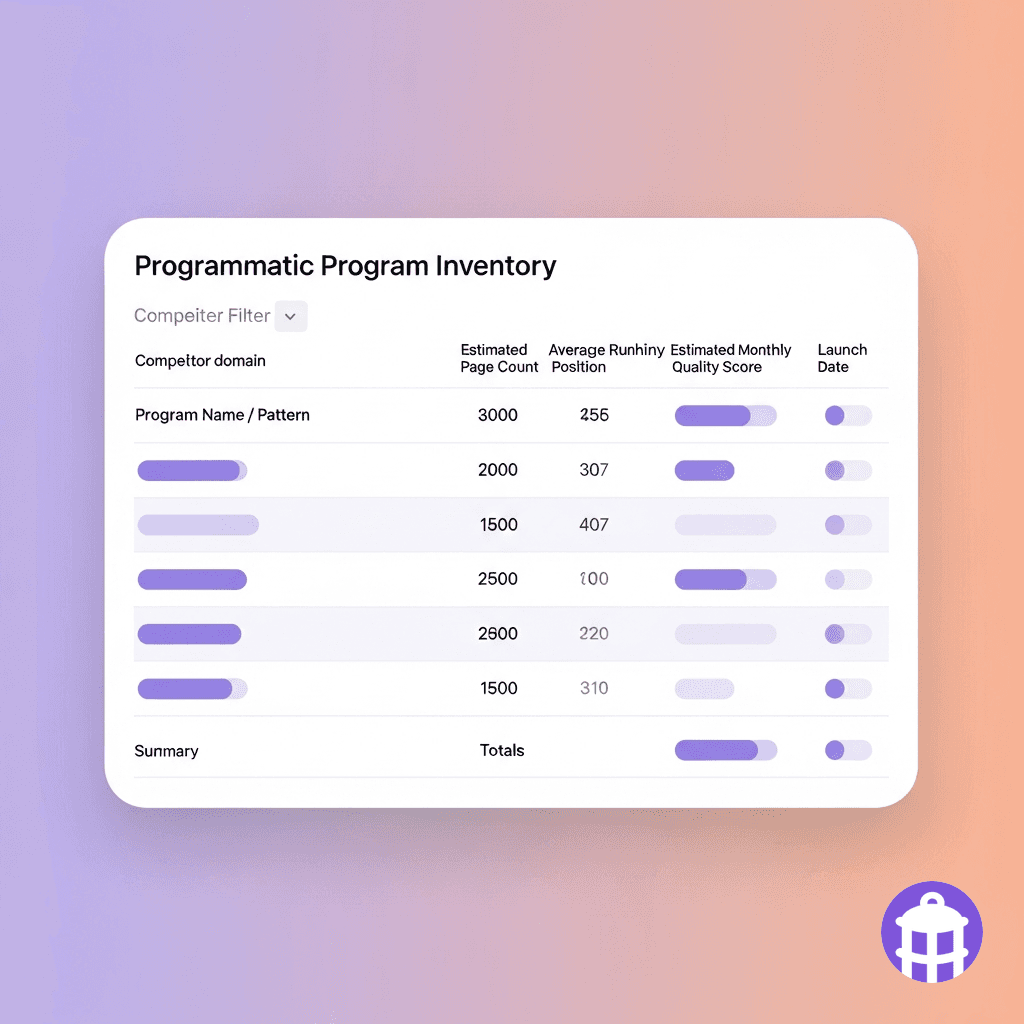
Programmatic pages have distinctive signals — consistent URL patterns, templated heading structures, repeated schema markup, and data-populated content with predictable variation across a keyword pattern. The agent scans competitor domains to identify pages matching these signals, clusters them into discrete programs, and catalogs each program by keyword pattern, estimated page count, template structure, and indexed coverage. For a typical B2B SaaS company, this surfaces 3–8 distinct programmatic programs across 2–5 competitor domains — giving you a comprehensive map of the programmatic landscape in your category before you invest in your own build.
Outreach.io programmatic SEO audit: 4 distinct programs detected. (1) '[Competitor] alternatives' — 67 pages indexed, avg pos 8.3, est. 12,400 monthly organic visits. (2) '[City] sales engagement software' — 312 pages, avg pos 14.1, est. 8,700 visits. (3) 'Sales engagement for [industry]' — 28 pages, est. 2,100 visits. (4) '[Feature] software' comparison pages — 44 pages, est. 3,800 visits.
Detects and catalogs competitor programmatic programs
Programmatic pages have distinctive signals — consistent URL patterns, templated heading structures, repeated schema markup, and data-populated content with predictable variation across a keyword pattern. The agent scans competitor domains to identify pages matching these signals, clusters them into discrete programs, and catalogs each program by keyword pattern, estimated page count, template structure, and indexed coverage. For a typical B2B SaaS company, this surfaces 3–8 distinct programmatic programs across 2–5 competitor domains — giving you a comprehensive map of the programmatic landscape in your category before you invest in your own build.
Outreach.io programmatic SEO audit: 4 distinct programs detected. (1) '[Competitor] alternatives' — 67 pages indexed, avg pos 8.3, est. 12,400 monthly organic visits. (2) '[City] sales engagement software' — 312 pages, avg pos 14.1, est. 8,700 visits. (3) 'Sales engagement for [industry]' — 28 pages, est. 2,100 visits. (4) '[Feature] software' comparison pages — 44 pages, est. 3,800 visits.
Analyzes template structure and content patterns
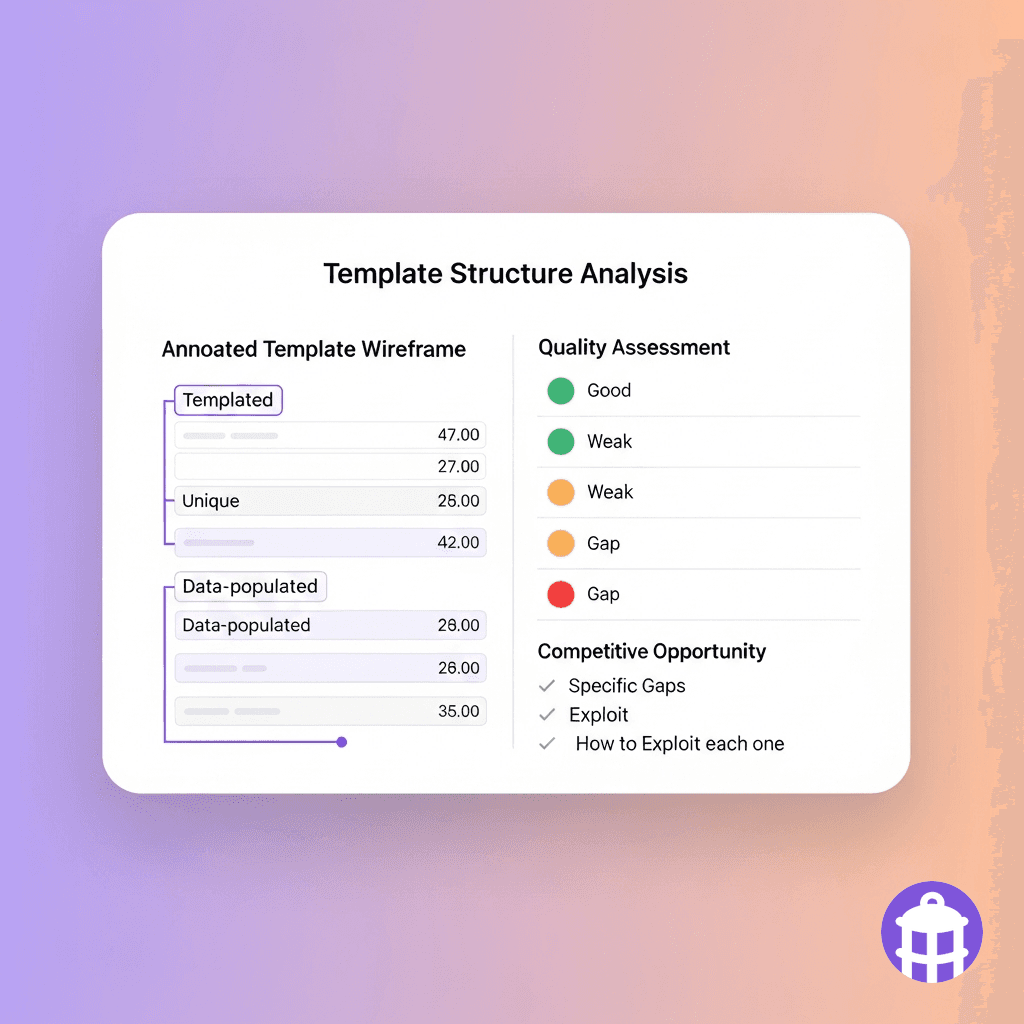
Understanding what a competitor's programmatic template looks like is more valuable than knowing it exists. The agent extracts the template structure from a representative sample of each competitor's programmatic pages: heading hierarchy, word count range, section types (hero, comparison table, FAQ, CTA), unique content elements versus templated copy, internal link patterns, and schema markup. This template analysis reveals both what's working in the SERP and where the competitor has taken quality shortcuts — templated sections with minimal unique content, data fields that are sparse or inaccurate, and structural patterns that could be improved to rank above their pages. Your template brief is built from what's already proven to work, with specific improvements over current competitors.
'[Competitor] alternatives' template analysis (Outreach.io): Structure: H1 + intro (templated, 180 words avg), comparison table (6 rows, data-populated), 4 H2 verdict sections (unique per page, avg 280 words each), FAQ (5 questions, templated answers). Quality gaps: comparison table prices are 6+ months stale, verdict sections generic (no first-hand perspective). Schema: FAQ only (missing Review schema — opportunity). Avg word count: 1,840.
Analyzes template structure and content patterns
Understanding what a competitor's programmatic template looks like is more valuable than knowing it exists. The agent extracts the template structure from a representative sample of each competitor's programmatic pages: heading hierarchy, word count range, section types (hero, comparison table, FAQ, CTA), unique content elements versus templated copy, internal link patterns, and schema markup. This template analysis reveals both what's working in the SERP and where the competitor has taken quality shortcuts — templated sections with minimal unique content, data fields that are sparse or inaccurate, and structural patterns that could be improved to rank above their pages. Your template brief is built from what's already proven to work, with specific improvements over current competitors.
'[Competitor] alternatives' template analysis (Outreach.io): Structure: H1 + intro (templated, 180 words avg), comparison table (6 rows, data-populated), 4 H2 verdict sections (unique per page, avg 280 words each), FAQ (5 questions, templated answers). Quality gaps: comparison table prices are 6+ months stale, verdict sections generic (no first-hand perspective). Schema: FAQ only (missing Review schema — opportunity). Avg word count: 1,840.
Estimates traffic performance and keyword coverage
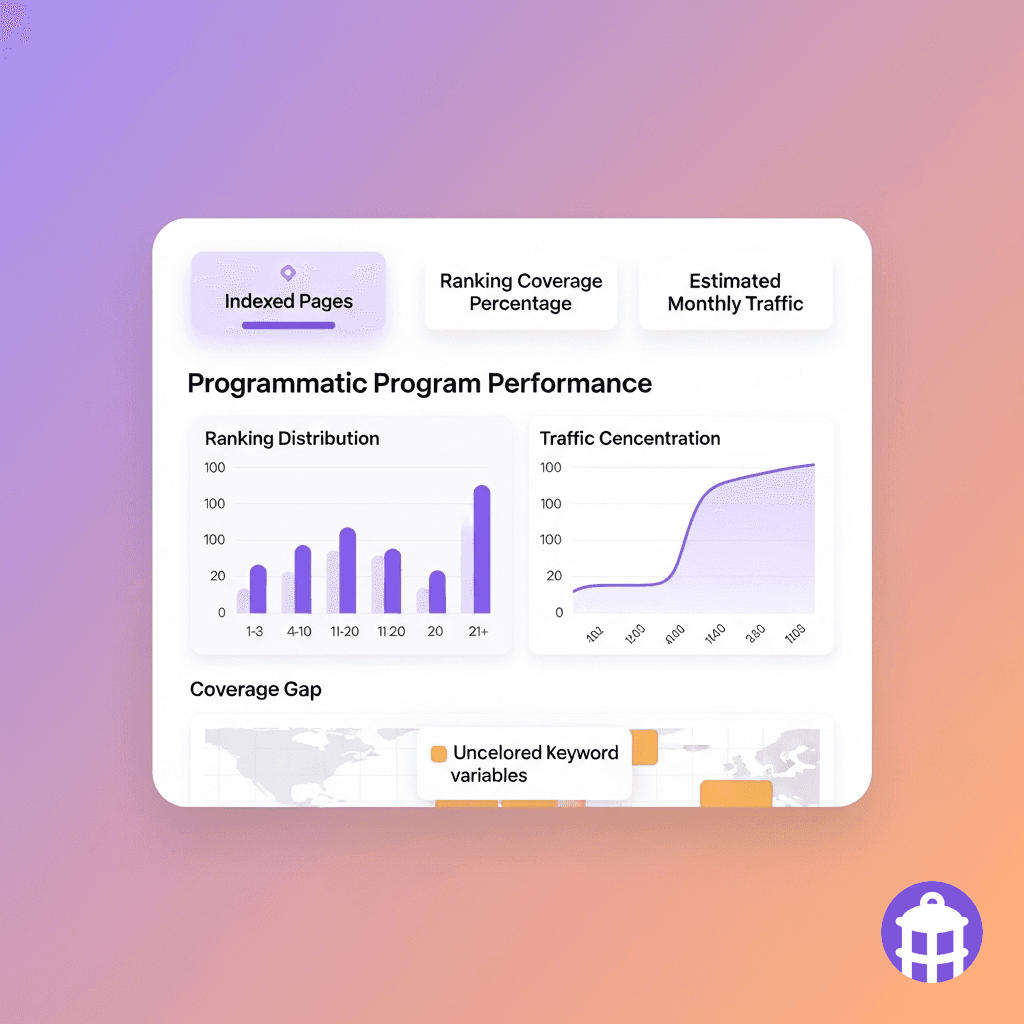
A programmatic program with 300 pages but poor keyword coverage across its variable space is underperforming its potential — which is an opportunity. The agent estimates traffic per program using rank tracking data, search volume per keyword pattern variable, and CTR modeling by position. It then calculates keyword coverage: out of all viable variables in the pattern, what percentage has the competitor actually indexed, and at what quality level. Programs with high page counts but poor coverage (lots of pages, most not ranking) signal a quality execution problem you can capitalize on. Programs with high coverage and strong average positions signal a well-executing competitor you need to outperform structurally.
Salesloft '[city] sales engagement' program: 312 pages indexed. Keyword coverage: 41% of viable city variables (coverage gap: 184 cities not targeted). Ranking performance: top 10 in 23% of indexed pages, top 20 in 61%. Traffic concentration: top 50 pages account for 78% of traffic — long tail underperforming. Quality issue: city-specific content on page 200+ is 40% shorter than pages 1–50.
Estimates traffic performance and keyword coverage
A programmatic program with 300 pages but poor keyword coverage across its variable space is underperforming its potential — which is an opportunity. The agent estimates traffic per program using rank tracking data, search volume per keyword pattern variable, and CTR modeling by position. It then calculates keyword coverage: out of all viable variables in the pattern, what percentage has the competitor actually indexed, and at what quality level. Programs with high page counts but poor coverage (lots of pages, most not ranking) signal a quality execution problem you can capitalize on. Programs with high coverage and strong average positions signal a well-executing competitor you need to outperform structurally.
Salesloft '[city] sales engagement' program: 312 pages indexed. Keyword coverage: 41% of viable city variables (coverage gap: 184 cities not targeted). Ranking performance: top 10 in 23% of indexed pages, top 20 in 61%. Traffic concentration: top 50 pages account for 78% of traffic — long tail underperforming. Quality issue: city-specific content on page 200+ is 40% shorter than pages 1–50.
Identifies exploitable gaps and strategic positioning opportunities
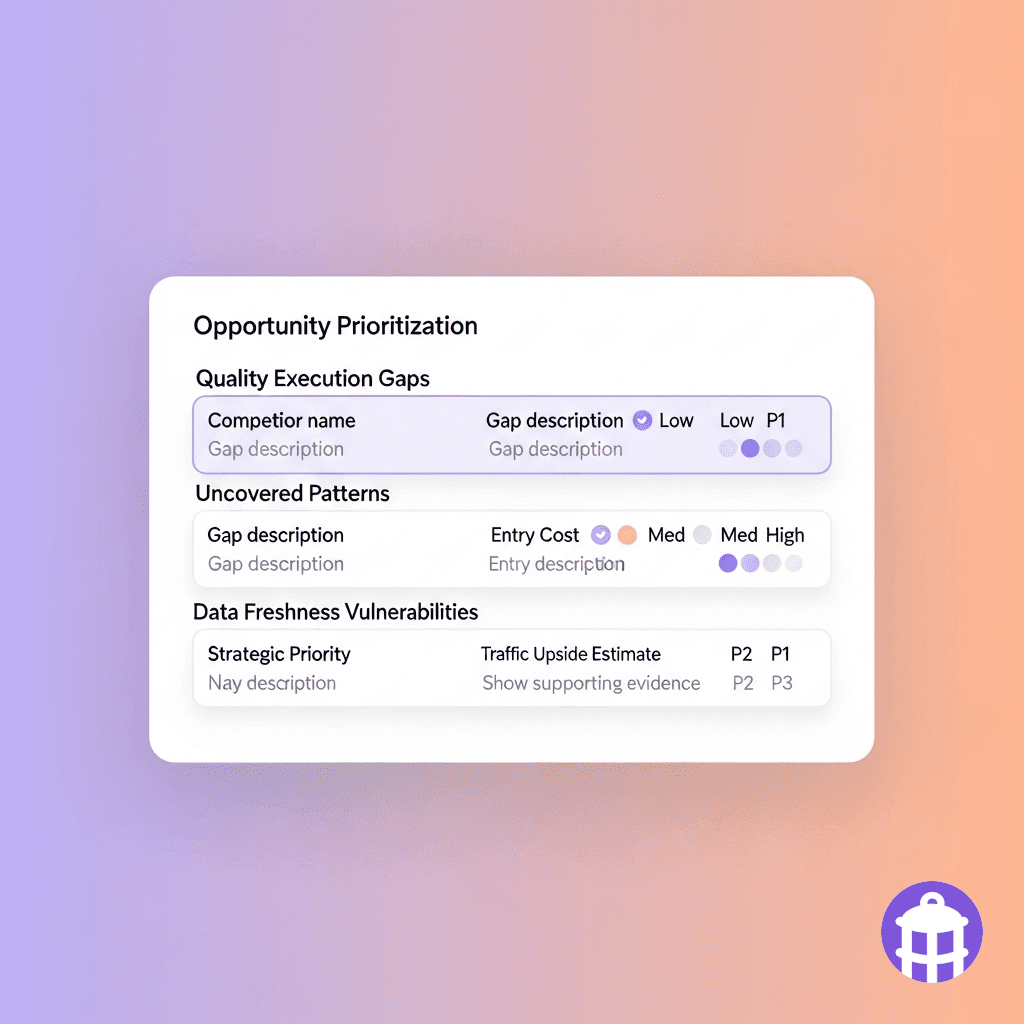
Competitive intelligence is only valuable if it translates into strategic decisions. The agent synthesizes competitor programmatic program analysis into a prioritized opportunity list: keyword patterns competitors are running poorly (high page count, low ranking coverage — quality execution gap you can beat), patterns competitors haven't entered that have significant search volume, template quality gaps where a structurally superior version would rank above theirs, and data freshness vulnerabilities where competitors' pages have become stale enough to be displaced. Each opportunity is scored on entry cost and upside, so your programmatic roadmap is built on market gaps rather than speculation.
Priority programmatic opportunities identified: (1) '[Competitor] alternative' pattern — 3 competitors running low-quality templates, avg quality score 54/100. High-quality entrant can rank above all 3. Entry: medium (data sourcing). (2) 'Sales engagement for [industry]' — only 1 competitor present, 18 untargeted industries. (3) '[City] outbound sales' — uncovered by all competitors in 200+ cities. Highest upside gap.
Identifies exploitable gaps and strategic positioning opportunities
Competitive intelligence is only valuable if it translates into strategic decisions. The agent synthesizes competitor programmatic program analysis into a prioritized opportunity list: keyword patterns competitors are running poorly (high page count, low ranking coverage — quality execution gap you can beat), patterns competitors haven't entered that have significant search volume, template quality gaps where a structurally superior version would rank above theirs, and data freshness vulnerabilities where competitors' pages have become stale enough to be displaced. Each opportunity is scored on entry cost and upside, so your programmatic roadmap is built on market gaps rather than speculation.
Priority programmatic opportunities identified: (1) '[Competitor] alternative' pattern — 3 competitors running low-quality templates, avg quality score 54/100. High-quality entrant can rank above all 3. Entry: medium (data sourcing). (2) 'Sales engagement for [industry]' — only 1 competitor present, 18 untargeted industries. (3) '[City] outbound sales' — uncovered by all competitors in 200+ cities. Highest upside gap.
Today vs. with
Today vs. with
Spy on Programmatic SEO
Spy on Programmatic SEO
Today
Teams aware competitors have 'a lot of landing pages' but no systematic view of what patterns, quality, or traffic they represent
Programmatic SEO strategy designed without knowing which template structures are already working in the category's SERPs
No visibility into which competitor programs are underperforming and where organic traffic opportunity is unclaimed

With ABM Strategist
Complete catalog of competitor programmatic programs — keyword patterns, page counts, ranking performance, and quality scores
Template analysis from top-performing competitor programs — structural patterns proven to rank, with specific quality gaps your version can improve on
Coverage gap analysis and quality execution scoring per program — prioritized list of opportunities ranked by entry cost and traffic upside
Works with
Works with
Plan Programmatic SEO
Designs your programmatic SEO architecture using competitor intelligence as the foundation — build on what's proven to work.
Find SEO Opportunities
Identifies the full keyword opportunity landscape, including non-programmatic gaps, to complement programmatic strategy.
Monitor Competitors
Tracks competitor programmatic program changes over time as part of broader ongoing competitive monitoring.
Three layers, one platform by Lantern
Three layers, one platform by Lantern
Every agent runs on three layers: a unified data model, 150+ enrichment providers, and an open-source engine where every decision is auditable.
Every agent runs on three layers: a unified data model, 150+ enrichment providers, and an open-source engine where every decision is auditable.
Data Waterfall
150+ enrichment providers. Sequential routing optimized per segment. The best answer wins. No vendor lock-in.

Agent Engine
Open-source execution engine. Workflows defined in code. Human-in-the-loop checkpoints. Full audit trail on every action.

Revenue Ontology
Every data source normalized into one model. Entity resolution across systems. Relationships stored, not inferred. Schema that evolves with your business.
FAQ
FAQ
How does the agent detect programmatic pages versus regular content?
Can it analyze programmatic programs in non-English languages?
How current is the analysis?
What if a competitor uses JavaScript rendering for their programmatic pages?

Your competitors built a traffic machine in public — study it before you build yours.
Your competitors built a traffic machine in public — study it before you build yours.