
Operate

Prioritize Paid Channels

Prioritize Paid Channels

Decide which paid channels deserve your budget based on what they actually generate — not what the platforms claim.

Decide which paid channels deserve your budget based on what they actually generate — not what the platforms claim.

average additional pipeline per quarter projected from implementing data-driven channel tier recommendations versus maintaining status quo allocation based on habit and platform-reported ROAS.

average additional pipeline per quarter projected from implementing data-driven channel tier recommendations versus maintaining status quo allocation based on habit and platform-reported ROAS.

THE brıef

Budget allocation across paid channels is one of the most consequential and least rigorous decisions in B2B marketing. Teams often distribute spend based on where they've always spent, what the channel reps tell them, or the most recent campaign that happened to perform well. The Prioritize Paid Channels agent evaluates every paid channel on a consistent framework — CAC, LTV, pipeline contribution, sales cycle influence, and payback period — calculated from CRM-verified data, not platform-reported metrics. The output is a channel tier ranking with specific budget guidance, not a general recommendation to 'test more channels.'
Measures CAC and payback period per channel from CRM data

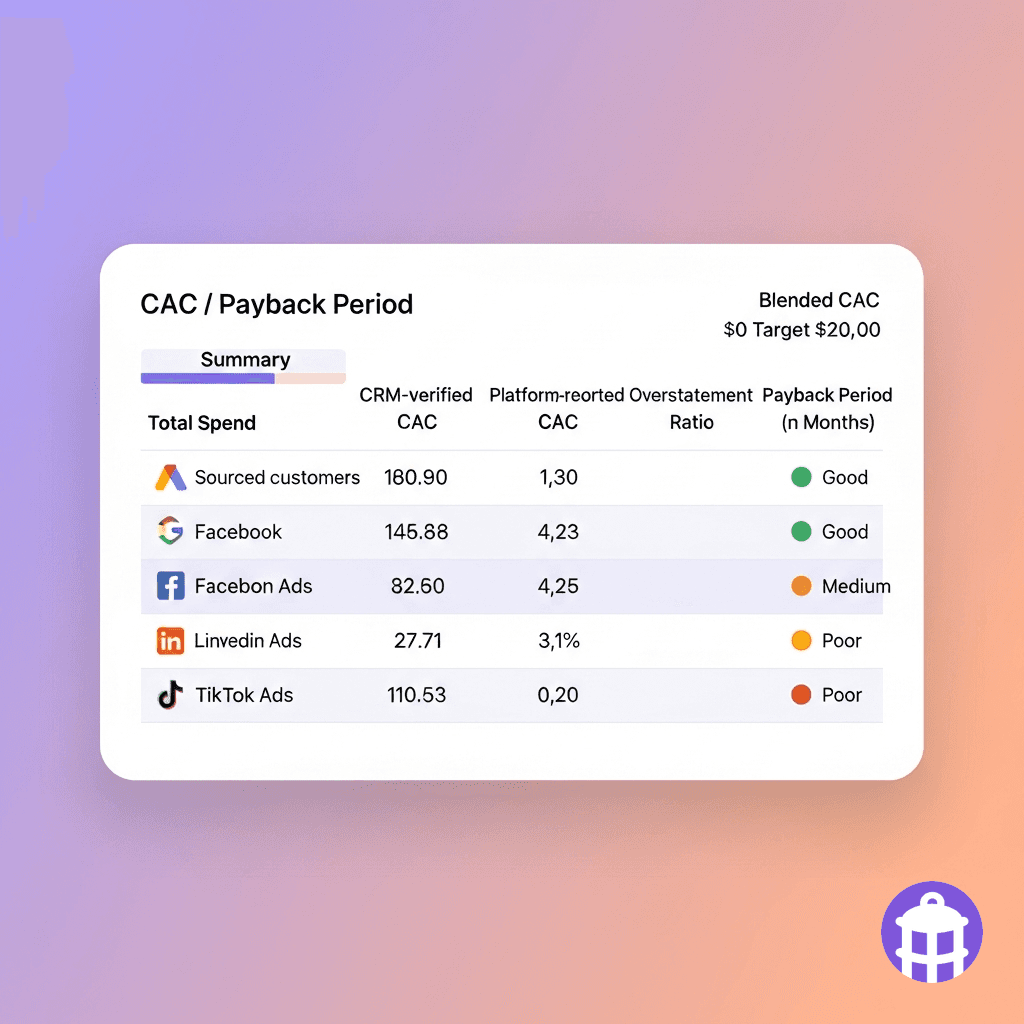
Customer acquisition cost as reported by ad platforms is almost always wrong for B2B — it's calculated from platform-side conversion events that overcount touches and inflate attribution. The agent calculates CAC from the ground up using CRM-verified data: total spend per channel in a period, divided by the number of new customers sourced by that channel based on CRM opportunity attribution. Payback period is calculated using the median ACV of channel-sourced deals and the gross margin of the product. These two metrics — real CAC and real payback period — are the foundation of the channel evaluation model and cannot be calculated accurately without connecting ad spend data to CRM deal data.

CAC by channel (Q1 2026, CRM-verified): LinkedIn: $7,940 CAC, 9.4mo payback. Google Search: $5,200 CAC, 6.1mo payback. Content/Organic: $2,800 CAC, 3.3mo payback. Meta Retargeting: $4,100 CAC, 4.9mo payback. Events/Field: $11,200 CAC, 13.2mo payback. Industry benchmark (SaaS, $30K ACV): target CAC $6,000–$9,000.

Measures CAC and payback period per channel from CRM data

Customer acquisition cost as reported by ad platforms is almost always wrong for B2B — it's calculated from platform-side conversion events that overcount touches and inflate attribution. The agent calculates CAC from the ground up using CRM-verified data: total spend per channel in a period, divided by the number of new customers sourced by that channel based on CRM opportunity attribution. Payback period is calculated using the median ACV of channel-sourced deals and the gross margin of the product. These two metrics — real CAC and real payback period — are the foundation of the channel evaluation model and cannot be calculated accurately without connecting ad spend data to CRM deal data.

CAC by channel (Q1 2026, CRM-verified): LinkedIn: $7,940 CAC, 9.4mo payback. Google Search: $5,200 CAC, 6.1mo payback. Content/Organic: $2,800 CAC, 3.3mo payback. Meta Retargeting: $4,100 CAC, 4.9mo payback. Events/Field: $11,200 CAC, 13.2mo payback. Industry benchmark (SaaS, $30K ACV): target CAC $6,000–$9,000.

Evaluates pipeline contribution and sales cycle influence

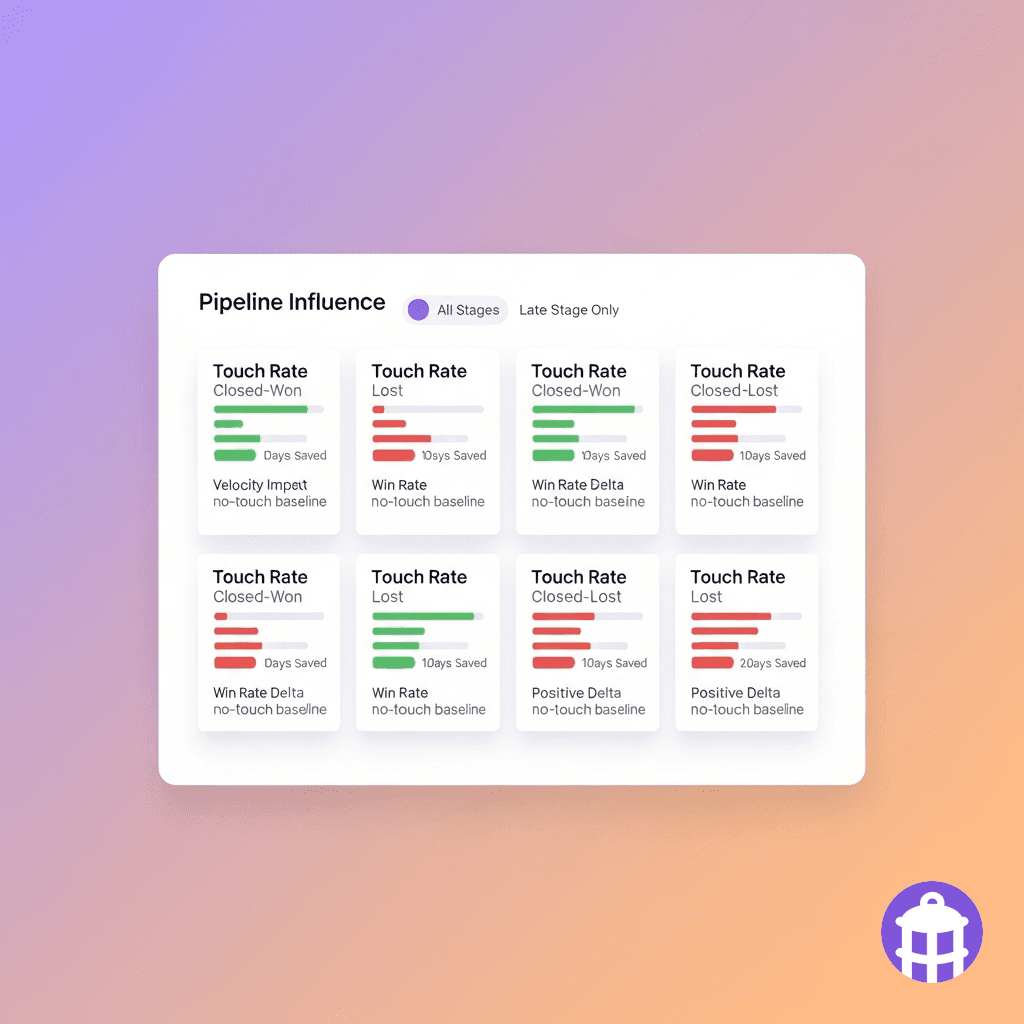
CAC measures efficiency for closed deals, but not every paid channel's value is captured at the bottom of the funnel. Some channels contribute most of their value in the middle of the sales cycle — keeping deals warm, reaching buying committee members who aren't directly engaged with the sales team, and accelerating deal velocity rather than sourcing net-new pipeline. The agent evaluates multi-touch pipeline contribution for each channel: how many opportunities had a paid touch from this channel, at what stage, and did those opportunities convert at a higher rate or faster velocity than opportunities without a touch from this channel. Channels that show strong mid-funnel influence — even when their sourced-pipeline CAC is high — are distinguished from channels that look good on paper but have no detectable influence on pipeline outcomes.

Pipeline influence analysis, Q1 2026: LinkedIn Ads — touched 67% of closed-won opps (vs 34% for closed-lost). Deals with LinkedIn mid-funnel touch: 18% faster velocity, 11% higher win rate. Google Search — primarily sourcing opps (low mid-funnel touch rate). Meta Retargeting — strong mid-funnel influence on deals sourced by other channels (34% touch rate on late-stage opps).

Evaluates pipeline contribution and sales cycle influence

CAC measures efficiency for closed deals, but not every paid channel's value is captured at the bottom of the funnel. Some channels contribute most of their value in the middle of the sales cycle — keeping deals warm, reaching buying committee members who aren't directly engaged with the sales team, and accelerating deal velocity rather than sourcing net-new pipeline. The agent evaluates multi-touch pipeline contribution for each channel: how many opportunities had a paid touch from this channel, at what stage, and did those opportunities convert at a higher rate or faster velocity than opportunities without a touch from this channel. Channels that show strong mid-funnel influence — even when their sourced-pipeline CAC is high — are distinguished from channels that look good on paper but have no detectable influence on pipeline outcomes.

Pipeline influence analysis, Q1 2026: LinkedIn Ads — touched 67% of closed-won opps (vs 34% for closed-lost). Deals with LinkedIn mid-funnel touch: 18% faster velocity, 11% higher win rate. Google Search — primarily sourcing opps (low mid-funnel touch rate). Meta Retargeting — strong mid-funnel influence on deals sourced by other channels (34% touch rate on late-stage opps).

Ranks channels by LTV-adjusted ROI

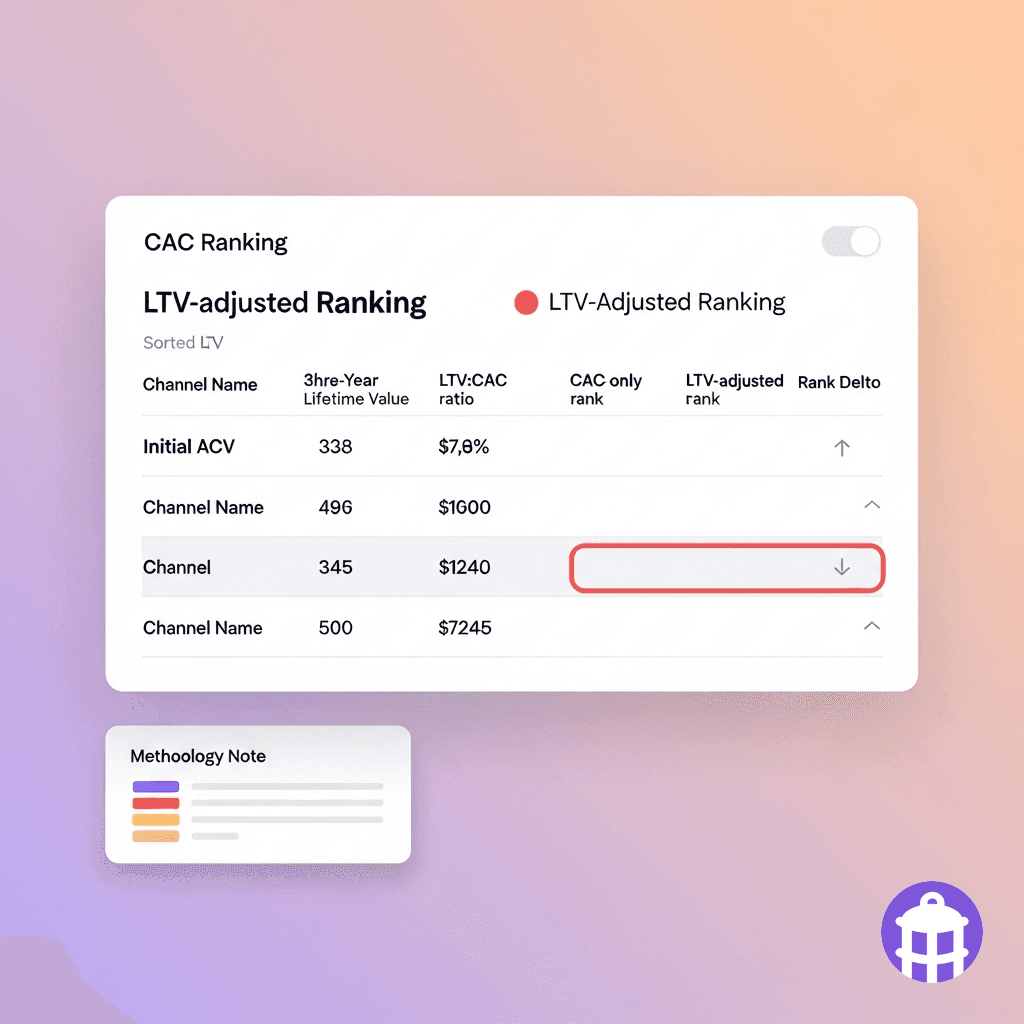
CAC-only channel evaluation misses the customer lifetime dimension — a channel that delivers higher CAC deals may be acquiring customers with higher LTV, lower churn, and stronger expansion behavior that makes the economics more favorable over a 3-year horizon than a lower-CAC channel acquiring churner-profile customers. The agent calculates LTV by channel cohort using CRM retention data and expansion revenue history, and adjusts the channel ROI calculation to reflect LTV rather than just initial ACV. The LTV-adjusted ranking can differ materially from the simple CAC ranking — a channel that looks inefficient on a CAC basis may rank first on a 3-year LTV basis, and vice versa. Both rankings are shown with the methodology made explicit.

LTV-adjusted channel ranking (3-year LTV model): Content/Organic — LTV $94K, LTV:CAC 33.6× (rank 1). Google Search — LTV $82K, LTV:CAC 15.8× (rank 2). Meta Retargeting — LTV $71K, LTV:CAC 17.3× (rank 3). LinkedIn Ads — LTV $88K, LTV:CAC 11.1× (rank 4). Events/Field — LTV $103K, LTV:CAC 9.2× (rank 5). Note: Events rank 5 on LTV:CAC but deliver highest absolute LTV — recommended for enterprise segment only.

Ranks channels by LTV-adjusted ROI

CAC-only channel evaluation misses the customer lifetime dimension — a channel that delivers higher CAC deals may be acquiring customers with higher LTV, lower churn, and stronger expansion behavior that makes the economics more favorable over a 3-year horizon than a lower-CAC channel acquiring churner-profile customers. The agent calculates LTV by channel cohort using CRM retention data and expansion revenue history, and adjusts the channel ROI calculation to reflect LTV rather than just initial ACV. The LTV-adjusted ranking can differ materially from the simple CAC ranking — a channel that looks inefficient on a CAC basis may rank first on a 3-year LTV basis, and vice versa. Both rankings are shown with the methodology made explicit.

LTV-adjusted channel ranking (3-year LTV model): Content/Organic — LTV $94K, LTV:CAC 33.6× (rank 1). Google Search — LTV $82K, LTV:CAC 15.8× (rank 2). Meta Retargeting — LTV $71K, LTV:CAC 17.3× (rank 3). LinkedIn Ads — LTV $88K, LTV:CAC 11.1× (rank 4). Events/Field — LTV $103K, LTV:CAC 9.2× (rank 5). Note: Events rank 5 on LTV:CAC but deliver highest absolute LTV — recommended for enterprise segment only.

Generates a channel tier recommendation with budget guidance

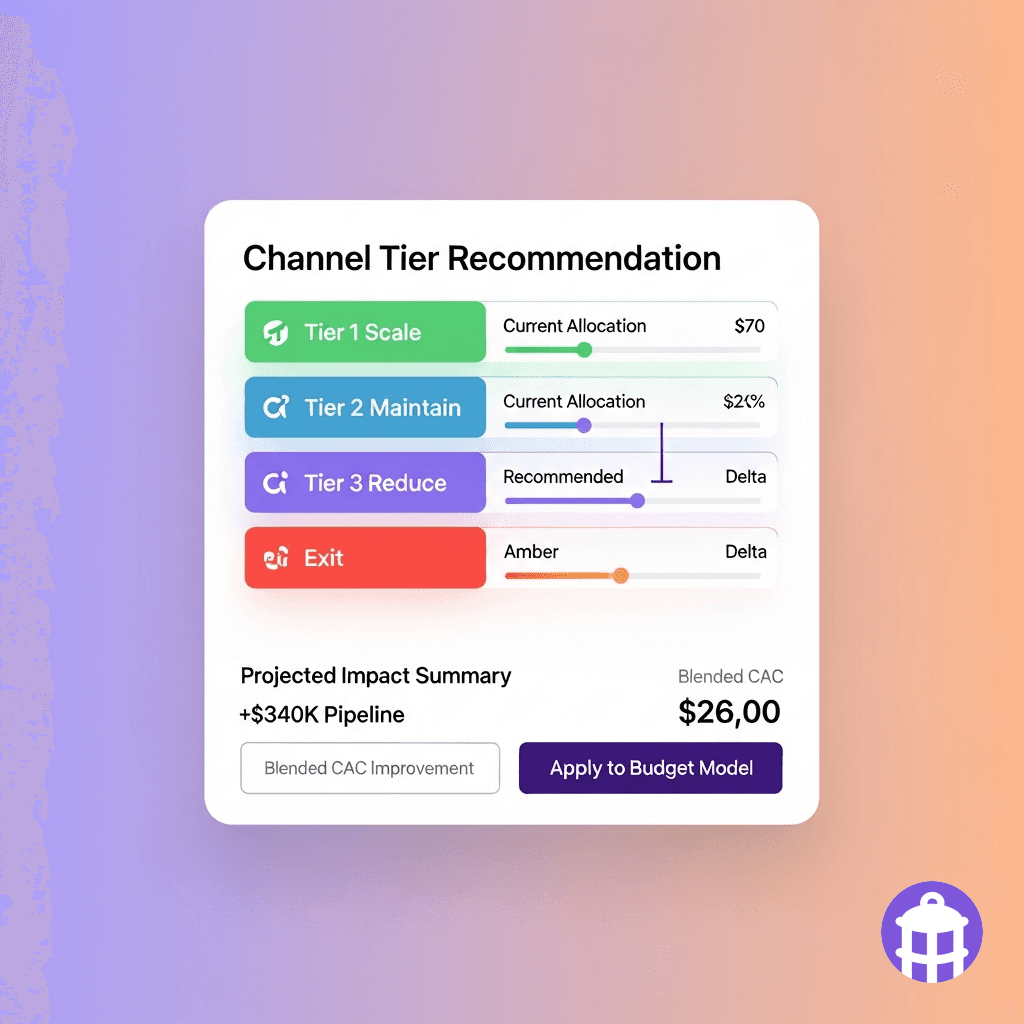
The output of channel evaluation is a decision, not a report. The agent synthesizes CAC, payback period, pipeline contribution, sales cycle influence, and LTV-adjusted ROI into a channel tier recommendation: Tier 1 channels (invest and scale), Tier 2 channels (maintain and optimize), Tier 3 channels (test or reduce), and channels to exit. For each tier, specific budget guidance is generated: the current allocation as a percentage of total paid spend, the recommended allocation with rationale, and the projected pipeline impact of implementing the recommended shift. The recommendation accounts for diversification risk — a framework that concentrates 90% of paid budget in one channel creates fragility even if that channel has the best current ROI.

Channel tier recommendation: Tier 1 (scale): Google Search (current 26%, recommended 35% — under-allocated vs marginal ROI), Content/Organic (boost SEO investment). Tier 2 (maintain): LinkedIn Ads (current 55%, recommend 45% — slight reduction, still primary pipeline source). Tier 3 (reduce): Events/Field (current 12%, recommend 8% — strong LTV but highest CAC). Exit: Meta Prospecting (performance below CAC target, low LTV cohort data). Projected impact of implementing recommendations: +$340K pipeline/quarter.

Generates a channel tier recommendation with budget guidance

The output of channel evaluation is a decision, not a report. The agent synthesizes CAC, payback period, pipeline contribution, sales cycle influence, and LTV-adjusted ROI into a channel tier recommendation: Tier 1 channels (invest and scale), Tier 2 channels (maintain and optimize), Tier 3 channels (test or reduce), and channels to exit. For each tier, specific budget guidance is generated: the current allocation as a percentage of total paid spend, the recommended allocation with rationale, and the projected pipeline impact of implementing the recommended shift. The recommendation accounts for diversification risk — a framework that concentrates 90% of paid budget in one channel creates fragility even if that channel has the best current ROI.

Channel tier recommendation: Tier 1 (scale): Google Search (current 26%, recommended 35% — under-allocated vs marginal ROI), Content/Organic (boost SEO investment). Tier 2 (maintain): LinkedIn Ads (current 55%, recommend 45% — slight reduction, still primary pipeline source). Tier 3 (reduce): Events/Field (current 12%, recommend 8% — strong LTV but highest CAC). Exit: Meta Prospecting (performance below CAC target, low LTV cohort data). Projected impact of implementing recommendations: +$340K pipeline/quarter.

Today vs. with

Today vs. with

Prioritize Paid Channels

Prioritize Paid Channels

Today

Channel budget allocation carried forward from last year with incremental adjustments — based on internal advocacy and platform-reported ROAS, not CRM-verified performance

All paid channels evaluated on the same CAC metric regardless of their role in the funnel — channels that accelerate deals rather than source them look inefficient

Channel concentration risk never formally evaluated — teams often have 60–70% of paid budget in one channel without a defensible rationale for that concentration

With ABM Strategist

CRM-verified CAC, payback period, and LTV calculated per channel — allocation decisions grounded in actual deal data, not platform attribution claims

Multi-touch pipeline contribution and sales cycle influence measured per channel — mid-funnel and acceleration channels evaluated on their actual role in deal outcomes

Channel tier recommendations account for diversification risk — allocation guidance that avoids single-channel fragility even when one channel currently leads on ROI

Three layers, one platform by Lantern

Three layers, one platform by Lantern

Every agent runs on three layers: a unified data model, 150+ enrichment providers, and an open-source engine where every decision is auditable.

Every agent runs on three layers: a unified data model, 150+ enrichment providers, and an open-source engine where every decision is auditable.

Data Waterfall

150+ enrichment providers. Sequential routing optimized per segment. The best answer wins. No vendor lock-in.

Agent Engine

Open-source execution engine. Workflows defined in code. Human-in-the-loop checkpoints. Full audit trail on every action.

Revenue Ontology

Every data source normalized into one model. Entity resolution across systems. Relationships stored, not inferred. Schema that evolves with your business.

FAQ

FAQ

How long does historical data need to be available before the channel ranking is reliable?

What if a channel is new and doesn't have enough historical data for the evaluation?

Does the model account for the fact that some channels work better together than independently?

How often should channel tier recommendations be revisited?

Every paid channel claims it's working — make them prove it in CRM-verified pipeline, then invest accordingly.

Every paid channel claims it's working — make them prove it in CRM-verified pipeline, then invest accordingly.

USE CASES

Revenue Team

Marketing Team

Customer Success

PRICING

Pricing

RESOURCES

Blog

About Lantern

Status

Support

© LANTERN 2025

Terms

Privacy

Linkedin

USE CASES

Revenue Team

Marketing Team

Customer Success

PRICING

Pricing

RESOURCES

Blog

About Lantern

Status

Support

© LANTERN 2025

Terms

Privacy

Linkedin

USE CASES

Revenue Team

Marketing Team

Customer Success

PRICING

Pricing

RESOURCES

Blog

About Lantern

Status

Support

© LANTERN 2025

Terms

Privacy

Linkedin