
Grow Customers

Coach Sales Reps

Coach Sales Reps

Specific coaching for individual reps — based on what their data actually shows.

Specific coaching for individual reps — based on what their data actually shows.

higher quota attainment in the 6 months following structured, data-driven coaching vs. standard monthly review cadences.

higher quota attainment in the 6 months following structured, data-driven coaching vs. standard monthly review cadences.

THE brıef

Most sales coaching is anecdotal, inconsistent, and disconnected from the activities that actually drive results. The Coach Sales Reps agent analyzes each rep's performance patterns — call quality, sequence engagement rates, stage conversion, objection handling, and activity mix — and generates specific, evidence-based coaching recommendations for each individual. It's skill development, not deal strategy.
Analyzes individual rep activity and conversion patterns

Aggregate sales metrics hide the patterns that matter for coaching. The agent breaks each rep's performance down by activity type and conversion outcome: call volume vs. call quality (measured by talk ratio, question frequency, and follow-up rate), email outreach vs. reply rate vs. meeting booked rate, stage-to-stage conversion vs. team benchmark, and pipeline generation vs. pipeline velocity. The goal isn't to produce a leaderboard — it's to identify the specific activities where each rep is stronger or weaker than the benchmark, so coaching addresses actual skill gaps rather than generic best practices. The analysis runs weekly and updates coaching recommendations as patterns change.

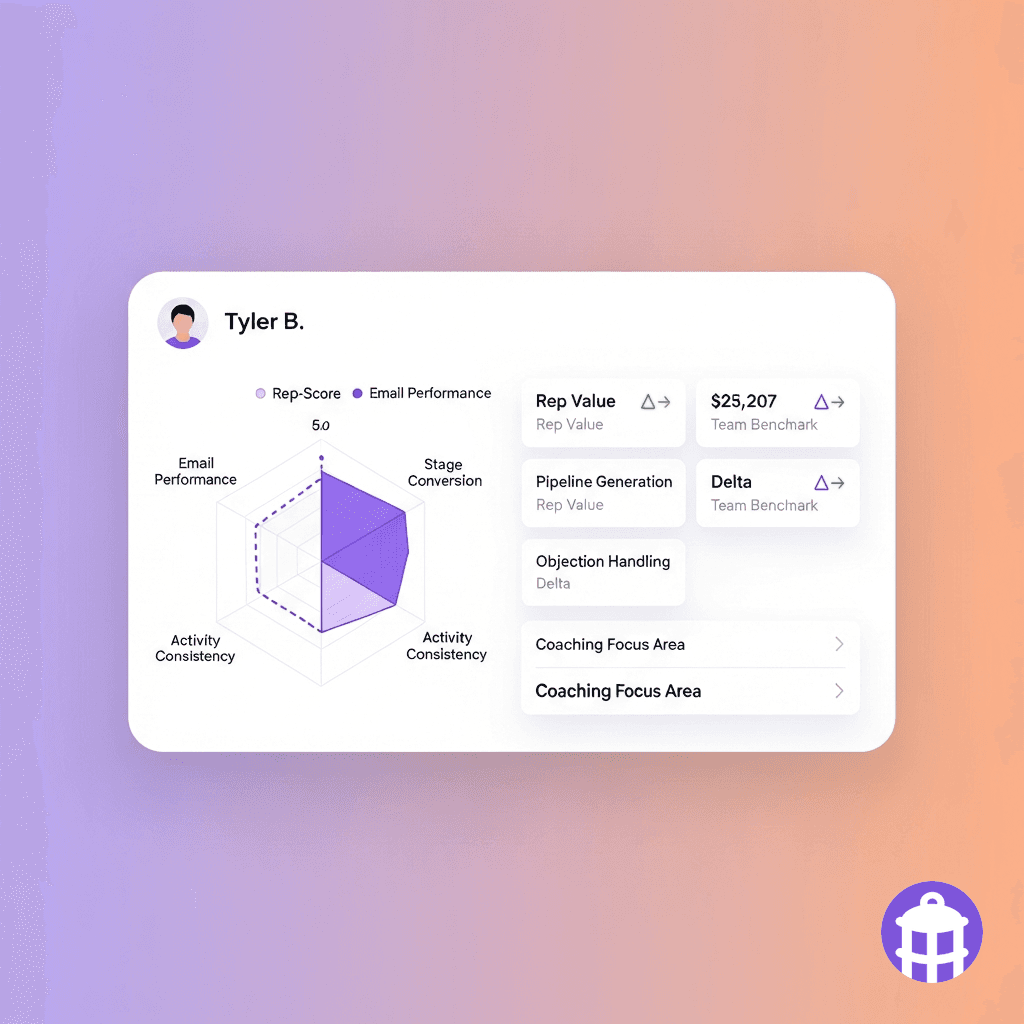
Rep analysis: Tyler B., Mid-Market AE. Call-to-meeting rate: 11% (team avg: 18%). Email reply rate: 22% (team avg: 19%). Demo-to-proposal rate: 61% (team avg: 58%). Pattern: strong on email, weak on call conversion. Coaching focus: call opening and discovery question depth.

Analyzes individual rep activity and conversion patterns

Aggregate sales metrics hide the patterns that matter for coaching. The agent breaks each rep's performance down by activity type and conversion outcome: call volume vs. call quality (measured by talk ratio, question frequency, and follow-up rate), email outreach vs. reply rate vs. meeting booked rate, stage-to-stage conversion vs. team benchmark, and pipeline generation vs. pipeline velocity. The goal isn't to produce a leaderboard — it's to identify the specific activities where each rep is stronger or weaker than the benchmark, so coaching addresses actual skill gaps rather than generic best practices. The analysis runs weekly and updates coaching recommendations as patterns change.

Rep analysis: Tyler B., Mid-Market AE. Call-to-meeting rate: 11% (team avg: 18%). Email reply rate: 22% (team avg: 19%). Demo-to-proposal rate: 61% (team avg: 58%). Pattern: strong on email, weak on call conversion. Coaching focus: call opening and discovery question depth.

Identifies specific skill gaps from call and email data

Generic performance metrics point to symptoms; skill analysis identifies causes. The agent connects to call recording platforms and analyzes transcripts for coaching-relevant patterns: does the rep ask discovery questions or move immediately to pitch mode? How often do they confirm next steps explicitly before ending a call? Do their follow-up emails reference specific things the prospect said, or are they template-based? When a rep's call-to-meeting rate is below benchmark, the agent identifies whether the gap is in the opener, the qualification conversation, the demo, or the close — not just that the number is low. This specificity is what makes coaching actionable rather than motivational.

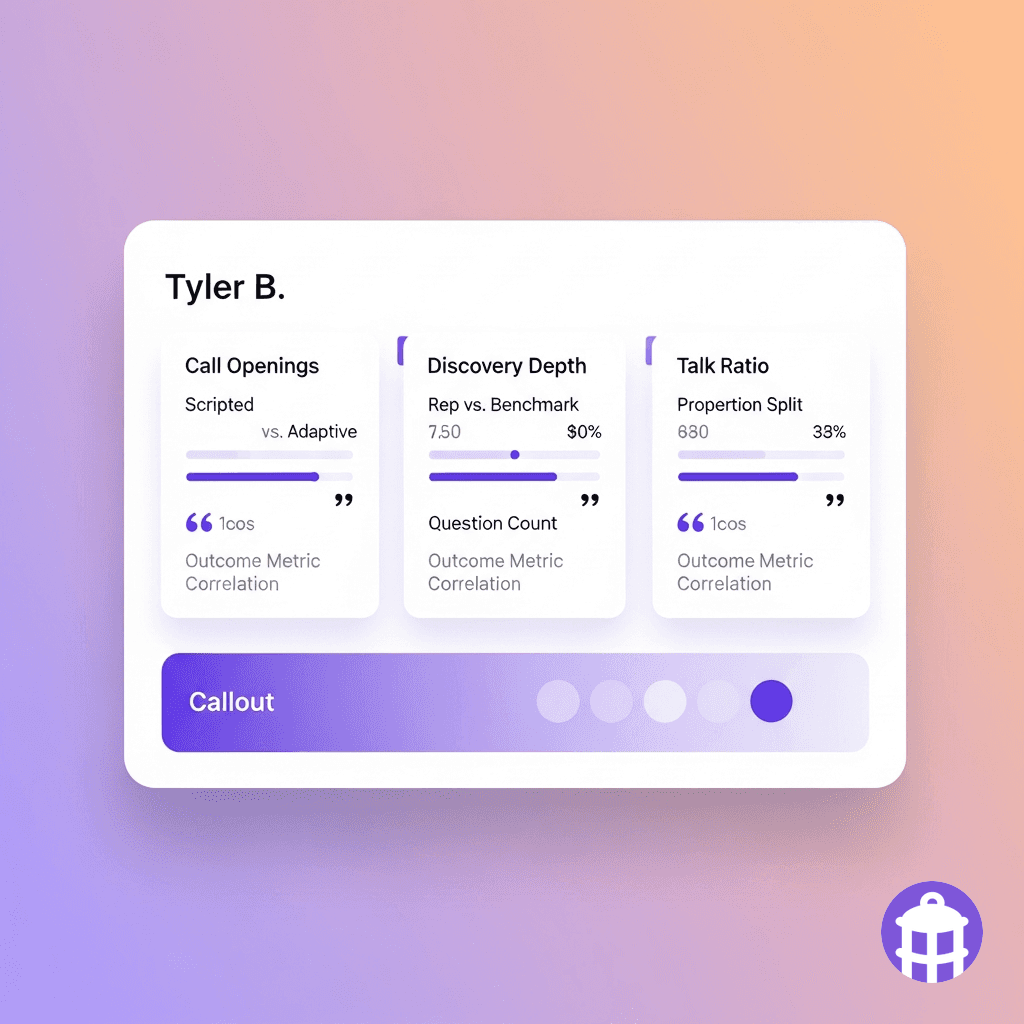
Skill gap analysis: Tyler B. Call openings: 78% follow a script (vs. 41% team avg). Discovery question rate: 1.8 per call (team avg: 4.2). Talk ratio: 68% rep / 32% prospect (team avg: 52%/48%). Specific finding: underuses open-ended questions in first 3 minutes — correlates with 44% lower follow-up meeting rate for calls where talk ratio exceeds 60% in the opening.

Identifies specific skill gaps from call and email data

Generic performance metrics point to symptoms; skill analysis identifies causes. The agent connects to call recording platforms and analyzes transcripts for coaching-relevant patterns: does the rep ask discovery questions or move immediately to pitch mode? How often do they confirm next steps explicitly before ending a call? Do their follow-up emails reference specific things the prospect said, or are they template-based? When a rep's call-to-meeting rate is below benchmark, the agent identifies whether the gap is in the opener, the qualification conversation, the demo, or the close — not just that the number is low. This specificity is what makes coaching actionable rather than motivational.

Skill gap analysis: Tyler B. Call openings: 78% follow a script (vs. 41% team avg). Discovery question rate: 1.8 per call (team avg: 4.2). Talk ratio: 68% rep / 32% prospect (team avg: 52%/48%). Specific finding: underuses open-ended questions in first 3 minutes — correlates with 44% lower follow-up meeting rate for calls where talk ratio exceeds 60% in the opening.

Generates weekly coaching briefs for managers

1:1 coaching time is limited, and managers shouldn't spend it reviewing dashboards. The agent generates a weekly coaching brief for each rep on the manager's team: the top 2–3 skill areas to address this week, the specific evidence from the week's activity (a call example, a sequence that underperformed), a recommended coaching exercise or framework, and a progress update against last week's focus area. The brief takes 5 minutes to read and makes the coaching conversation specific and evidence-based rather than intuition-driven. Managers who run their 1:1s from the brief have higher rep improvement rates because every conversation is grounded in real data from that week, not general observations.

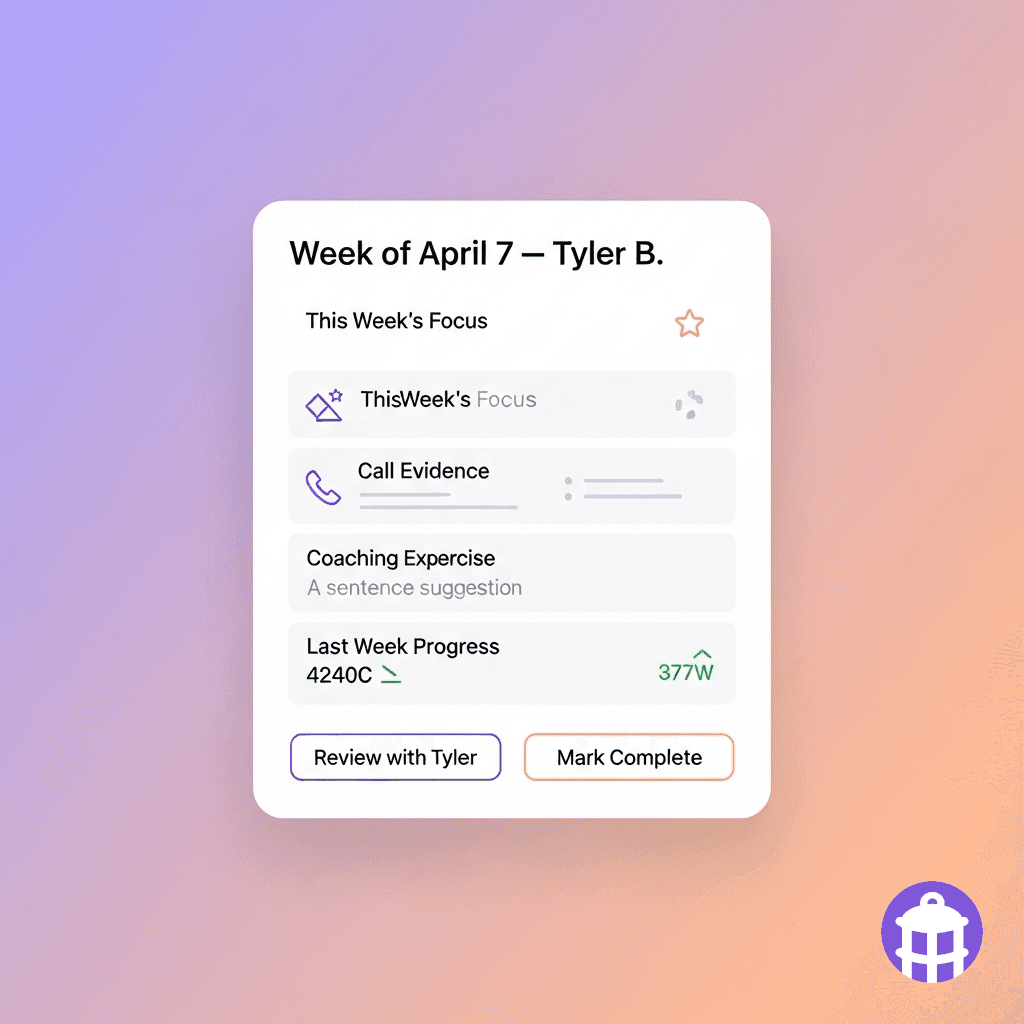
Weekly coaching brief: Tyler B. — Week of April 7. Focus: Discovery question depth. Evidence: 3 calls reviewed — avg 1.9 questions per call (target: 4+). One call where Tyler jumped to demo at minute 4 — prospect said 'I'm not sure this is right for us' by minute 12. Recommended exercise: 5-question minimum practice with manager role-play. Progress from last week: Talk ratio improved 6 points (68% → 62%). Keep reinforcing.

Generates weekly coaching briefs for managers

1:1 coaching time is limited, and managers shouldn't spend it reviewing dashboards. The agent generates a weekly coaching brief for each rep on the manager's team: the top 2–3 skill areas to address this week, the specific evidence from the week's activity (a call example, a sequence that underperformed), a recommended coaching exercise or framework, and a progress update against last week's focus area. The brief takes 5 minutes to read and makes the coaching conversation specific and evidence-based rather than intuition-driven. Managers who run their 1:1s from the brief have higher rep improvement rates because every conversation is grounded in real data from that week, not general observations.

Weekly coaching brief: Tyler B. — Week of April 7. Focus: Discovery question depth. Evidence: 3 calls reviewed — avg 1.9 questions per call (target: 4+). One call where Tyler jumped to demo at minute 4 — prospect said 'I'm not sure this is right for us' by minute 12. Recommended exercise: 5-question minimum practice with manager role-play. Progress from last week: Talk ratio improved 6 points (68% → 62%). Keep reinforcing.

Tracks skill development over time

Coaching only works if skill improvement is measurable. The agent tracks each coached skill area over rolling 4-week and 12-week windows — did the rep's discovery question rate increase after the coaching session? Did the call-to-meeting conversion improve? Did the pattern persist or revert? Progress is shown at both the individual level and the team level so managers can see which reps are responding to coaching and which need a different approach. When a skill area shows sustained improvement, the coaching brief updates to focus on the next priority. When a rep shows no improvement after 4 weeks of focus on the same skill, the brief flags an escalation for the sales director.

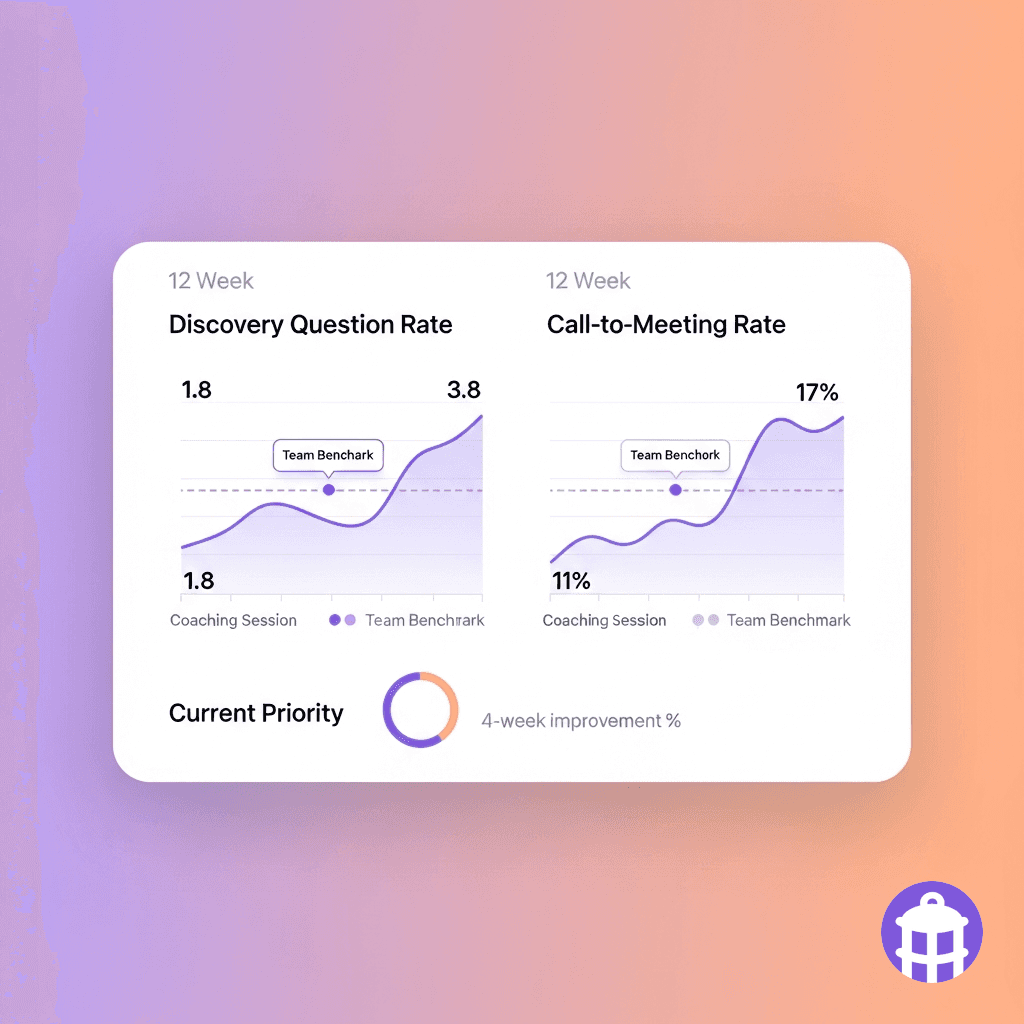
12-week skill trend: Tyler B. Discovery question rate: 1.8 → 2.4 → 3.1 → 3.8 (week 1→4). Call-to-meeting rate: 11% → 12% → 15% → 17% (week 1→4). Target: 18%. On track. Coaching focus rotating to: objection handling at proposal stage (current conversion: 54%, team avg: 71%).

Tracks skill development over time

Coaching only works if skill improvement is measurable. The agent tracks each coached skill area over rolling 4-week and 12-week windows — did the rep's discovery question rate increase after the coaching session? Did the call-to-meeting conversion improve? Did the pattern persist or revert? Progress is shown at both the individual level and the team level so managers can see which reps are responding to coaching and which need a different approach. When a skill area shows sustained improvement, the coaching brief updates to focus on the next priority. When a rep shows no improvement after 4 weeks of focus on the same skill, the brief flags an escalation for the sales director.

12-week skill trend: Tyler B. Discovery question rate: 1.8 → 2.4 → 3.1 → 3.8 (week 1→4). Call-to-meeting rate: 11% → 12% → 15% → 17% (week 1→4). Target: 18%. On track. Coaching focus rotating to: objection handling at proposal stage (current conversion: 54%, team avg: 71%).

Today vs. with

Today vs. with

Coach Sales Reps

Coach Sales Reps

Today

Manager knows Tyler is underperforming but can't pinpoint whether it's prospecting, discovery, demos, or closing.

Coaching in 1:1s is based on the manager's memory of one or two deals from the week — not a systematic view of activity patterns.

No way to know whether a coaching conversation had any impact — metrics are tracked monthly at best.

With ABM Strategist

Activity analysis isolates the specific skill gap — Tyler's calls are weak on discovery depth, not volume or pitch quality.

Weekly coaching brief gives the manager specific evidence from the week's activity, a coaching exercise, and a progress update in 5 minutes.

Coached skill areas are tracked weekly — if the conversation landed, the numbers show it within 2–3 weeks.

Three layers, one platform by Lantern

Three layers, one platform by Lantern

Every agent runs on three layers: a unified data model, 150+ enrichment providers, and an open-source engine where every decision is auditable.

Every agent runs on three layers: a unified data model, 150+ enrichment providers, and an open-source engine where every decision is auditable.

Data Waterfall

150+ enrichment providers. Sequential routing optimized per segment. The best answer wins. No vendor lock-in.

Agent Engine

Open-source execution engine. Workflows defined in code. Human-in-the-loop checkpoints. Full audit trail on every action.

Revenue Ontology

Every data source normalized into one model. Entity resolution across systems. Relationships stored, not inferred. Schema that evolves with your business.

FAQ

FAQ

What call recording platforms does this integrate with?

Can reps see their own coaching data?

How does it distinguish between a skill gap and a territory or market issue?

Is the coaching advice prescriptive or does it require manager judgment?

Every rep has a ceiling — coaching determines how quickly they reach it.

Every rep has a ceiling — coaching determines how quickly they reach it.

USE CASES

Revenue Team

Marketing Team

Customer Success

PRICING

Pricing

RESOURCES

Blog

About Lantern

Status

Support

© LANTERN 2025

Terms

Privacy

Linkedin

USE CASES

Revenue Team

Marketing Team

Customer Success

PRICING

Pricing

RESOURCES

Blog

About Lantern

Status

Support

© LANTERN 2025

Terms

Privacy

Linkedin

USE CASES

Revenue Team

Marketing Team

Customer Success

PRICING

Pricing

RESOURCES

Blog

About Lantern

Status

Support

© LANTERN 2025

Terms

Privacy

Linkedin