
Grow Customers

Monitor Product Usage

Monitor Product Usage

Know what every customer is doing in your product — and what it means.

Know what every customer is doing in your product — and what it means.

of churned accounts showed a measurable usage decline trend in the 45 days prior that wasn't flagged to the CSM.

of churned accounts showed a measurable usage decline trend in the 45 days prior that wasn't flagged to the CSM.

THE brıef

Product usage data is the most accurate signal of customer health, expansion readiness, and churn risk — but most customer success teams can't access it without querying an engineer or waiting for a weekly data pull. The Monitor Product Usage agent surfaces real-time feature adoption, engagement trends, and account-level usage anomalies directly to CSMs and sales teams, with the context to interpret what each signal means for the customer relationship.
Tracks feature adoption and engagement at the account level

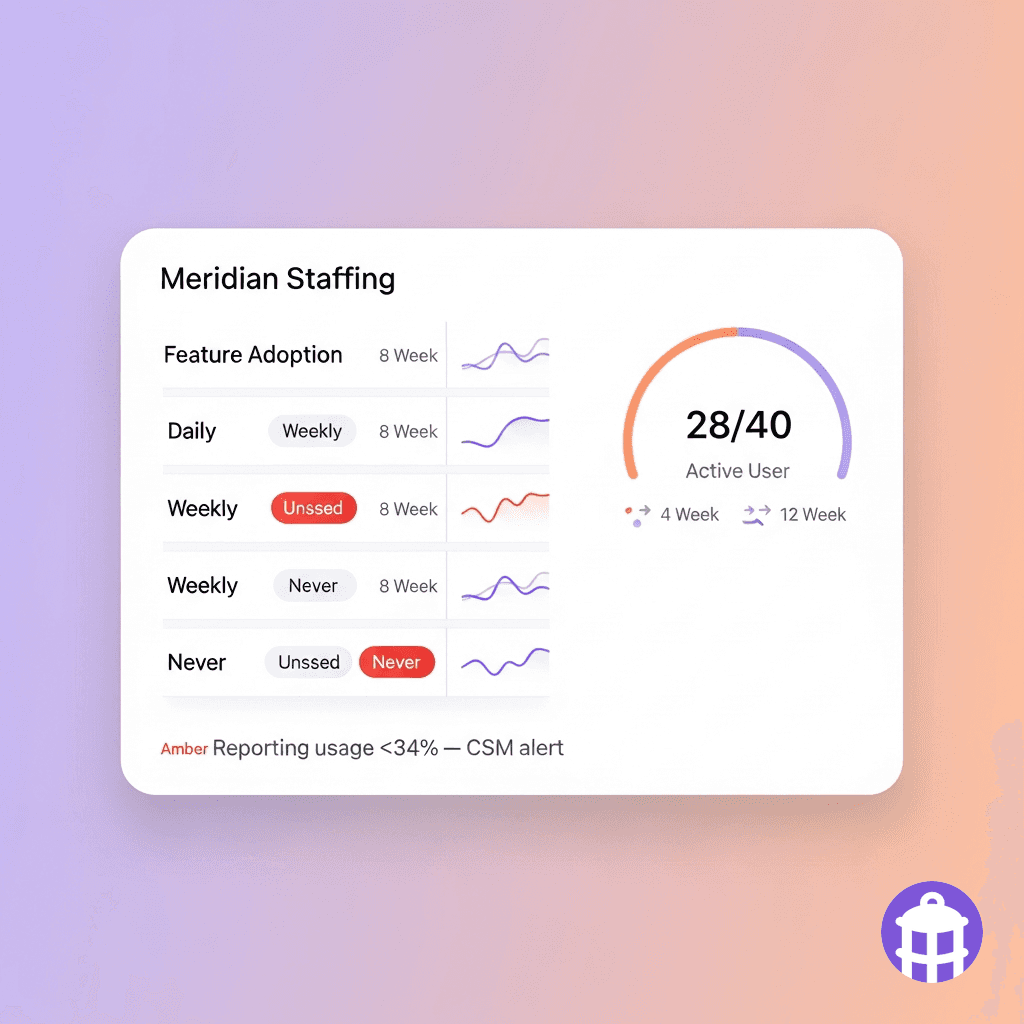
Aggregate product metrics tell you how the product is doing. Account-level usage data tells you how each customer is doing. The agent maintains a per-account usage profile that tracks: which features are being used, at what frequency, by how many users, and how their adoption has changed over the past 4 and 12 weeks. This profile is updated from product event streams in near-real-time — not from a weekly export. CSMs can see at a glance whether a customer is deepening their adoption (expanding into new feature areas) or narrowing it (logging in but using less of the product than they were 8 weeks ago). Narrowing adoption is one of the strongest leading indicators of churn — and it's only visible at the account level.

Account usage profile: Meridian Staffing. Active users: 28 of 40 seats. Feature adoption: Core workflow (daily), API sync (daily), reporting module (weekly). Not adopted: bulk export (0 uses), team analytics (0 uses). 8-week trend: core workflow usage stable, reporting module usage down 34%. Churn risk signal: reporting disengagement flagged.

Tracks feature adoption and engagement at the account level

Aggregate product metrics tell you how the product is doing. Account-level usage data tells you how each customer is doing. The agent maintains a per-account usage profile that tracks: which features are being used, at what frequency, by how many users, and how their adoption has changed over the past 4 and 12 weeks. This profile is updated from product event streams in near-real-time — not from a weekly export. CSMs can see at a glance whether a customer is deepening their adoption (expanding into new feature areas) or narrowing it (logging in but using less of the product than they were 8 weeks ago). Narrowing adoption is one of the strongest leading indicators of churn — and it's only visible at the account level.

Account usage profile: Meridian Staffing. Active users: 28 of 40 seats. Feature adoption: Core workflow (daily), API sync (daily), reporting module (weekly). Not adopted: bulk export (0 uses), team analytics (0 uses). 8-week trend: core workflow usage stable, reporting module usage down 34%. Churn risk signal: reporting disengagement flagged.

Detects anomalies and trend changes before they become problems

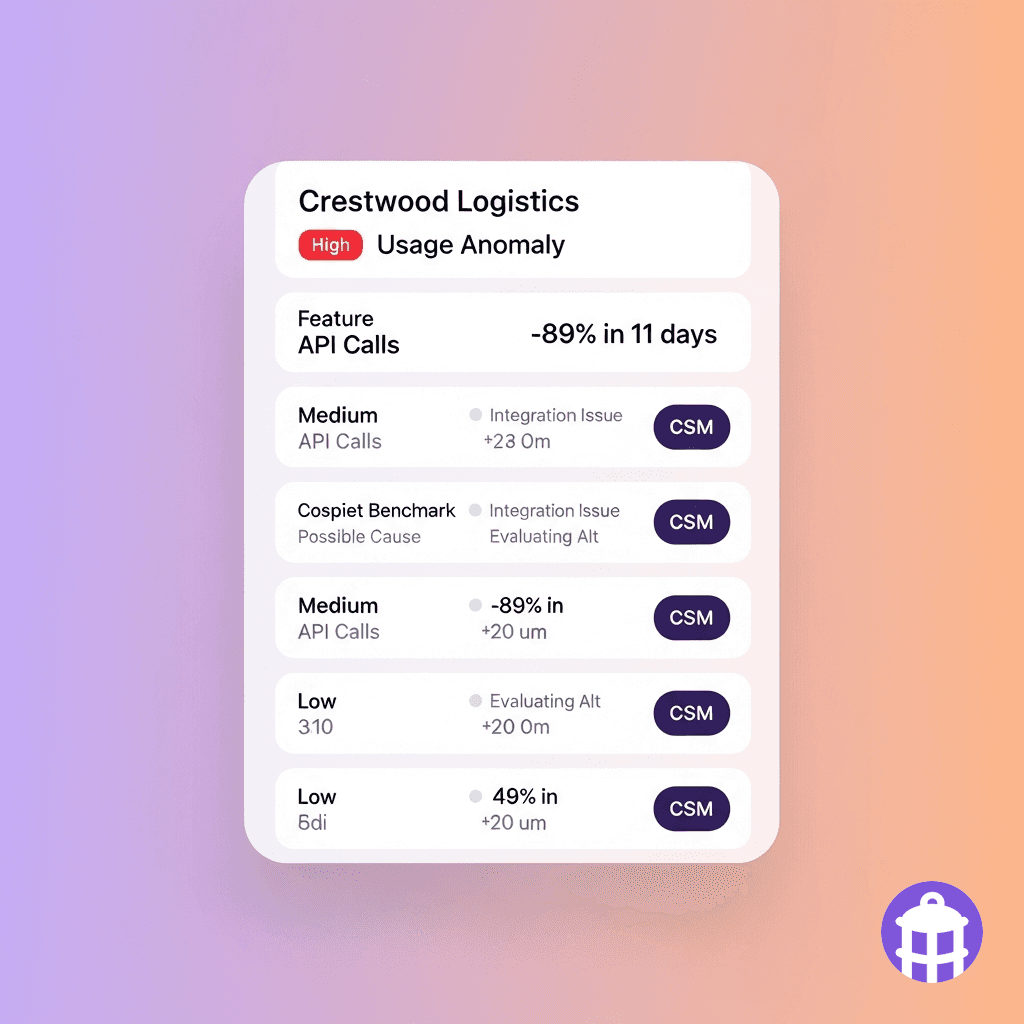
A single week of low usage might be a holiday. Three consecutive weeks of declining usage is a pattern. The agent applies statistical trend detection to each account's usage history — distinguishing normal variance from sustained directional changes. When an account's usage falls below 2 standard deviations from their own historical baseline for a defined feature, an anomaly alert fires. The alert includes the feature affected, the magnitude and duration of the decline, a comparison to similar accounts in the same cohort, and a recommended CSM action. This is different from a simple threshold alert — a 40% usage drop for a customer who was at 100% engagement is more significant than a 40% drop for a customer who was already a light user.

Anomaly alert: Crestwood Logistics — API calls dropped from avg 1,840/day to 210/day over 11 days. Cohort benchmark: similar accounts avg 1,600/day. Possible causes: (1) integration issue, (2) reduced use case, (3) evaluating alternative. Recommended: technical check-in within 48 hours.

Detects anomalies and trend changes before they become problems

A single week of low usage might be a holiday. Three consecutive weeks of declining usage is a pattern. The agent applies statistical trend detection to each account's usage history — distinguishing normal variance from sustained directional changes. When an account's usage falls below 2 standard deviations from their own historical baseline for a defined feature, an anomaly alert fires. The alert includes the feature affected, the magnitude and duration of the decline, a comparison to similar accounts in the same cohort, and a recommended CSM action. This is different from a simple threshold alert — a 40% usage drop for a customer who was at 100% engagement is more significant than a 40% drop for a customer who was already a light user.

Anomaly alert: Crestwood Logistics — API calls dropped from avg 1,840/day to 210/day over 11 days. Cohort benchmark: similar accounts avg 1,600/day. Possible causes: (1) integration issue, (2) reduced use case, (3) evaluating alternative. Recommended: technical check-in within 48 hours.

Identifies expansion signals from usage patterns

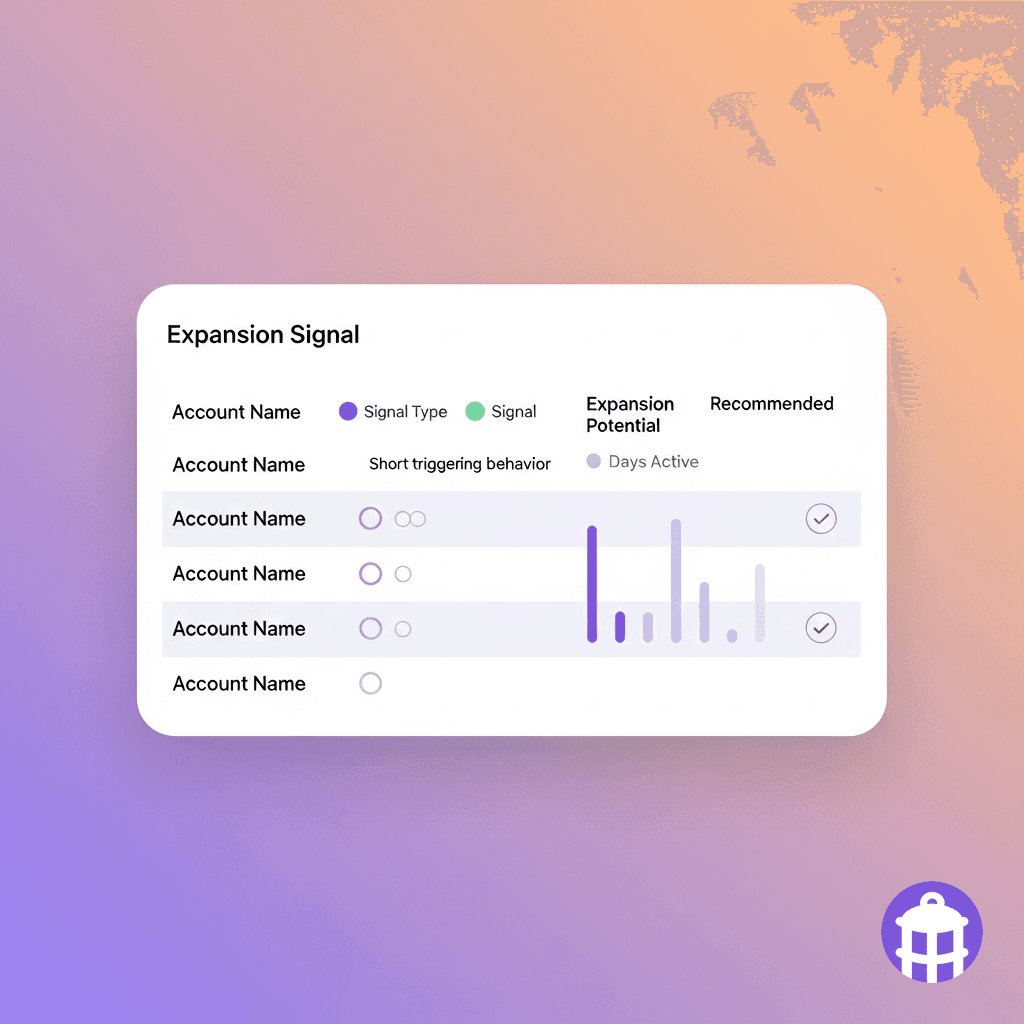
Usage data is the most reliable source of expansion signals because it reflects actual behavior, not stated intent. The agent identifies three expansion pattern types from account-level usage: limit approach (seat utilization, API call volume, or data storage crossing 80% of plan limit), feature gateway (high engagement with a feature that has an upgraded version in a higher tier), and white space (consistent heavy usage of core features but zero adoption of adjacent capabilities that are well-matched to the account's profile). For each pattern, the agent generates an expansion signal with estimated ARR impact and a recommended conversation angle — giving CSMs the data to have a relevant commercial conversation, not just a product check-in.

Expansion signal: Thornfield Media. Pattern: Feature gateway — heavy usage of standard reporting (daily, all 50 seats), but custom dashboard feature (Enterprise tier) has been accessed in trial mode 14 times in the past 3 weeks. 3 of those accesses resulted in a saved-but-not-published custom dashboard. Estimated expansion ARR: $22,000/yr. Recommended angle: unlock the dashboards they've already built.

Identifies expansion signals from usage patterns

Usage data is the most reliable source of expansion signals because it reflects actual behavior, not stated intent. The agent identifies three expansion pattern types from account-level usage: limit approach (seat utilization, API call volume, or data storage crossing 80% of plan limit), feature gateway (high engagement with a feature that has an upgraded version in a higher tier), and white space (consistent heavy usage of core features but zero adoption of adjacent capabilities that are well-matched to the account's profile). For each pattern, the agent generates an expansion signal with estimated ARR impact and a recommended conversation angle — giving CSMs the data to have a relevant commercial conversation, not just a product check-in.

Expansion signal: Thornfield Media. Pattern: Feature gateway — heavy usage of standard reporting (daily, all 50 seats), but custom dashboard feature (Enterprise tier) has been accessed in trial mode 14 times in the past 3 weeks. 3 of those accesses resulted in a saved-but-not-published custom dashboard. Estimated expansion ARR: $22,000/yr. Recommended angle: unlock the dashboards they've already built.

Provides portfolio-level usage visibility for CS leadership

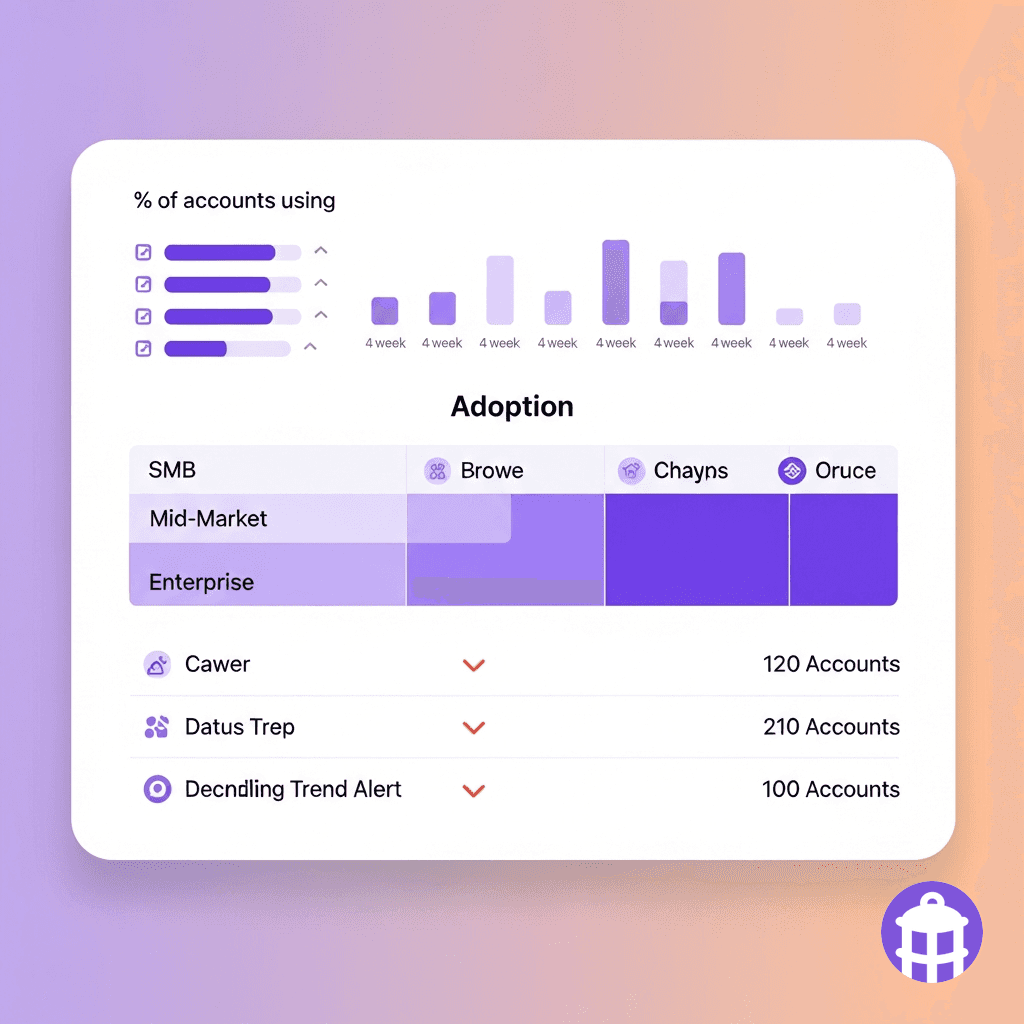
Individual account alerts are necessary but not sufficient for CS leadership. The agent maintains a portfolio-level product usage view that shows adoption rates for each feature across the customer base, identifies which cohorts are driving the strongest adoption (by industry, segment, CSM, or onboarding track), and flags features with declining adoption trends across multiple accounts simultaneously. When a specific feature shows declining engagement across 15% of the account base in the same month, that's a product or documentation problem — not 15 individual CSM issues. This visibility enables leadership to escalate product signals, prioritize documentation improvements, and allocate CSM attention to the accounts and features where engagement risk is concentrated.

Portfolio usage summary: Q2. Feature with broadest adoption: CRM sync (88% of accounts, daily). Feature with fastest adoption growth: bulk export (+41% WoW, post-April release). Feature with most concerning trend: reporting module — 22% of accounts showing >20% decline over 8 weeks. Flagged for product review.

Provides portfolio-level usage visibility for CS leadership

Individual account alerts are necessary but not sufficient for CS leadership. The agent maintains a portfolio-level product usage view that shows adoption rates for each feature across the customer base, identifies which cohorts are driving the strongest adoption (by industry, segment, CSM, or onboarding track), and flags features with declining adoption trends across multiple accounts simultaneously. When a specific feature shows declining engagement across 15% of the account base in the same month, that's a product or documentation problem — not 15 individual CSM issues. This visibility enables leadership to escalate product signals, prioritize documentation improvements, and allocate CSM attention to the accounts and features where engagement risk is concentrated.

Portfolio usage summary: Q2. Feature with broadest adoption: CRM sync (88% of accounts, daily). Feature with fastest adoption growth: bulk export (+41% WoW, post-April release). Feature with most concerning trend: reporting module — 22% of accounts showing >20% decline over 8 weeks. Flagged for product review.

Today vs. with

Today vs. with

Monitor Product Usage

Monitor Product Usage

Today

CSMs find out a customer's usage dropped when the customer brings it up on a call or doesn't renew.

Expansion conversations are based on intuition or scheduled QBR slots — not on the actual moment when usage signals are strongest.

CS leadership has no view into which features are declining across the account base until product runs a quarterly analytics report.

With ABM Strategist

Anomaly detection fires within days of a sustained usage decline — with context about the affected feature and a recommended action.

Expansion signals fire when usage patterns indicate readiness — feature gateway, limit approach, and white space identified and quantified.

Portfolio-level feature adoption trends are visible in real time — cross-account declining trends escalate to product review automatically.

Three layers, one platform by Lantern

Three layers, one platform by Lantern

Every agent runs on three layers: a unified data model, 150+ enrichment providers, and an open-source engine where every decision is auditable.

Every agent runs on three layers: a unified data model, 150+ enrichment providers, and an open-source engine where every decision is auditable.

Data Waterfall

150+ enrichment providers. Sequential routing optimized per segment. The best answer wins. No vendor lock-in.

Agent Engine

Open-source execution engine. Workflows defined in code. Human-in-the-loop checkpoints. Full audit trail on every action.

Revenue Ontology

Every data source normalized into one model. Entity resolution across systems. Relationships stored, not inferred. Schema that evolves with your business.

FAQ

FAQ

What product analytics platforms does this integrate with?

How granular can usage tracking get?

Can it track usage at the individual user level within an account?

How does it handle products with very different usage patterns by customer type?

Your product already knows which customers are at risk — you just need to be listening.

Your product already knows which customers are at risk — you just need to be listening.

USE CASES

Revenue Team

Marketing Team

Customer Success

PRICING

Pricing

RESOURCES

Blog

About Lantern

Status

Support

© LANTERN 2025

Terms

Privacy

Linkedin

USE CASES

Revenue Team

Marketing Team

Customer Success

PRICING

Pricing

RESOURCES

Blog

About Lantern

Status

Support

© LANTERN 2025

Terms

Privacy

Linkedin

USE CASES

Revenue Team

Marketing Team

Customer Success

PRICING

Pricing

RESOURCES

Blog

About Lantern

Status

Support

© LANTERN 2025

Terms

Privacy

Linkedin