
Grow Customers
Prevent Churn
Prevent Churn
Find accounts at risk before the cancellation email arrives.
Find accounts at risk before the cancellation email arrives.
of churned accounts showed detectable early warning signals in the 60 days prior that went unaddressed.
of churned accounts showed detectable early warning signals in the 60 days prior that went unaddressed.

THE brıef
Churn is expensive not just because of lost ARR, but because it's usually visible well before it happens — and most teams don't act until it's too late. The Prevent Churn agent monitors product usage, support activity, engagement signals, and NPS data to build a real-time health score for every customer account and triggers CSM intervention at the earliest sign of risk.
Builds a real-time health score for every account
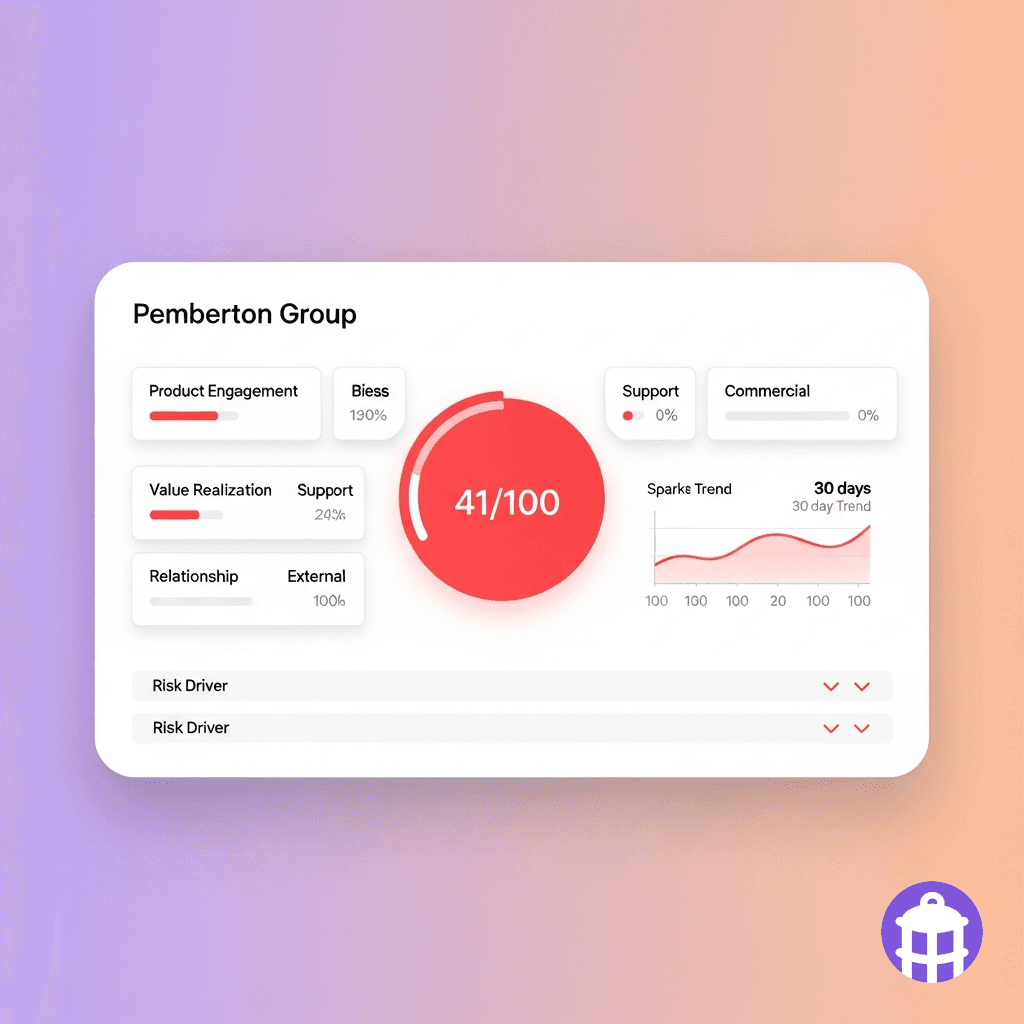
A health score that lives in a quarterly spreadsheet isn't a health score — it's a retrospective. The agent computes health scores continuously from six signal categories: product engagement (login frequency, feature depth, session length), value realization (are they using the capabilities tied to their stated goals?), support activity (open tickets, CSAT, escalation history), commercial signals (overdue invoices, downgrade requests, contract change history), relationship signals (CSM touchpoint recency, executive engagement), and external signals (leadership changes, company contraction). Each category is weighted based on its predictive correlation with churn for that customer segment. The score updates daily and triggers alerts at defined thresholds.
Health score update: Pemberton Group. Overall: 41/100 (↓18 in 30 days). Drivers: login frequency dropped 60% in 3 weeks (high weight), 2 open support tickets (medium weight), no CSM touchpoint in 47 days (medium weight). Churn risk: High.
Builds a real-time health score for every account
A health score that lives in a quarterly spreadsheet isn't a health score — it's a retrospective. The agent computes health scores continuously from six signal categories: product engagement (login frequency, feature depth, session length), value realization (are they using the capabilities tied to their stated goals?), support activity (open tickets, CSAT, escalation history), commercial signals (overdue invoices, downgrade requests, contract change history), relationship signals (CSM touchpoint recency, executive engagement), and external signals (leadership changes, company contraction). Each category is weighted based on its predictive correlation with churn for that customer segment. The score updates daily and triggers alerts at defined thresholds.
Health score update: Pemberton Group. Overall: 41/100 (↓18 in 30 days). Drivers: login frequency dropped 60% in 3 weeks (high weight), 2 open support tickets (medium weight), no CSM touchpoint in 47 days (medium weight). Churn risk: High.
Detects early warning patterns before scores drop
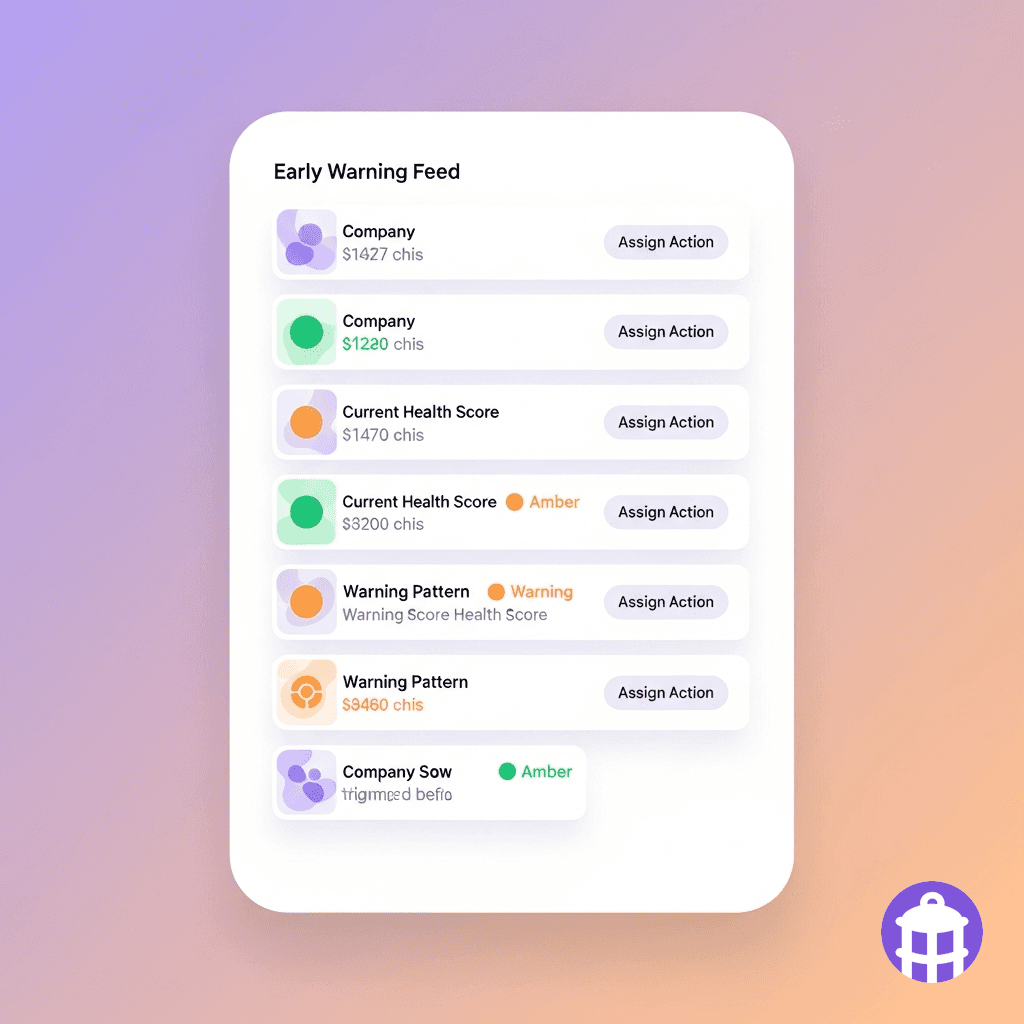
Health scores measure current state. Early warning detection looks for patterns that predict future decline — before the score itself drops. The agent monitors for a specific set of behavioral patterns correlated with churn in the 60–90 days prior: declining login frequency over a 3-week trend (not just a single week), support ticket themes shifting from 'how do I' to 'this doesn't work,' champion engagement dropping off while power user engagement holds steady (signals internal champion may be disengaging), and contract data showing no expansion in 12+ months in a high-growth account cohort. When a pattern matches, the early warning fires independently of the health score — so the CSM knows something is changing before the number drops.
Early warning: Altira Consulting. Health score: 72/100 (normal). Pattern detected: login frequency declining 3 consecutive weeks (-12% week-over-week), champion (VP Ops) last login 18 days ago, 2 power users still active. Early warning: champion disengagement. Recommended: CSM outreach within 5 days.
Detects early warning patterns before scores drop
Health scores measure current state. Early warning detection looks for patterns that predict future decline — before the score itself drops. The agent monitors for a specific set of behavioral patterns correlated with churn in the 60–90 days prior: declining login frequency over a 3-week trend (not just a single week), support ticket themes shifting from 'how do I' to 'this doesn't work,' champion engagement dropping off while power user engagement holds steady (signals internal champion may be disengaging), and contract data showing no expansion in 12+ months in a high-growth account cohort. When a pattern matches, the early warning fires independently of the health score — so the CSM knows something is changing before the number drops.
Early warning: Altira Consulting. Health score: 72/100 (normal). Pattern detected: login frequency declining 3 consecutive weeks (-12% week-over-week), champion (VP Ops) last login 18 days ago, 2 power users still active. Early warning: champion disengagement. Recommended: CSM outreach within 5 days.
Generates CSM intervention playbooks
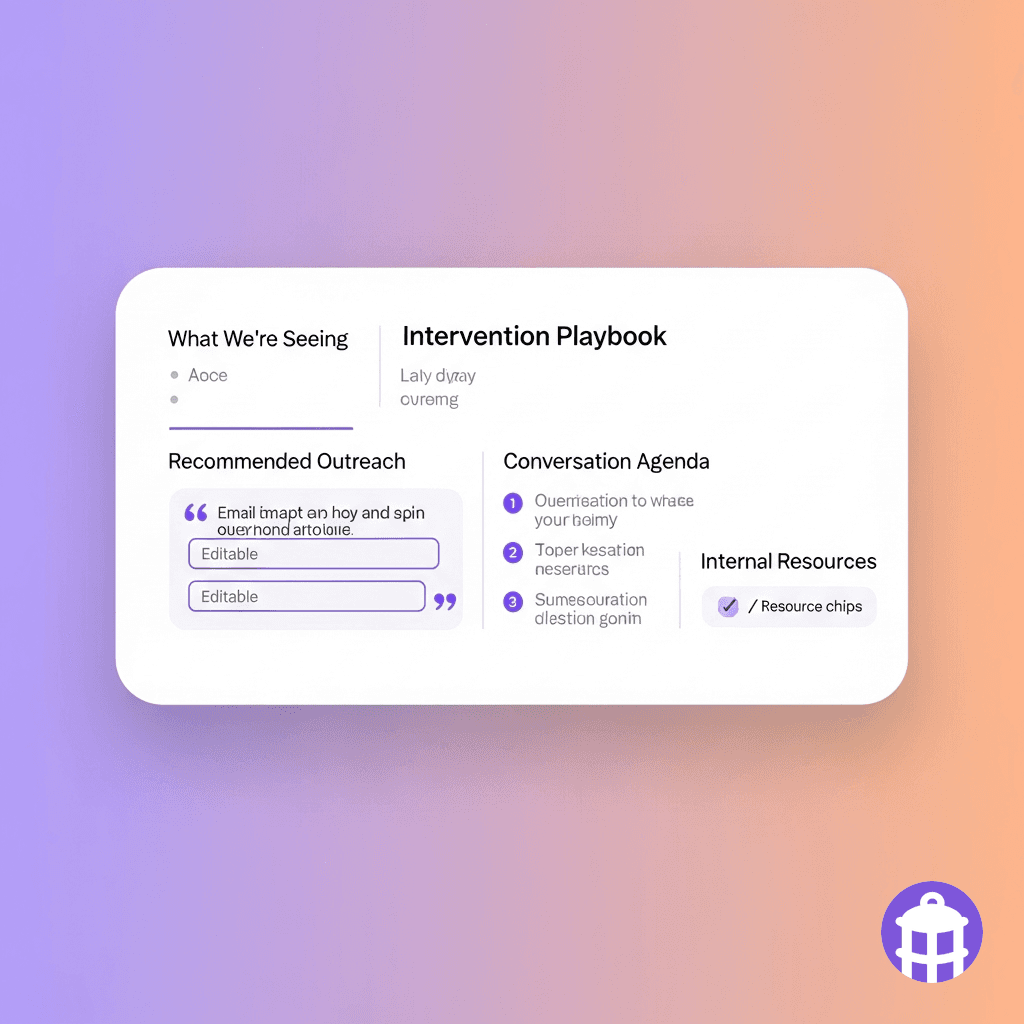
When a health score drops below threshold or an early warning fires, the agent generates a specific intervention playbook for the CSM — not a generic 'reach out and check in' prompt, but a structured plan tailored to the risk pattern. A champion disengagement playbook looks different from a product adoption failure playbook, which looks different from a competitive threat playbook. Each includes: the specific signals that triggered it, a recommended outreach message calibrated to the customer's communication history, a suggested agenda for the conversation, a list of internal resources (relevant training, product features, success stories) to address the underlying issue, and an escalation trigger if the first touchpoint doesn't get a response in 5 days.
Intervention playbook — Pemberton Group. Risk type: Low product adoption + champion absence. Recommended action: Executive business review request. Draft outreach: 'Hi [Name] — wanted to connect given some changes we've seen in your team's usage patterns. Would you be open to a 30-min call to walk through how teams like yours are getting the most out of [feature]?' Internal resource: adoption guide for [core feature], success story: Clearfield Industries case study.
Generates CSM intervention playbooks
When a health score drops below threshold or an early warning fires, the agent generates a specific intervention playbook for the CSM — not a generic 'reach out and check in' prompt, but a structured plan tailored to the risk pattern. A champion disengagement playbook looks different from a product adoption failure playbook, which looks different from a competitive threat playbook. Each includes: the specific signals that triggered it, a recommended outreach message calibrated to the customer's communication history, a suggested agenda for the conversation, a list of internal resources (relevant training, product features, success stories) to address the underlying issue, and an escalation trigger if the first touchpoint doesn't get a response in 5 days.
Intervention playbook — Pemberton Group. Risk type: Low product adoption + champion absence. Recommended action: Executive business review request. Draft outreach: 'Hi [Name] — wanted to connect given some changes we've seen in your team's usage patterns. Would you be open to a 30-min call to walk through how teams like yours are getting the most out of [feature]?' Internal resource: adoption guide for [core feature], success story: Clearfield Industries case study.
Tracks churn risk across the full portfolio
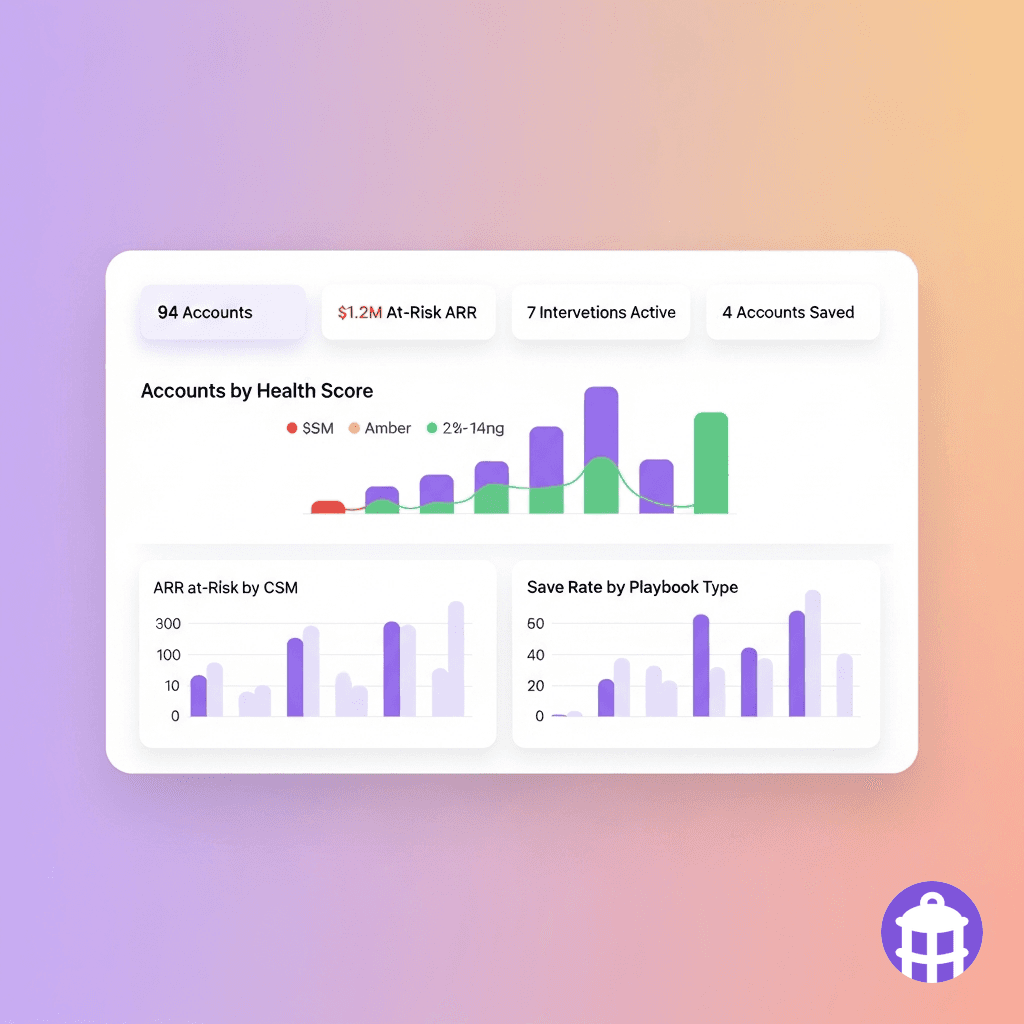
Individual account interventions are only half the picture. The agent maintains a portfolio-level churn risk view that shows the distribution of account health across the book, the total ARR at risk in each tier, and the CSM workload required to address it. When a significant portion of ARR is concentrated in the at-risk tier, leadership can make resourcing decisions before accounts start canceling. The view also tracks intervention outcomes: which playbooks are working, which CSMs have the best save rates, and which risk patterns are hardest to reverse. This feeds back into the scoring model to improve early detection over time.
Portfolio health summary: 94 accounts. ARR at risk (health <50): $1.2M across 11 accounts. Intervention in progress: 7 accounts. Saved this quarter: 4 accounts ($310K ARR retained). Hardest to reverse: product adoption failure pattern (38% save rate).
Tracks churn risk across the full portfolio
Individual account interventions are only half the picture. The agent maintains a portfolio-level churn risk view that shows the distribution of account health across the book, the total ARR at risk in each tier, and the CSM workload required to address it. When a significant portion of ARR is concentrated in the at-risk tier, leadership can make resourcing decisions before accounts start canceling. The view also tracks intervention outcomes: which playbooks are working, which CSMs have the best save rates, and which risk patterns are hardest to reverse. This feeds back into the scoring model to improve early detection over time.
Portfolio health summary: 94 accounts. ARR at risk (health <50): $1.2M across 11 accounts. Intervention in progress: 7 accounts. Saved this quarter: 4 accounts ($310K ARR retained). Hardest to reverse: product adoption failure pattern (38% save rate).
Today vs. with
Today vs. with
Prevent Churn
Prevent Churn
Today
CSMs find out an account is at risk when they stop responding to emails or send a cancellation request.
Health scoring is manual, quarterly, and based on CSM gut feel rather than structured signal data.
When an account goes at-risk, the CSM sends a generic check-in email because there's no playbook for this specific situation.

With ABM Strategist
Health scores and early warning patterns surface risk 30–60 days before it becomes a cancellation — with a specific intervention plan.
Health scores update daily from six signal categories, weighted by their predictive correlation with churn for each customer segment.
Risk type determines the playbook — champion disengagement gets a different response than product adoption failure or competitive threat.
Works with
Works with
Monitor Product Usage
Product engagement data is the highest-weight signal in the health scoring model — usage monitoring feeds directly into churn prediction.
Capture Voice of Customer
NPS and support ticket themes are churn risk inputs — Voice of Customer data feeds directly into the health scoring model.
Monitor Product Usage
Product engagement data is the highest-weight signal in the health scoring model — usage monitoring feeds directly into churn prediction.
Retain Champions
Champion departure is one of the strongest early warning patterns — Retain Champions and Prevent Churn share the same contact monitoring infrastructure.
Capture Voice of Customer
NPS and support ticket themes are churn risk inputs — Voice of Customer data feeds directly into the health scoring model.
Three layers, one platform by Lantern
Three layers, one platform by Lantern
Every agent runs on three layers: a unified data model, 150+ enrichment providers, and an open-source engine where every decision is auditable.
Every agent runs on three layers: a unified data model, 150+ enrichment providers, and an open-source engine where every decision is auditable.
Data Waterfall
150+ enrichment providers. Sequential routing optimized per segment. The best answer wins. No vendor lock-in.

Agent Engine
Open-source execution engine. Workflows defined in code. Human-in-the-loop checkpoints. Full audit trail on every action.

Revenue Ontology
Every data source normalized into one model. Entity resolution across systems. Relationships stored, not inferred. Schema that evolves with your business.
FAQ
FAQ
What data sources does the health scoring model use?
How quickly do health scores update?
Can we customize the health scoring model?
What happens if an intervention doesn't work?

By the time they tell you they're leaving, you've already lost most of the fight.
By the time they tell you they're leaving, you've already lost most of the fight.