
Grow Customers

Automate Onboarding

Automate Onboarding

Guide every new customer to first value — without the manual handholding.

Guide every new customer to first value — without the manual handholding.

reduction in average time-to-value for customers onboarded with automated milestone tracking and stall intervention vs. manual CSM-managed processes.

reduction in average time-to-value for customers onboarded with automated milestone tracking and stall intervention vs. manual CSM-managed processes.

THE brıef

The first 30 days determine whether a customer becomes a long-term advocate or a churn statistic. Most onboarding processes fail not because the product is hard, but because customers stall at predictable steps and no one intervenes in time. The Automate Onboarding agent tracks each customer's progress against a defined milestone path, automates the routine steps, and triggers the right intervention — email, CSM alert, or in-product nudge — the moment a customer falls behind.
Defines and tracks onboarding milestones per customer segment

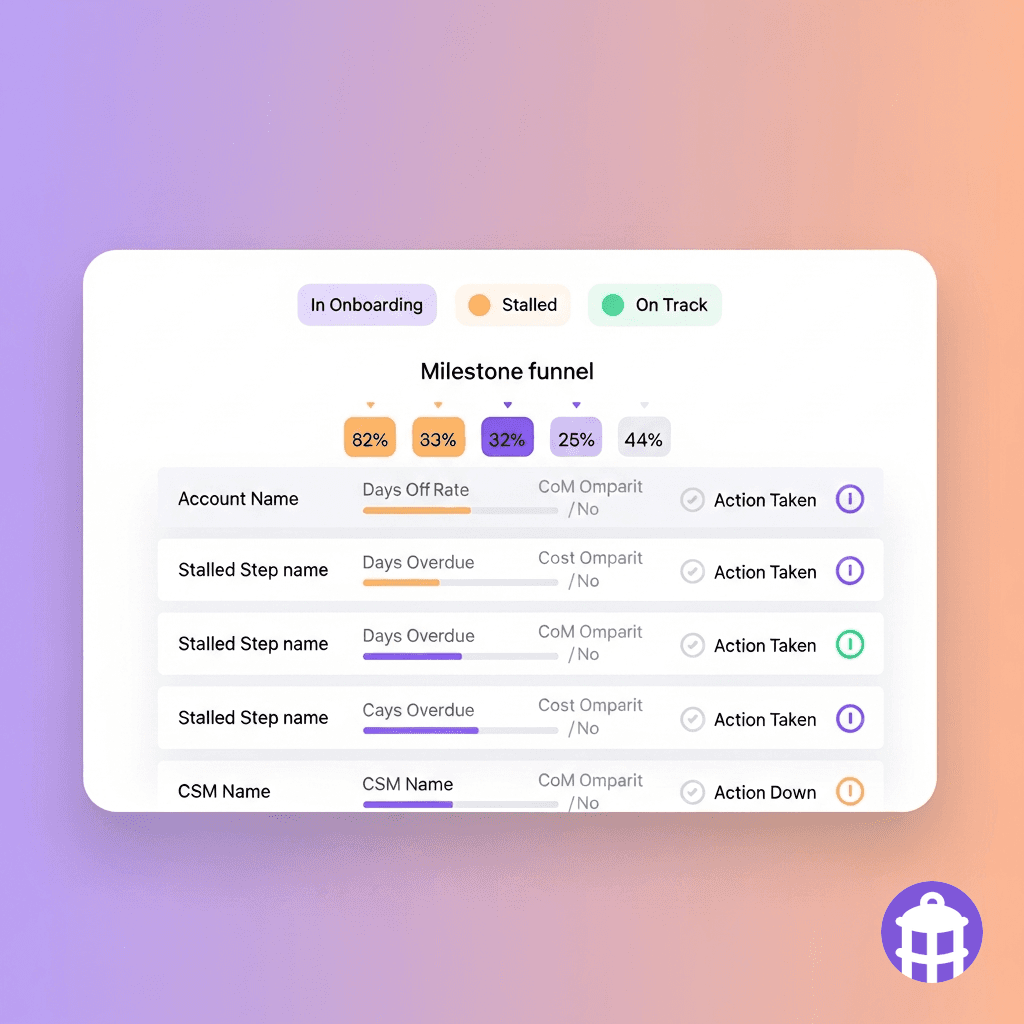
A 5-person startup and a 200-person enterprise need different onboarding paths. The agent supports configurable milestone tracks by customer segment — company size, plan tier, primary use case, or any CRM attribute. Each track defines the specific product events that constitute a successful onboarding: account setup, first integration connected, first workflow triggered, first team member added, first successful export or sync. Milestone completion is tracked from product event streams — not self-reported. Customers see their own progress; CSMs see progress across their entire book. No spreadsheet, no manual status update, no guesswork about where each customer stands.

Onboarding progress: Folio Creative. Segment: Mid-Market, Pro plan. Milestone track: 5 steps. Completed: Account setup (Day 1), Slack integration (Day 2). Pending: First automation triggered (stalled — Day 6, cohort avg Day 3), Team invitation, CRM sync. Onboarding health: At Risk.

Defines and tracks onboarding milestones per customer segment

A 5-person startup and a 200-person enterprise need different onboarding paths. The agent supports configurable milestone tracks by customer segment — company size, plan tier, primary use case, or any CRM attribute. Each track defines the specific product events that constitute a successful onboarding: account setup, first integration connected, first workflow triggered, first team member added, first successful export or sync. Milestone completion is tracked from product event streams — not self-reported. Customers see their own progress; CSMs see progress across their entire book. No spreadsheet, no manual status update, no guesswork about where each customer stands.

Onboarding progress: Folio Creative. Segment: Mid-Market, Pro plan. Milestone track: 5 steps. Completed: Account setup (Day 1), Slack integration (Day 2). Pending: First automation triggered (stalled — Day 6, cohort avg Day 3), Team invitation, CRM sync. Onboarding health: At Risk.

Automates routine onboarding steps and communications

A significant portion of onboarding CSM time goes to tasks that could be automated without any loss of quality: sending the integration setup guide the day after account creation, scheduling the kickoff call 48 hours post-signup, sending the 'your first week checklist' email when setup is complete, logging milestone completions to the CRM, and creating CSM tasks when a customer hits a specific step. The agent handles all of these automatically so CSM time is reserved for the conversations that require human judgment — not the administrative work of routing guides and logging updates. Automation coverage is configurable; teams can define exactly which steps are automated and which require CSM involvement.

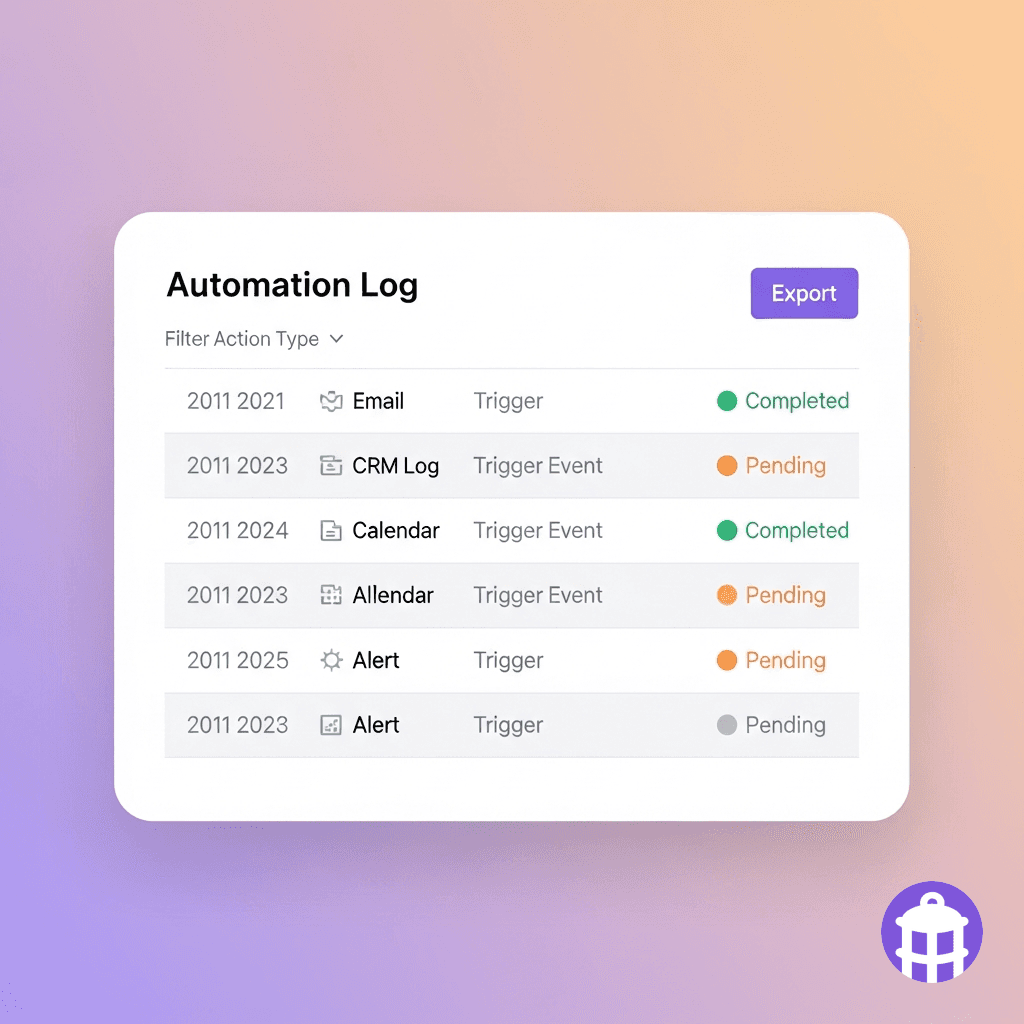
Automated actions completed: Folio Creative (Days 1–5). Day 1: Welcome email sent + kickoff calendar invite sent. Day 2: Integration setup guide delivered (triggered by account created event). Day 2: Slack integration detected — milestone logged to CRM. Day 5: Stall detected at automation step — CSM alert created + intervention email queued.

Automates routine onboarding steps and communications

A significant portion of onboarding CSM time goes to tasks that could be automated without any loss of quality: sending the integration setup guide the day after account creation, scheduling the kickoff call 48 hours post-signup, sending the 'your first week checklist' email when setup is complete, logging milestone completions to the CRM, and creating CSM tasks when a customer hits a specific step. The agent handles all of these automatically so CSM time is reserved for the conversations that require human judgment — not the administrative work of routing guides and logging updates. Automation coverage is configurable; teams can define exactly which steps are automated and which require CSM involvement.

Automated actions completed: Folio Creative (Days 1–5). Day 1: Welcome email sent + kickoff calendar invite sent. Day 2: Integration setup guide delivered (triggered by account created event). Day 2: Slack integration detected — milestone logged to CRM. Day 5: Stall detected at automation step — CSM alert created + intervention email queued.

Triggers CSM intervention when customers stall

Stall detection is the highest-value function in automated onboarding. The agent compares each customer's progression against the segment cohort benchmark — not a theoretical ideal, but the actual median time for customers in the same segment to complete each step. When a customer is behind the median by a configurable threshold (e.g., 50% beyond median time at a given step), the CSM receives an intervention alert with a specific recommended action: send a targeted guide, schedule a live troubleshooting call, escalate to the technical team. The alert includes context about which step they're stuck on and the most common reasons customers stall at that step — so the CSM can address the likely cause, not just check in generically.

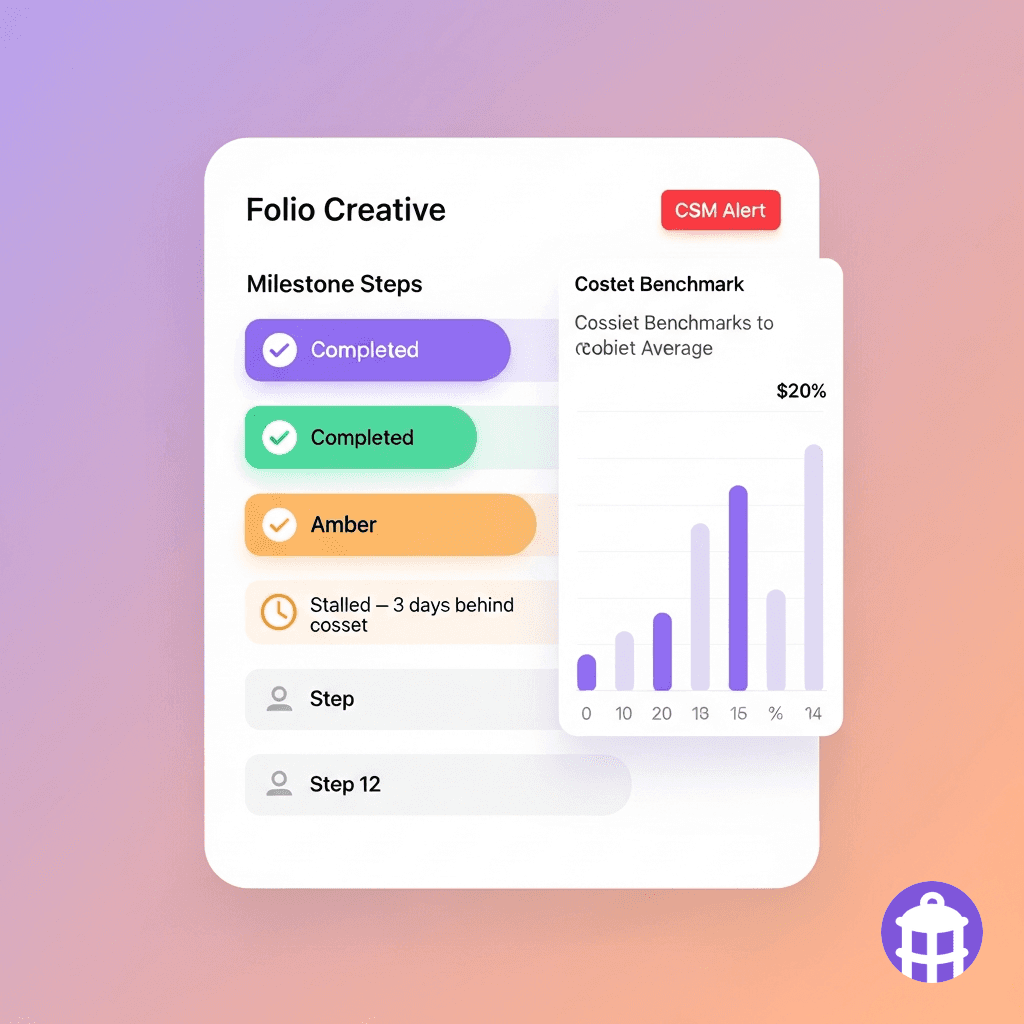
Stall alert: Folio Creative — stalled at 'First Automation Triggered' step (Day 6, cohort avg Day 3). Most common reasons at this step: (1) Slack permissions not configured (42% of stalls), (2) Workflow template not selected (31%). Recommended action: Send permissions walkthrough guide. CSM: Morgan T. — notified 4 hours ago, no action taken. Escalation trigger: 24h.

Triggers CSM intervention when customers stall

Stall detection is the highest-value function in automated onboarding. The agent compares each customer's progression against the segment cohort benchmark — not a theoretical ideal, but the actual median time for customers in the same segment to complete each step. When a customer is behind the median by a configurable threshold (e.g., 50% beyond median time at a given step), the CSM receives an intervention alert with a specific recommended action: send a targeted guide, schedule a live troubleshooting call, escalate to the technical team. The alert includes context about which step they're stuck on and the most common reasons customers stall at that step — so the CSM can address the likely cause, not just check in generically.

Stall alert: Folio Creative — stalled at 'First Automation Triggered' step (Day 6, cohort avg Day 3). Most common reasons at this step: (1) Slack permissions not configured (42% of stalls), (2) Workflow template not selected (31%). Recommended action: Send permissions walkthrough guide. CSM: Morgan T. — notified 4 hours ago, no action taken. Escalation trigger: 24h.

Measures time-to-value and onboarding completion rates

Onboarding success is measured by one thing: how quickly customers reach their first meaningful value milestone — the moment they get the outcome they signed up for. The agent tracks time-to-value for every customer and cuts it by segment, CSM, plan tier, and onboarding track. Completion rates, average time-to-value, and stall frequency by step are reported at both the individual account level and the cohort level. When a specific step is causing disproportionate stall across the cohort, that's a product or documentation problem — the agent flags it for the product and CS leadership teams so it gets addressed at the root, not just at the individual account level.

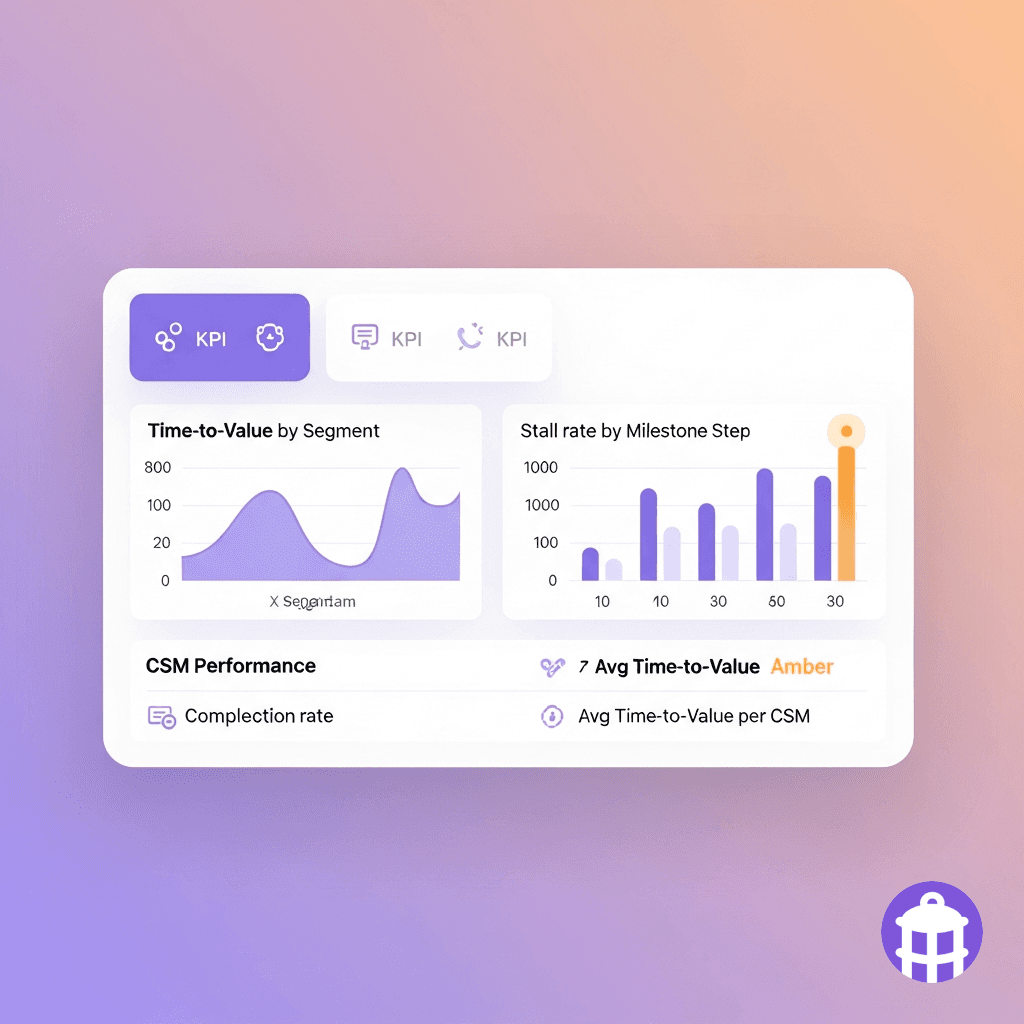
Onboarding cohort report: Q1, Pro plan. 34 accounts. Average time-to-value: 8.2 days. Completion rate: 76%. Top stall point: CRM sync step (29% stall rate). Recommendation: product team review of CRM sync setup flow. CSMs with best completion rates: Jamie R. (91%), Alex M. (84%).

Measures time-to-value and onboarding completion rates

Onboarding success is measured by one thing: how quickly customers reach their first meaningful value milestone — the moment they get the outcome they signed up for. The agent tracks time-to-value for every customer and cuts it by segment, CSM, plan tier, and onboarding track. Completion rates, average time-to-value, and stall frequency by step are reported at both the individual account level and the cohort level. When a specific step is causing disproportionate stall across the cohort, that's a product or documentation problem — the agent flags it for the product and CS leadership teams so it gets addressed at the root, not just at the individual account level.

Onboarding cohort report: Q1, Pro plan. 34 accounts. Average time-to-value: 8.2 days. Completion rate: 76%. Top stall point: CRM sync step (29% stall rate). Recommendation: product team review of CRM sync setup flow. CSMs with best completion rates: Jamie R. (91%), Alex M. (84%).

Today vs. with

Today vs. with

Automate Onboarding

Automate Onboarding

Today

CSMs manually check on new customers and send setup guides based on memory — coverage is inconsistent.

All new customers get the same onboarding sequence regardless of plan tier, company size, or use case.

Stalled customers get a generic check-in email days after the problem started — by then some have already disengaged.

With ABM Strategist

Every onboarding step is tracked from product events. Automated actions fire on schedule; CSMs are alerted when intervention is needed.

Milestone tracks are configured per segment — enterprise customers, SMB customers, and trial conversions follow different paths.

Stall detection fires within hours of falling behind the cohort benchmark, with a specific recommendation for the most common cause at that step.

Three layers, one platform by Lantern

Three layers, one platform by Lantern

Every agent runs on three layers: a unified data model, 150+ enrichment providers, and an open-source engine where every decision is auditable.

Every agent runs on three layers: a unified data model, 150+ enrichment providers, and an open-source engine where every decision is auditable.

Data Waterfall

150+ enrichment providers. Sequential routing optimized per segment. The best answer wins. No vendor lock-in.

Agent Engine

Open-source execution engine. Workflows defined in code. Human-in-the-loop checkpoints. Full audit trail on every action.

Revenue Ontology

Every data source normalized into one model. Entity resolution across systems. Relationships stored, not inferred. Schema that evolves with your business.

FAQ

FAQ

How does the agent know which product events count as milestone completions?

Can we run different onboarding tracks for different customer types?

What happens when a customer completes onboarding?

Does this replace our CSM team?

First value in the first week is the best retention investment you can make.

First value in the first week is the best retention investment you can make.

USE CASES

Revenue Team

Marketing Team

Customer Success

PRICING

Pricing

RESOURCES

Blog

About Lantern

Status

Support

© LANTERN 2025

Terms

Privacy

Linkedin

USE CASES

Revenue Team

Marketing Team

Customer Success

PRICING

Pricing

RESOURCES

Blog

About Lantern

Status

Support

© LANTERN 2025

Terms

Privacy

Linkedin

USE CASES

Revenue Team

Marketing Team

Customer Success

PRICING

Pricing

RESOURCES

Blog

About Lantern

Status

Support

© LANTERN 2025

Terms

Privacy

Linkedin