
Operate

Tear Down Competitor Ads

Tear Down Competitor Ads

Know exactly what your competitors are running, why it's working, and how to beat it.

Know exactly what your competitors are running, why it's working, and how to beat it.

Time from a competitor launching a new campaign to your team being briefed on the messaging angle, format, and estimated spend intensity.

Time from a competitor launching a new campaign to your team being briefed on the messaging angle, format, and estimated spend intensity.

THE brıef

Your competitors are broadcasting their entire messaging strategy through every ad they run — most teams just aren't listening systematically. The Tear Down Competitor Ads agent monitors ad libraries, paid social platforms, and public signals to catalog competitor creative, decode messaging angles, estimate spend patterns, and surface the targeting strategies driving their highest-engagement placements. Stop guessing at what the market responds to. Start knowing.
Catalogs competitor ad creative continuously

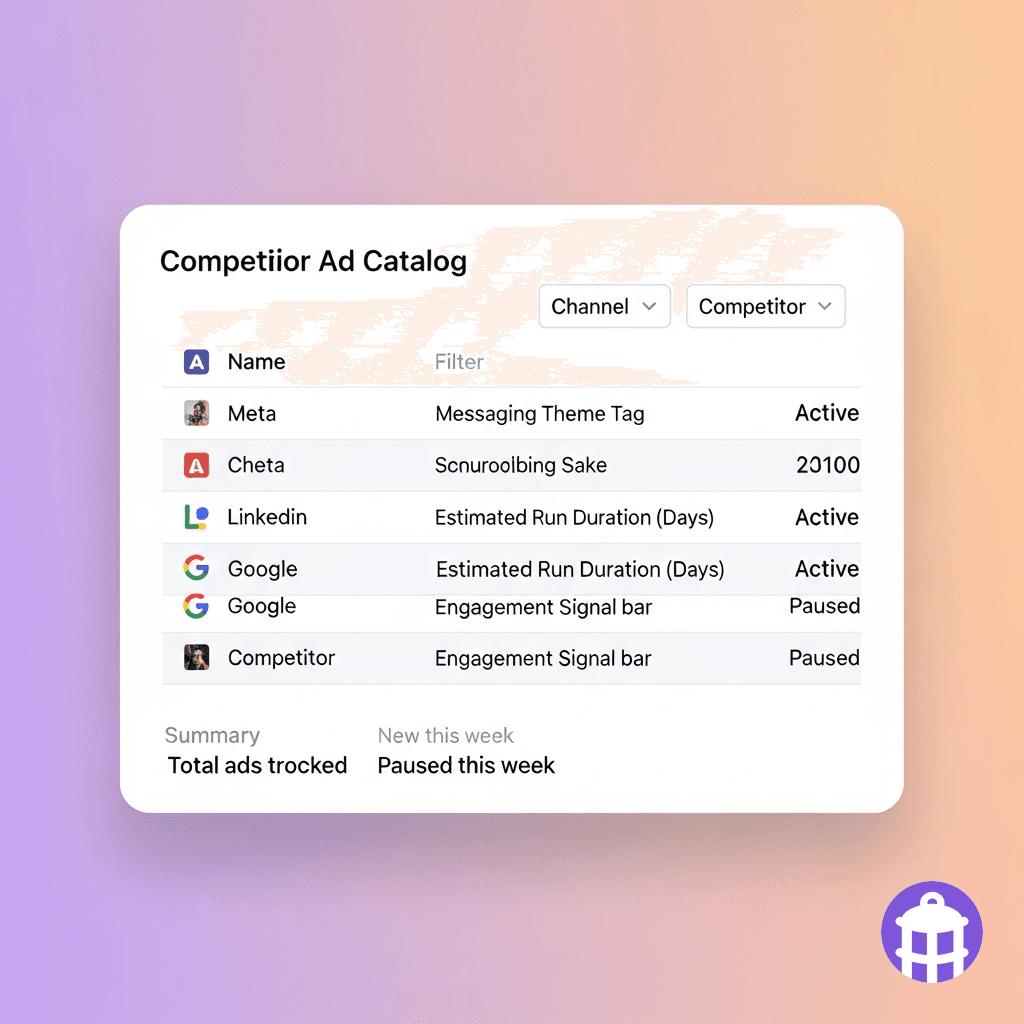
The agent monitors Meta Ad Library, Google Ads Transparency Center, LinkedIn Ad Library, and third-party ad intelligence sources to build a continuously updated catalog of every ad your key competitors are running. Each ad is tagged by format (video, static, carousel, search), channel, estimated run duration, and creative theme. Ads are clustered into messaging families — all the variants testing the same angle grouped together — so you can see which themes they're doubling down on versus which they're abandoning. The catalog updates on a rolling basis, so when a competitor launches a new campaign, you know within 48 hours rather than finding out when a prospect mentions it on a discovery call.

Competitor Gong: 47 active ads cataloged across Meta, LinkedIn, Google. Top messaging cluster: 'Pipeline visibility' (18 ads). Fastest-growing cluster: 'AI coaching' (11 ads, launched 3 weeks ago). 6 ads paused in the last 30 days — 'deal forecasting' angle retired.

Catalogs competitor ad creative continuously

The agent monitors Meta Ad Library, Google Ads Transparency Center, LinkedIn Ad Library, and third-party ad intelligence sources to build a continuously updated catalog of every ad your key competitors are running. Each ad is tagged by format (video, static, carousel, search), channel, estimated run duration, and creative theme. Ads are clustered into messaging families — all the variants testing the same angle grouped together — so you can see which themes they're doubling down on versus which they're abandoning. The catalog updates on a rolling basis, so when a competitor launches a new campaign, you know within 48 hours rather than finding out when a prospect mentions it on a discovery call.

Competitor Gong: 47 active ads cataloged across Meta, LinkedIn, Google. Top messaging cluster: 'Pipeline visibility' (18 ads). Fastest-growing cluster: 'AI coaching' (11 ads, launched 3 weeks ago). 6 ads paused in the last 30 days — 'deal forecasting' angle retired.

Decodes messaging angles and positioning

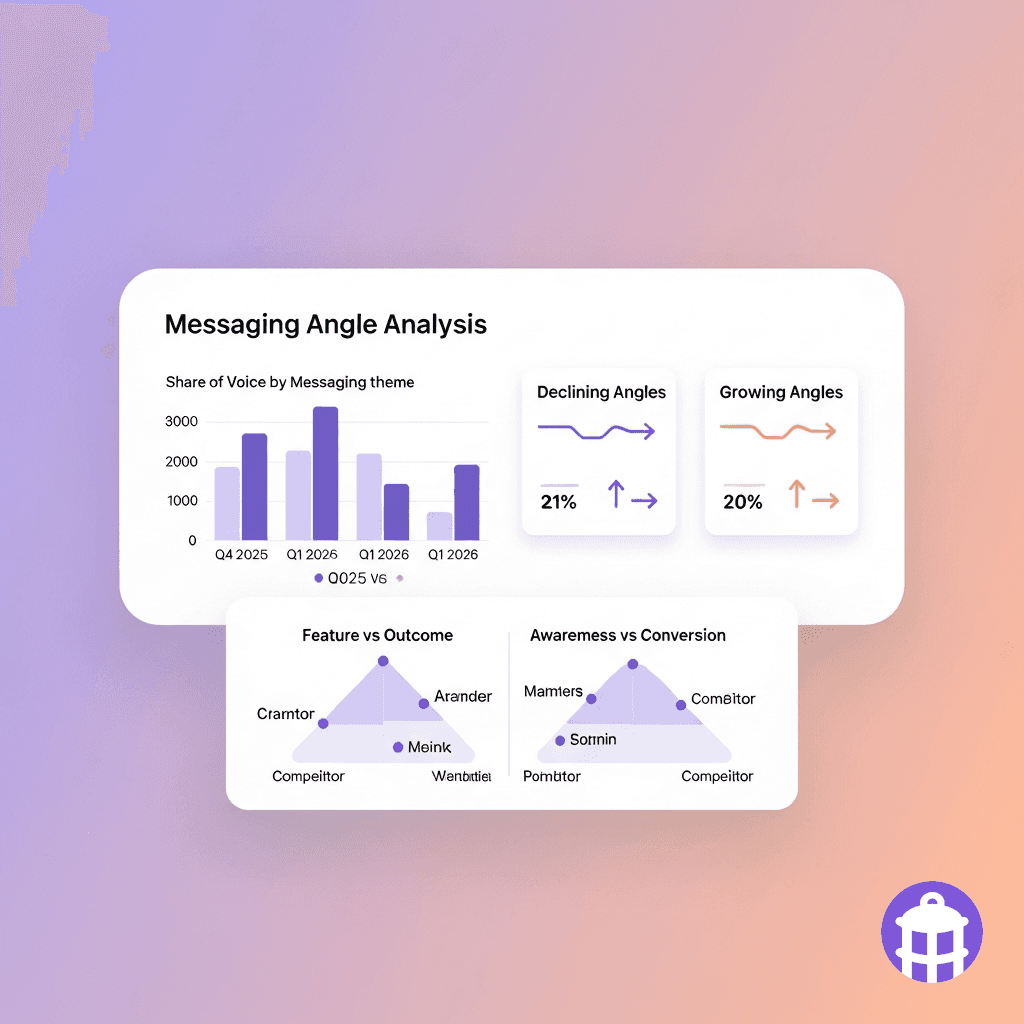
Volume of ads tells you what a competitor is running. The agent goes further — it analyzes the messaging architecture across the full creative catalog to identify the three to five core positioning angles each competitor is leaning on, how those have shifted over the past six months, and which audience signals their copy is targeting. A competitor running twelve variations of 'reduce sales cycle length' is telling you what their customers are asking for. One pivoting from feature-forward copy to outcome-based copy in the past quarter is responding to a win/loss pattern. The agent surfaces these strategic signals, not just ad counts.

Salesloft Q1 2026 messaging shift: Feature copy ('AI-powered cadences') dropped 40% share of voice. Outcome copy ('hit quota with half the reps') now 61% of active ads. Suggests win/loss feedback indicating buyers want ROI proof, not feature differentiation.

Decodes messaging angles and positioning

Volume of ads tells you what a competitor is running. The agent goes further — it analyzes the messaging architecture across the full creative catalog to identify the three to five core positioning angles each competitor is leaning on, how those have shifted over the past six months, and which audience signals their copy is targeting. A competitor running twelve variations of 'reduce sales cycle length' is telling you what their customers are asking for. One pivoting from feature-forward copy to outcome-based copy in the past quarter is responding to a win/loss pattern. The agent surfaces these strategic signals, not just ad counts.

Salesloft Q1 2026 messaging shift: Feature copy ('AI-powered cadences') dropped 40% share of voice. Outcome copy ('hit quota with half the reps') now 61% of active ads. Suggests win/loss feedback indicating buyers want ROI proof, not feature differentiation.

Estimates spend patterns and budget allocation

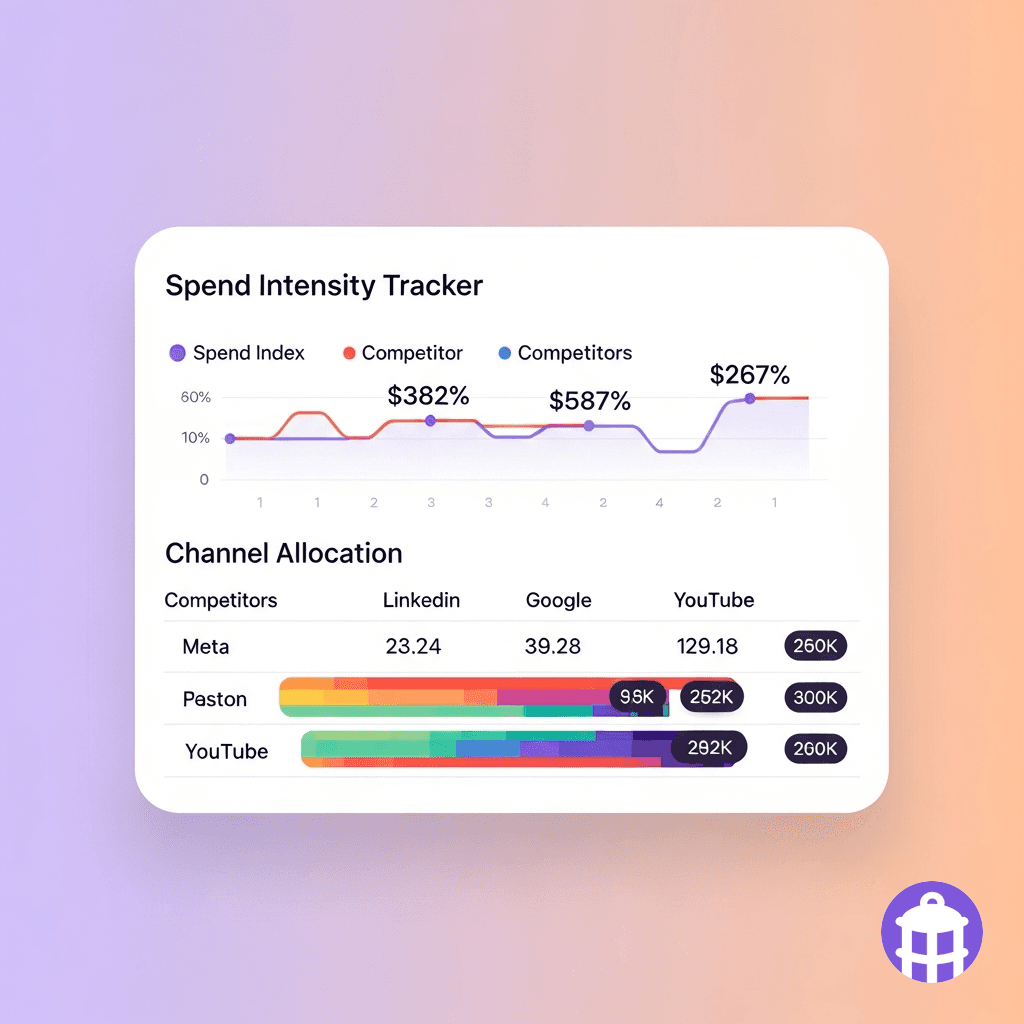
Ad libraries show what's running. The agent estimates how much budget is behind each placement by analyzing impression frequency, geographic spread, run duration, and ad format distribution — proxies that correlate with spend intensity across competitive intelligence methodologies. The output isn't a precise dollar figure but a directional spend index: which competitors are increasing paid investment, which channels they're prioritizing by quarter, and where budget is being pulled back. Combined with messaging data, this tells you not just what they're saying but how loudly they're saying it — which is often more strategically relevant than the message itself.

Outreach spend index Q1 2026: LinkedIn +34% QoQ (enterprise targeting expansion inferred from 6 new Sponsored Content formats). Google Search -18% QoQ (2 brand terms abandoned). Meta steady. Total paid intensity index: 74/100, up from 58 in Q4 2025.

Estimates spend patterns and budget allocation

Ad libraries show what's running. The agent estimates how much budget is behind each placement by analyzing impression frequency, geographic spread, run duration, and ad format distribution — proxies that correlate with spend intensity across competitive intelligence methodologies. The output isn't a precise dollar figure but a directional spend index: which competitors are increasing paid investment, which channels they're prioritizing by quarter, and where budget is being pulled back. Combined with messaging data, this tells you not just what they're saying but how loudly they're saying it — which is often more strategically relevant than the message itself.

Outreach spend index Q1 2026: LinkedIn +34% QoQ (enterprise targeting expansion inferred from 6 new Sponsored Content formats). Google Search -18% QoQ (2 brand terms abandoned). Meta steady. Total paid intensity index: 74/100, up from 58 in Q4 2025.

Identifies creative patterns worth testing

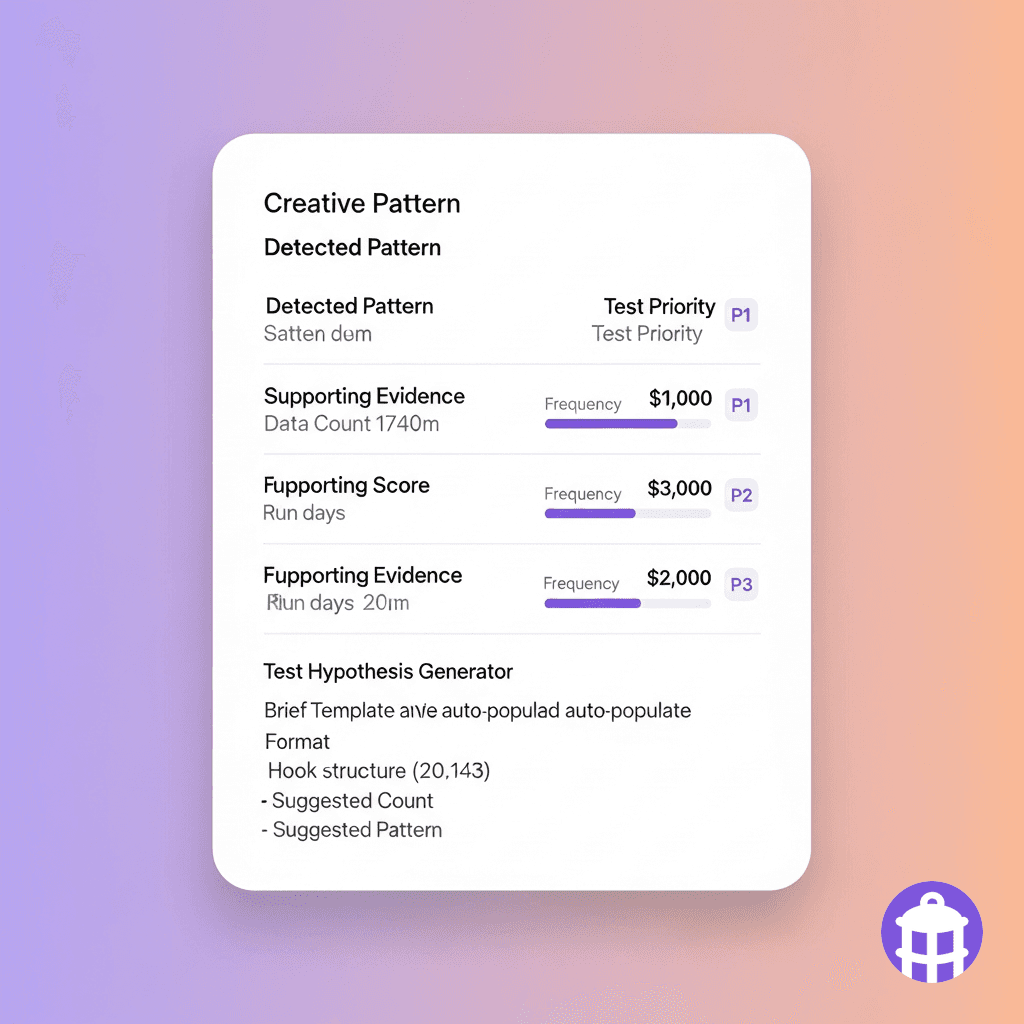
The most valuable output from competitor ad intelligence isn't knowing what they're running — it's knowing what's working in the market so you can test against it. The agent identifies the creative patterns associated with long-running, high-frequency competitor ads (a proxy for high-performing creative) and generates a prioritized list of hypotheses for your own testing roadmap. If every competitor in your category is running dark-background video ads with a specific hook structure and they've been running for 90+ days, that format is probably working. The agent flags these patterns with supporting evidence and suggests test variants so your creative team starts from a market-informed brief rather than a blank slate.

High-signal creative patterns detected: (1) Video ads with 'stat hook' opening (X% of teams do Y) — 8 competitors, avg 74-day run. (2) Social proof overlay on static image — 5 competitors, avg 91-day run. (3) Side-by-side 'before/after workflow' creative — 3 competitors, highest frequency score. Recommended test priority: stat hook video.

Identifies creative patterns worth testing

The most valuable output from competitor ad intelligence isn't knowing what they're running — it's knowing what's working in the market so you can test against it. The agent identifies the creative patterns associated with long-running, high-frequency competitor ads (a proxy for high-performing creative) and generates a prioritized list of hypotheses for your own testing roadmap. If every competitor in your category is running dark-background video ads with a specific hook structure and they've been running for 90+ days, that format is probably working. The agent flags these patterns with supporting evidence and suggests test variants so your creative team starts from a market-informed brief rather than a blank slate.

High-signal creative patterns detected: (1) Video ads with 'stat hook' opening (X% of teams do Y) — 8 competitors, avg 74-day run. (2) Social proof overlay on static image — 5 competitors, avg 91-day run. (3) Side-by-side 'before/after workflow' creative — 3 competitors, highest frequency score. Recommended test priority: stat hook video.

Today vs. with

Today vs. with

Tear Down Competitor Ads

Tear Down Competitor Ads

Today

Someone spots a competitor ad in their LinkedIn feed and screenshots it into a Slack channel

Creative strategy informed by gut feel and what the team has seen recently, not systematic market data

No visibility into whether a competitor is increasing or pulling back paid investment by channel

With ABM Strategist

Continuous catalog of every active ad across Meta, LinkedIn, and Google — updated within 48 hours of any change

Messaging angle analysis across the full competitive set — surface what's growing, what's declining, and what the market is responding to

Spend intensity index by competitor and channel, updated quarterly, showing directional budget shifts before they become obvious

Three layers, one platform by Lantern

Three layers, one platform by Lantern

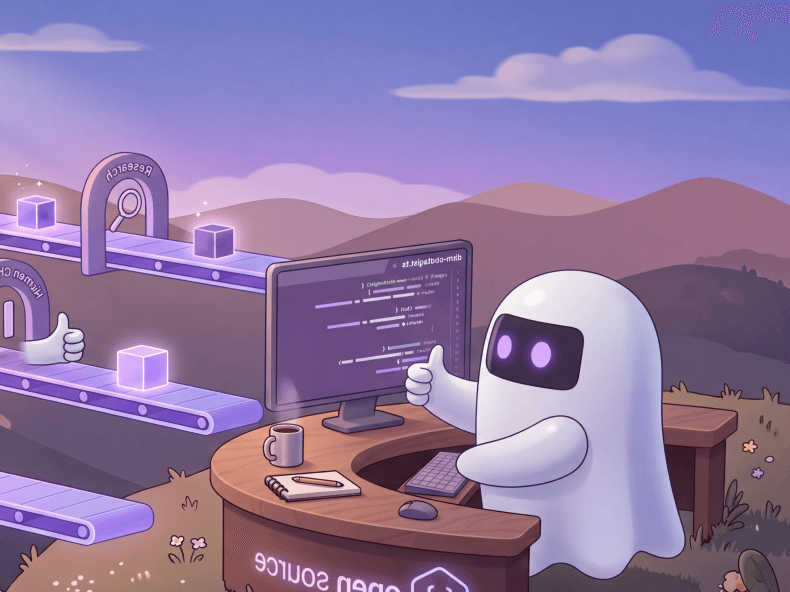
Every agent runs on three layers: a unified data model, 150+ enrichment providers, and an open-source engine where every decision is auditable.

Every agent runs on three layers: a unified data model, 150+ enrichment providers, and an open-source engine where every decision is auditable.

Data Waterfall

150+ enrichment providers. Sequential routing optimized per segment. The best answer wins. No vendor lock-in.

Agent Engine

Open-source execution engine. Workflows defined in code. Human-in-the-loop checkpoints. Full audit trail on every action.
Revenue Ontology

Every data source normalized into one model. Entity resolution across systems. Relationships stored, not inferred. Schema that evolves with your business.

FAQ

FAQ

Which ad platforms does the agent monitor?

How accurate are the spend estimates?

How many competitors can I track at once?

Can it track competitors in highly regulated industries where ad libraries have less data?

Your competitors are showing you their strategy — the agent makes sure you're watching.

Your competitors are showing you their strategy — the agent makes sure you're watching.

USE CASES

Revenue Team

Marketing Team

Customer Success

PRICING

Pricing

RESOURCES

Blog

About Lantern

Status

Support

© LANTERN 2025

Terms

Privacy

Linkedin

USE CASES

Revenue Team

Marketing Team

Customer Success

PRICING

Pricing

RESOURCES

Blog

About Lantern

Status

Support

© LANTERN 2025

Terms

Privacy

Linkedin

USE CASES

Revenue Team

Marketing Team

Customer Success

PRICING

Pricing

RESOURCES

Blog

About Lantern

Status

Support

© LANTERN 2025

Terms

Privacy

Linkedin