
Operate
Assign & Route Accounts
Assign & Route Accounts
Every account goes to the right rep, immediately — and stays assigned correctly when ownership changes.
Every account goes to the right rep, immediately — and stays assigned correctly when ownership changes.
Average time from account record creation to assigned owner — compared to 4–12 hours in teams relying on manual routing queues and round-robin spreadsheets.
Average time from account record creation to assigned owner — compared to 4–12 hours in teams relying on manual routing queues and round-robin spreadsheets.

THE brıef
Account assignment errors are quiet revenue killers — accounts that fall through ownership gaps, leads that sit unrouted while a rep is on vacation, inbound requests that take 12 hours to find the right owner. The Assign & Route Accounts agent automates account assignment and routing decisions based on territory, segment, expertise, and current workload — and re-routes instantly when ownership changes due to rep departures, role changes, or territory adjustments.
Routes incoming accounts and leads on arrival
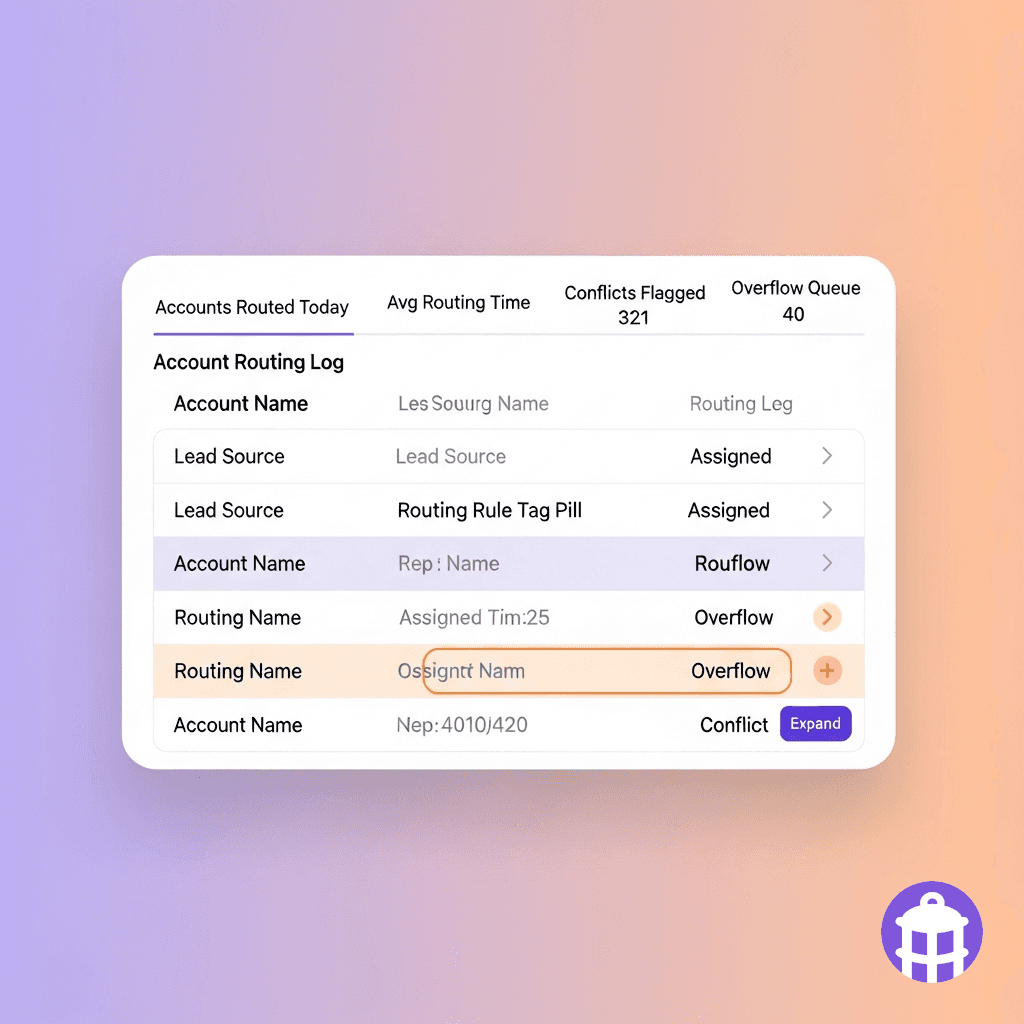
Every new account or lead entering the system gets routed to an owner within minutes, not hours. The agent applies a routing rule hierarchy: first checking if the account is a named account with a designated owner, then matching to the correct territory assignment, then evaluating rep capacity within the territory to avoid routing to reps at the top of their workload limit. Routing rules handle edge cases that break manual processes: what happens when the assigned territory rep is on leave, what happens when an inbound lead matches two territory rules due to a multi-location company, what happens when the lead is from a company already in active pipeline with a different rep. Every routing decision is logged with the rule that triggered it, so assignments are auditable and disputes are resolvable with data.
Routing log — last 24 hours: 47 accounts routed. Avg routing time: 3.4 minutes from record creation. 41 routed via territory rule. 3 routed to named account owners. 2 routed to overflow queue (assigned rep on leave). 1 conflict flagged: Acme Corp inbound lead matched both East Enterprise territory (open opp: $180K) and West Territory (billing address). Resolution: East Enterprise assigned based on existing opportunity rule. Sales Ops notified.
Routes incoming accounts and leads on arrival
Every new account or lead entering the system gets routed to an owner within minutes, not hours. The agent applies a routing rule hierarchy: first checking if the account is a named account with a designated owner, then matching to the correct territory assignment, then evaluating rep capacity within the territory to avoid routing to reps at the top of their workload limit. Routing rules handle edge cases that break manual processes: what happens when the assigned territory rep is on leave, what happens when an inbound lead matches two territory rules due to a multi-location company, what happens when the lead is from a company already in active pipeline with a different rep. Every routing decision is logged with the rule that triggered it, so assignments are auditable and disputes are resolvable with data.
Routing log — last 24 hours: 47 accounts routed. Avg routing time: 3.4 minutes from record creation. 41 routed via territory rule. 3 routed to named account owners. 2 routed to overflow queue (assigned rep on leave). 1 conflict flagged: Acme Corp inbound lead matched both East Enterprise territory (open opp: $180K) and West Territory (billing address). Resolution: East Enterprise assigned based on existing opportunity rule. Sales Ops notified.
Re-routes accounts when ownership changes
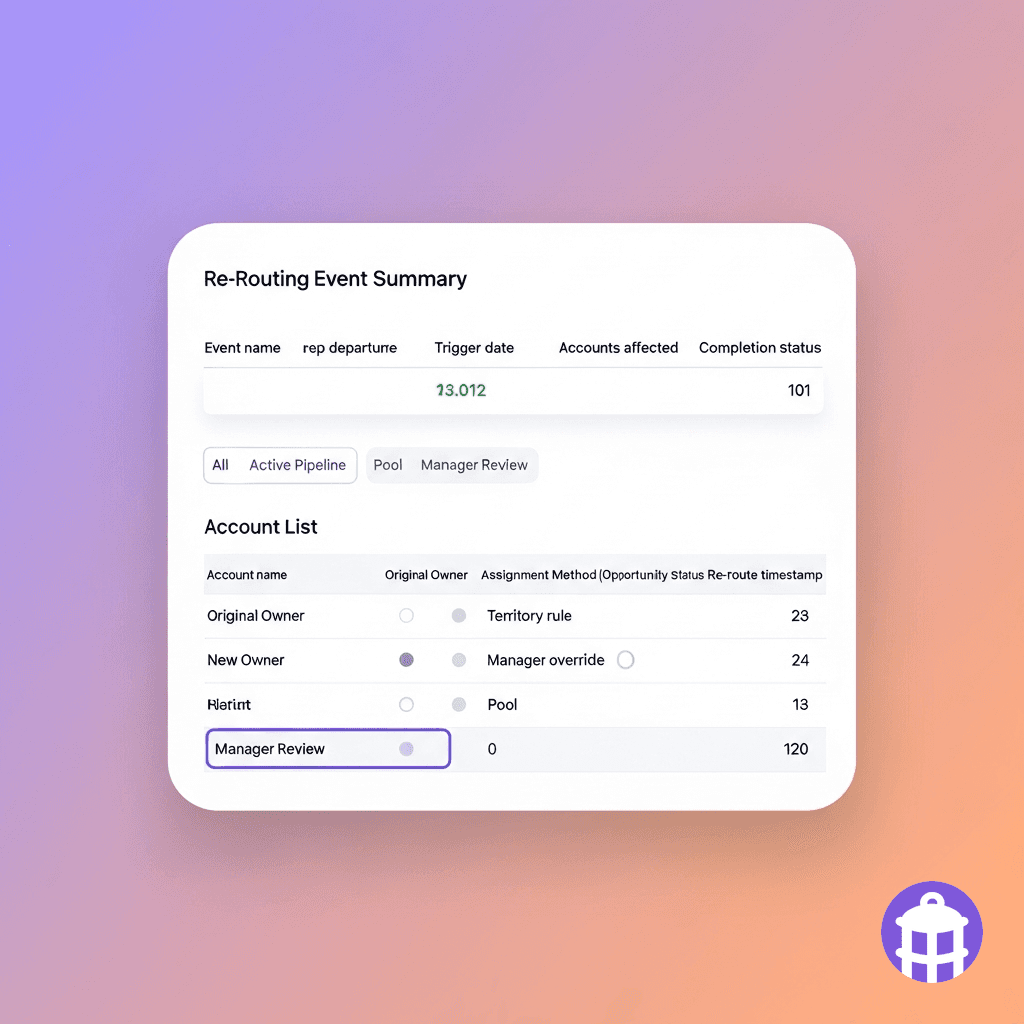
Ownership changes — rep departures, promotions, team restructures, territory adjustments — create account coverage gaps that persist until someone manually cleans them up, which often takes weeks. Unassigned accounts in active pipeline are one of the leading causes of deal loss that never gets attributed correctly. The agent monitors ownership status continuously and triggers automatic re-routing events when ownership becomes invalid: a rep who leaves has their account portfolio redistributed according to territory rules within the same business day, new territory boundaries are applied to affected accounts immediately rather than in the next quarterly cleanup, and accounts that have been unowned for more than 24 hours generate a management alert rather than silently sitting in limbo.
Re-routing event — March 15: Account Executive (Sarah K.) departure detected. 124 accounts in portfolio. Re-routing completed: 89 accounts re-assigned to territory-matching reps by territory rule (same business day). 8 accounts in active pipeline flagged for manager review and manual handoff coordination. 27 Tier 3 accounts moved to territory pool, available for next new hire. All reassignments logged with original and new owner.
Re-routes accounts when ownership changes
Ownership changes — rep departures, promotions, team restructures, territory adjustments — create account coverage gaps that persist until someone manually cleans them up, which often takes weeks. Unassigned accounts in active pipeline are one of the leading causes of deal loss that never gets attributed correctly. The agent monitors ownership status continuously and triggers automatic re-routing events when ownership becomes invalid: a rep who leaves has their account portfolio redistributed according to territory rules within the same business day, new territory boundaries are applied to affected accounts immediately rather than in the next quarterly cleanup, and accounts that have been unowned for more than 24 hours generate a management alert rather than silently sitting in limbo.
Re-routing event — March 15: Account Executive (Sarah K.) departure detected. 124 accounts in portfolio. Re-routing completed: 89 accounts re-assigned to territory-matching reps by territory rule (same business day). 8 accounts in active pipeline flagged for manager review and manual handoff coordination. 27 Tier 3 accounts moved to territory pool, available for next new hire. All reassignments logged with original and new owner.
Balances workload across rep teams dynamically
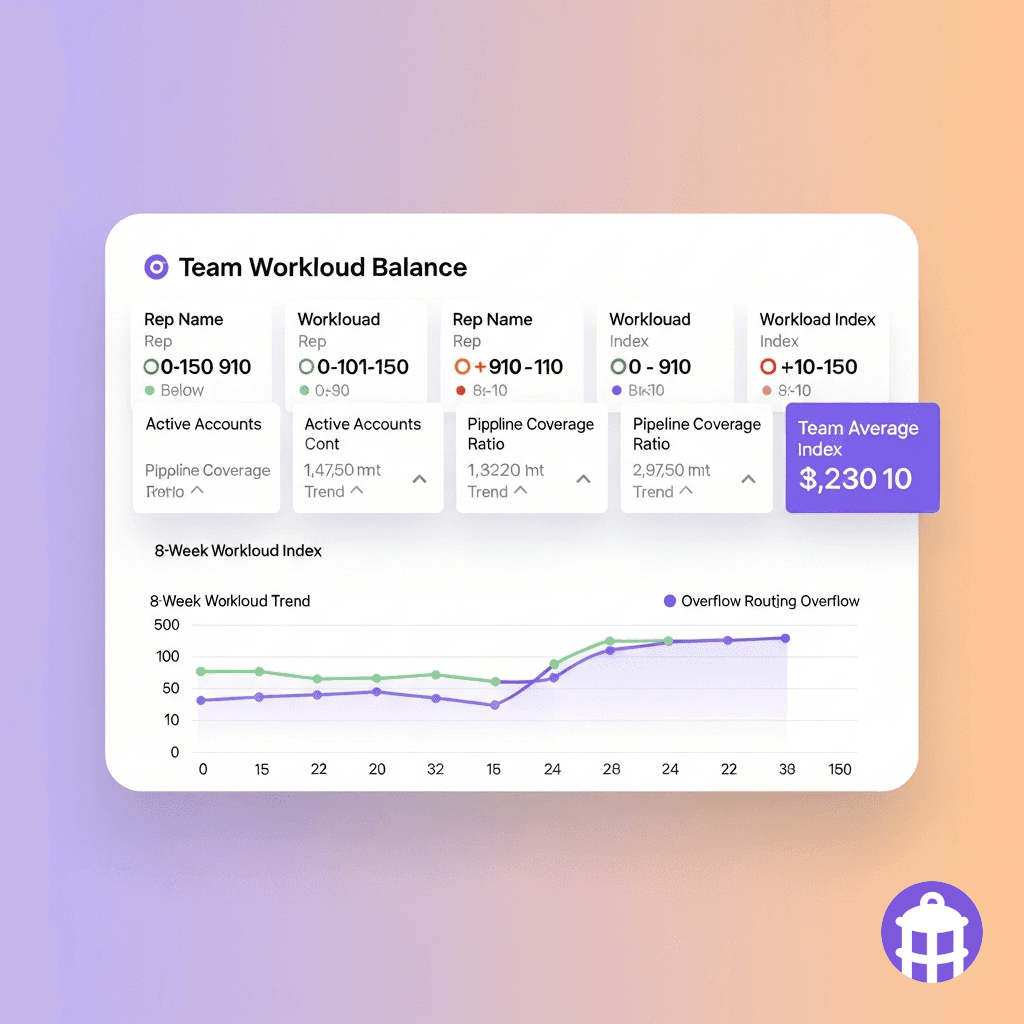
Territory assignments define the account universe each rep is responsible for — but within a territory, workload can become imbalanced as accounts move through the pipeline at different rates. The agent monitors workload metrics per rep: active account count, accounts in active pipeline, inbound volume by week, and coverage activity density. When a rep's workload score crosses a high-water mark — too many active accounts relative to their capacity based on historical coverage rates — the routing logic adjusts to temporarily direct overflow accounts to lower-workload reps in the same segment rather than stacking more on an already-full territory. Workload balancing prevents the common pattern where some reps are stretched thin while others have the capacity to take more.
Workload balance report — West Coast Mid-Market team: Marcus T. — workload index 112/100 (over capacity, 3 consecutive weeks). Routing adjustment: new inbound accounts routing to Jessica P. (workload index 74) until Marcus's index drops below 95. Jessica P. — workload 74, under capacity. Two new Tier 2 accounts assigned this week from overflow. Team avg workload index: 89. Manager alert sent: Marcus's capacity has been over-limit for 21 days.
Balances workload across rep teams dynamically
Territory assignments define the account universe each rep is responsible for — but within a territory, workload can become imbalanced as accounts move through the pipeline at different rates. The agent monitors workload metrics per rep: active account count, accounts in active pipeline, inbound volume by week, and coverage activity density. When a rep's workload score crosses a high-water mark — too many active accounts relative to their capacity based on historical coverage rates — the routing logic adjusts to temporarily direct overflow accounts to lower-workload reps in the same segment rather than stacking more on an already-full territory. Workload balancing prevents the common pattern where some reps are stretched thin while others have the capacity to take more.
Workload balance report — West Coast Mid-Market team: Marcus T. — workload index 112/100 (over capacity, 3 consecutive weeks). Routing adjustment: new inbound accounts routing to Jessica P. (workload index 74) until Marcus's index drops below 95. Jessica P. — workload 74, under capacity. Two new Tier 2 accounts assigned this week from overflow. Team avg workload index: 89. Manager alert sent: Marcus's capacity has been over-limit for 21 days.
Enforces routing governance and resolves conflicts
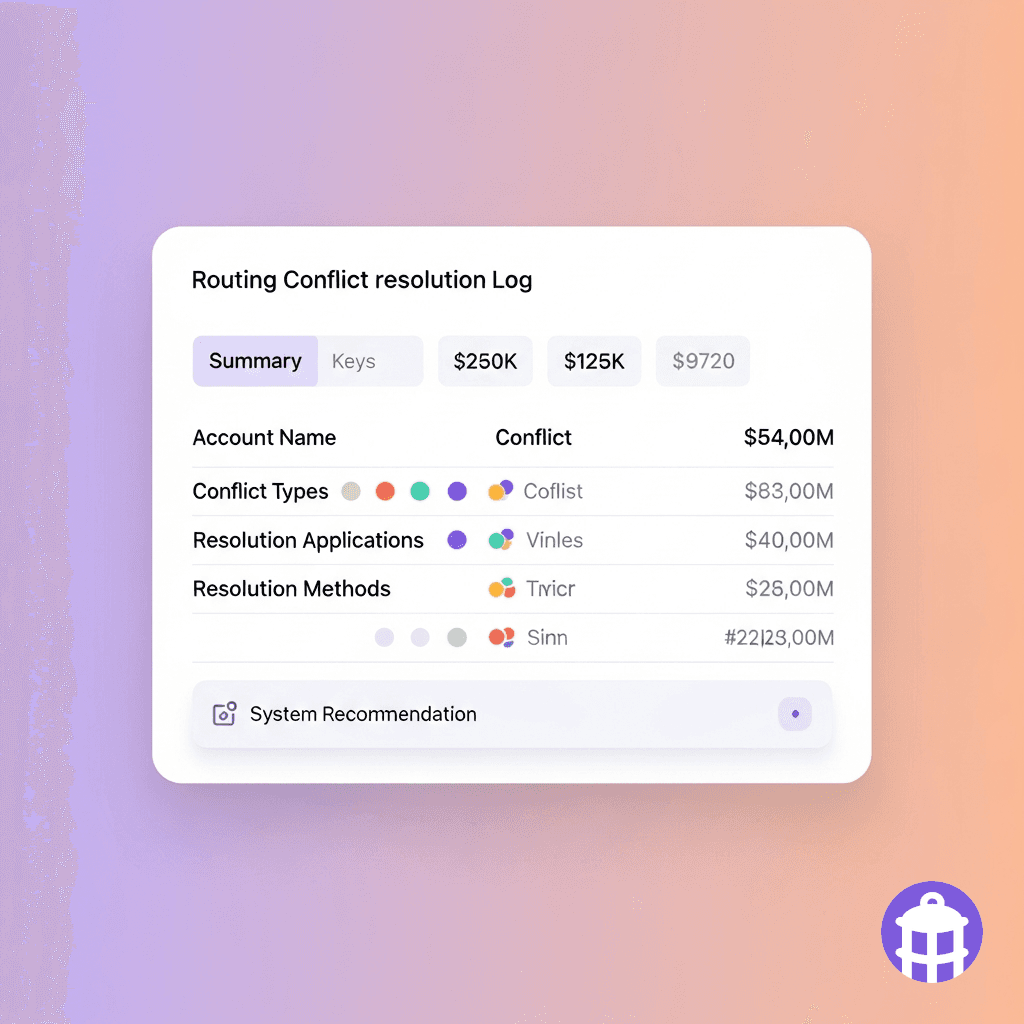
Routing rule conflicts are inevitable at scale — an inbound lead from a named account subsidiary, a company that spans two territory boundaries, a lead that matches an SDR's prospecting sequence and an inbound routing rule simultaneously. The agent applies a rule hierarchy to resolve conflicts deterministically rather than randomly or by whichever rep submits a claim first. Conflict resolution logic is configurable and transparent: each conflict is logged with the competing rules, the resolution applied, and the rationale. Sales Ops can review all conflicts in a single view, update the rule hierarchy when patterns reveal systematic gaps, and track conflict frequency by rule type to identify which rule combinations are most error-prone.
Routing conflict resolution log — March: 23 conflicts processed. Top conflict type: multi-territory match (12 cases, avg resolution: existing opportunity owner prioritized). Second: named account subsidiary match (7 cases, avg resolution: parent account owner assigned). 4 manual overrides by Sales Ops. Conflict rule improvement flagged: 'subsidiary of named account' rule missing — causing 7 preventable conflicts/month. Recommended rule addition attached.
Enforces routing governance and resolves conflicts
Routing rule conflicts are inevitable at scale — an inbound lead from a named account subsidiary, a company that spans two territory boundaries, a lead that matches an SDR's prospecting sequence and an inbound routing rule simultaneously. The agent applies a rule hierarchy to resolve conflicts deterministically rather than randomly or by whichever rep submits a claim first. Conflict resolution logic is configurable and transparent: each conflict is logged with the competing rules, the resolution applied, and the rationale. Sales Ops can review all conflicts in a single view, update the rule hierarchy when patterns reveal systematic gaps, and track conflict frequency by rule type to identify which rule combinations are most error-prone.
Routing conflict resolution log — March: 23 conflicts processed. Top conflict type: multi-territory match (12 cases, avg resolution: existing opportunity owner prioritized). Second: named account subsidiary match (7 cases, avg resolution: parent account owner assigned). 4 manual overrides by Sales Ops. Conflict rule improvement flagged: 'subsidiary of named account' rule missing — causing 7 preventable conflicts/month. Recommended rule addition attached.
Today vs. with
Today vs. with
Assign & Route Accounts
Assign & Route Accounts
Today
Inbound leads sit in a queue until someone manually reviews and assigns them — 4–12 hour delays on hot inbound are common
Rep departure leaves 100+ accounts in limbo — redistribution is a multi-day manual project that starts after IT deactivates the account
No workload balancing — some reps at maximum capacity while others have room for more accounts, with no systematic way to adjust

With ABM Strategist
Every account routed to an owner within 5 minutes using a deterministic rule hierarchy — no queue, no manual step
Rep departure triggers automatic portfolio redistribution the same business day — active pipeline accounts flagged for manager coordination, others assigned by territory rule
Workload index monitoring reroutes overflow accounts to under-capacity reps in the same segment — capacity is managed as a live metric, not a quarterly review topic
Works with
Works with
Plan Territories
Designs the territory structure that defines the routing rules this agent executes against — territory plan and routing engine work together.
Automate Lead Routing
Automates the full lead routing workflow from inbound capture to CRM assignment — integrates with Assign & Route Accounts for complex multi-rule routing.
Plan Territories
Designs the territory structure that defines the routing rules this agent executes against — territory plan and routing engine work together.
Score Leads & Accounts
Lead and account scores inform routing priority — high-scoring accounts get routed to senior reps or flagged for immediate follow-up.
Automate Lead Routing
Automates the full lead routing workflow from inbound capture to CRM assignment — integrates with Assign & Route Accounts for complex multi-rule routing.
Three layers, one platform by Lantern
Three layers, one platform by Lantern
Every agent runs on three layers: a unified data model, 150+ enrichment providers, and an open-source engine where every decision is auditable.
Every agent runs on three layers: a unified data model, 150+ enrichment providers, and an open-source engine where every decision is auditable.
Data Waterfall
150+ enrichment providers. Sequential routing optimized per segment. The best answer wins. No vendor lock-in.

Agent Engine
Open-source execution engine. Workflows defined in code. Human-in-the-loop checkpoints. Full audit trail on every action.

Revenue Ontology
Every data source normalized into one model. Entity resolution across systems. Relationships stored, not inferred. Schema that evolves with your business.
FAQ
FAQ
How are routing rules configured — is it technical?
What happens when no routing rule matches a new account?
Can routing rules account for rep OOO status?
How does the agent handle accounts that should be worked jointly by multiple reps?

Every minute an account sits unassigned is a minute a competitor has unchallenged access to it.
Every minute an account sits unassigned is a minute a competitor has unchallenged access to it.