
Operate
Plan Territories
Plan Territories
Territory plans that balance opportunity, capacity, and fairness — designed with data, not org chart politics.
Territory plans that balance opportunity, capacity, and fairness — designed with data, not org chart politics.
Average revenue lift from data-driven territory rebalancing versus perpetuating the prior year's plan — the compounding effect of putting the right accounts in front of the right reps.
Average revenue lift from data-driven territory rebalancing versus perpetuating the prior year's plan — the compounding effect of putting the right accounts in front of the right reps.

THE brıef
Most territory plans are perpetuated from last year's plan with minor adjustments — they reflect historical sales org structure more than current market opportunity, and they create persistent inequity that drives rep turnover and distorts performance metrics. The Plan Territories agent analyzes account opportunity, rep capacity, geographic coverage, and segment distribution to design territory plans that maximize total revenue potential while ensuring fair load distribution across the team.
Scores the total addressable opportunity per account
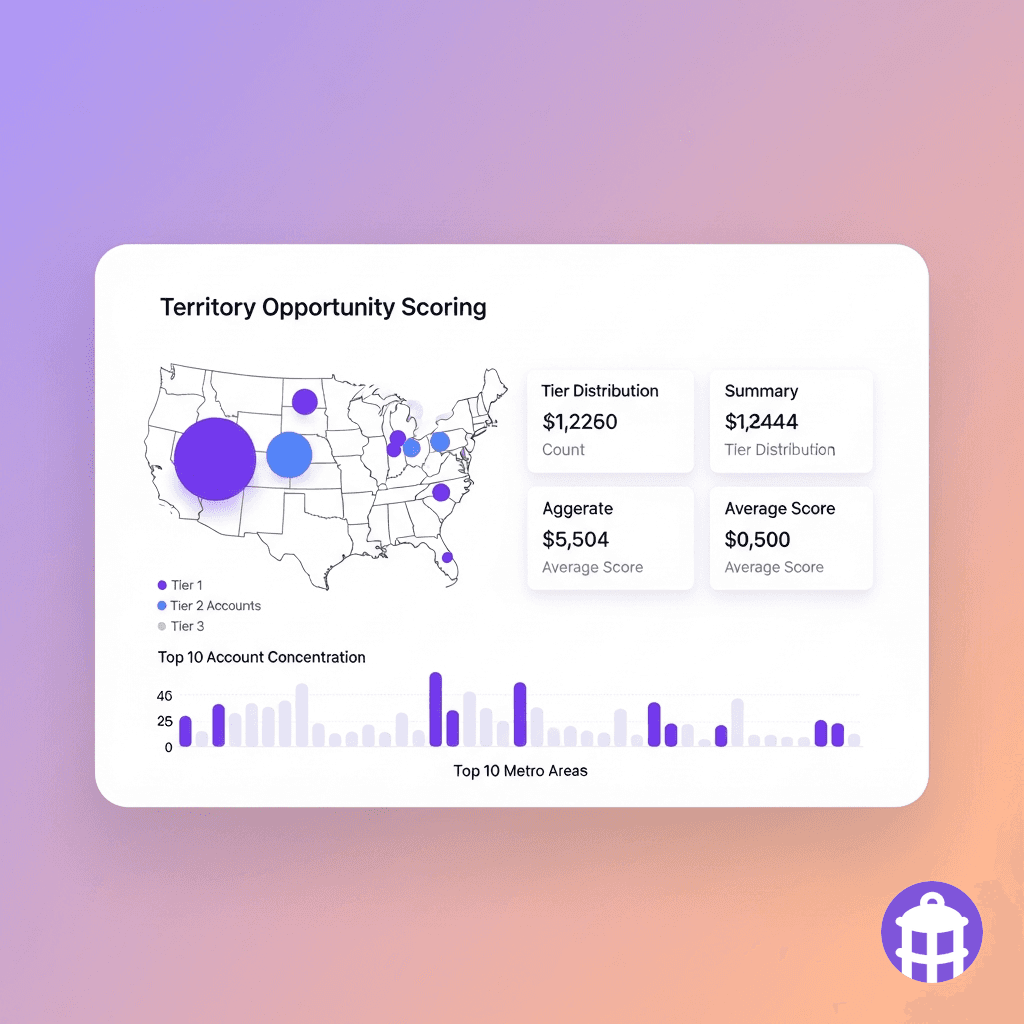
A territory's quality is defined by the aggregate opportunity of the accounts in it — and that requires scoring every potential account in your market before any assignment happens. The agent enriches all accounts in the target market with firmographic data (company size, industry, growth rate, funding), technographic signals (current stack, category readiness indicators), and intent data to produce an opportunity score per account. Accounts are then ranked and segmented by opportunity tier, giving the territory planning process a quantified view of where deal potential is concentrated geographically and by segment — rather than dividing accounts by alphabet or ZIP code and hoping the distribution is even.
Total addressable opportunity scoring — 4,200 target accounts: Tier 1 (high opportunity, high intent): 312 accounts, avg opportunity score 84, concentrated in SF Bay Area, NYC, Boston, Austin. Tier 2: 1,140 accounts. Tier 3: 2,748 accounts. Opportunity distribution: top 15% of accounts represent 61% of total estimated pipeline potential. Regional concentration: 43% of Tier 1 accounts in 5 metro areas.
Scores the total addressable opportunity per account
A territory's quality is defined by the aggregate opportunity of the accounts in it — and that requires scoring every potential account in your market before any assignment happens. The agent enriches all accounts in the target market with firmographic data (company size, industry, growth rate, funding), technographic signals (current stack, category readiness indicators), and intent data to produce an opportunity score per account. Accounts are then ranked and segmented by opportunity tier, giving the territory planning process a quantified view of where deal potential is concentrated geographically and by segment — rather than dividing accounts by alphabet or ZIP code and hoping the distribution is even.
Total addressable opportunity scoring — 4,200 target accounts: Tier 1 (high opportunity, high intent): 312 accounts, avg opportunity score 84, concentrated in SF Bay Area, NYC, Boston, Austin. Tier 2: 1,140 accounts. Tier 3: 2,748 accounts. Opportunity distribution: top 15% of accounts represent 61% of total estimated pipeline potential. Regional concentration: 43% of Tier 1 accounts in 5 metro areas.
Models territory balance scenarios across multiple dimensions
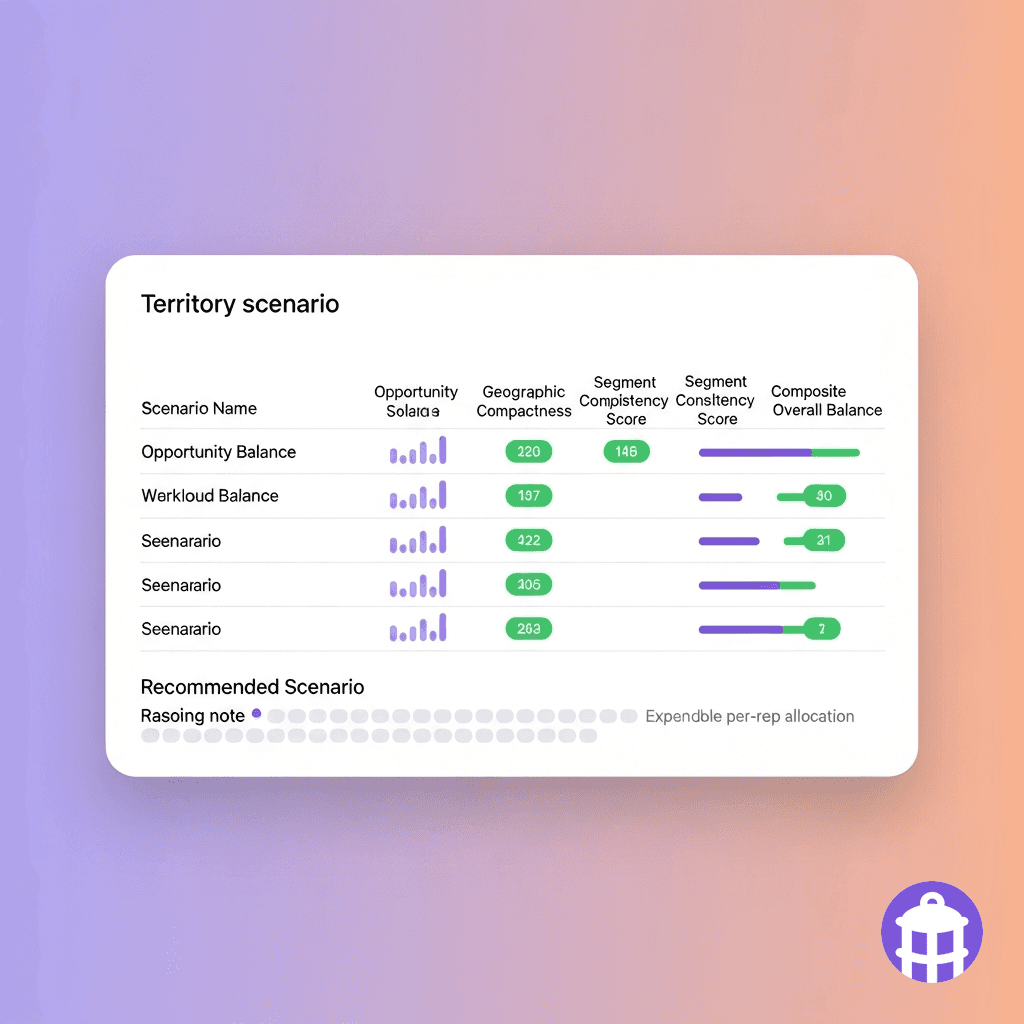
Territory balance isn't one-dimensional — an equal account count doesn't mean equal opportunity, and equal opportunity doesn't mean equal workload. The agent models territory balance scenarios across four dimensions simultaneously: total account opportunity (aggregate score across the territory), coverage workload (number of accounts requiring active coverage at each tier), geographic compactness (travel time and reachability for field reps), and segment consistency (keeping related industries together for rep specialization). Scenarios are generated algorithmically and evaluated against a balance score — the distribution of variance across reps on each dimension. The planning team can see 3–5 scenarios with different trade-off profiles before selecting one to finalize.
Territory balance scenarios — 8 rep team: Scenario A (opportunity-balanced): Gini coefficient 0.08 on opportunity, 0.19 on workload — good opportunity equity, moderate workload variance. Scenario B (workload-balanced): Gini 0.06 on workload, 0.14 on opportunity — excellent workload equity, some opportunity variance. Recommended: Scenario A with 3 minor account reallocation tweaks to bring workload variance below 0.12.
Models territory balance scenarios across multiple dimensions
Territory balance isn't one-dimensional — an equal account count doesn't mean equal opportunity, and equal opportunity doesn't mean equal workload. The agent models territory balance scenarios across four dimensions simultaneously: total account opportunity (aggregate score across the territory), coverage workload (number of accounts requiring active coverage at each tier), geographic compactness (travel time and reachability for field reps), and segment consistency (keeping related industries together for rep specialization). Scenarios are generated algorithmically and evaluated against a balance score — the distribution of variance across reps on each dimension. The planning team can see 3–5 scenarios with different trade-off profiles before selecting one to finalize.
Territory balance scenarios — 8 rep team: Scenario A (opportunity-balanced): Gini coefficient 0.08 on opportunity, 0.19 on workload — good opportunity equity, moderate workload variance. Scenario B (workload-balanced): Gini 0.06 on workload, 0.14 on opportunity — excellent workload equity, some opportunity variance. Recommended: Scenario A with 3 minor account reallocation tweaks to bring workload variance below 0.12.
Identifies rep capacity and specialization fit
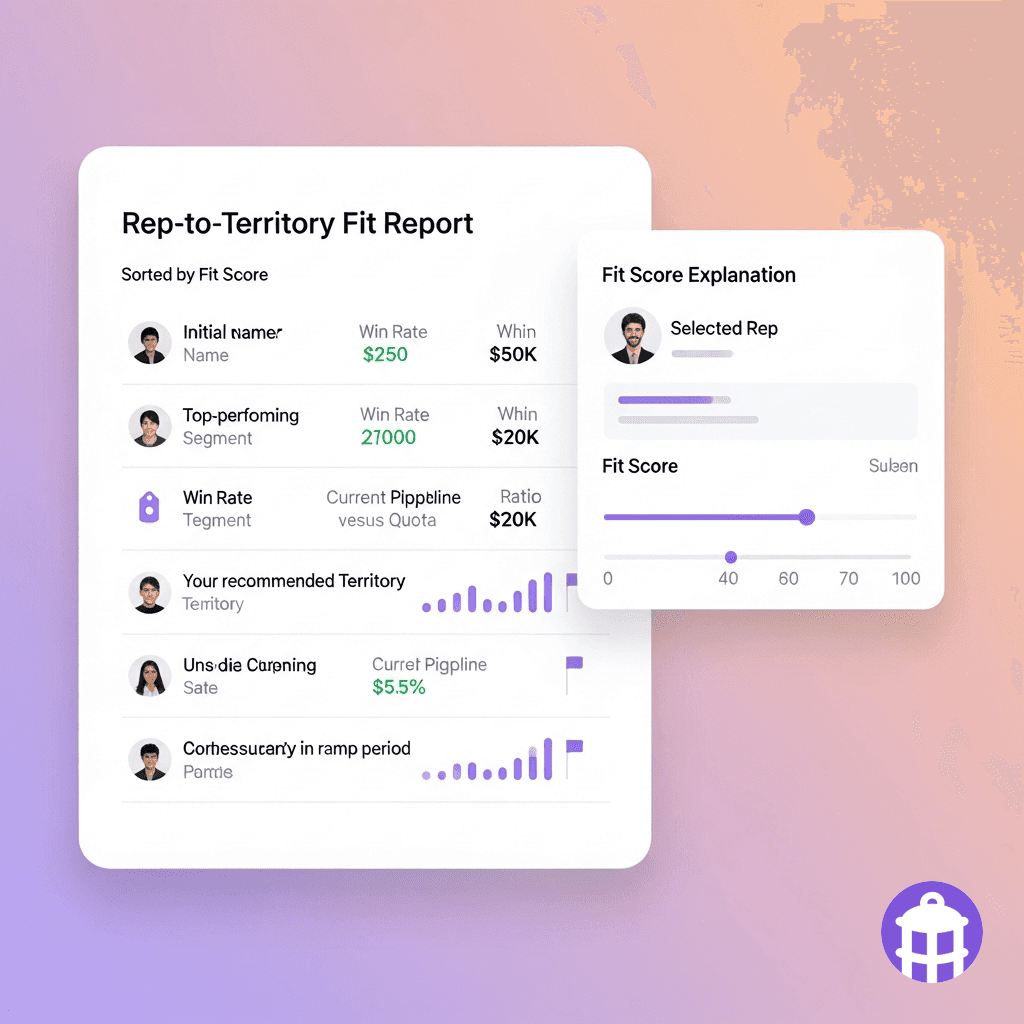
Territory design should match accounts to the rep most likely to close them — not just the rep whose geographic boundary they fall inside. The agent analyzes each rep's historical performance by segment (enterprise vs. SMB, specific industries, specific buying personas), conversion rates by deal type, average deal size, and current pipeline coverage relative to quota. High-performing reps in specific segments get territories concentrated in their sweet spot. Reps with capacity headroom get territories with more Tier 1 accounts than reps who are already at quota coverage. The result is territory design that considers the human variable — which rep is best positioned to work which accounts — not just the geographic and opportunity variables.
Rep-to-territory fit analysis: Sarah K. — 94% win rate on Enterprise Fintech (6 deals, 18 months). Recommended: East Coast Financial Services territory (87 Tier 1 Fintech accounts). Marcus T. — 74% win rate on Mid-Market Healthcare, current pipeline 1.8x quota coverage. Recommended: Midwest Healthcare territory (moderate Tier 1 concentration). 2 reps flagged for territories requiring ramp — assigned lower Tier 1 density with upside in Tier 2.
Identifies rep capacity and specialization fit
Territory design should match accounts to the rep most likely to close them — not just the rep whose geographic boundary they fall inside. The agent analyzes each rep's historical performance by segment (enterprise vs. SMB, specific industries, specific buying personas), conversion rates by deal type, average deal size, and current pipeline coverage relative to quota. High-performing reps in specific segments get territories concentrated in their sweet spot. Reps with capacity headroom get territories with more Tier 1 accounts than reps who are already at quota coverage. The result is territory design that considers the human variable — which rep is best positioned to work which accounts — not just the geographic and opportunity variables.
Rep-to-territory fit analysis: Sarah K. — 94% win rate on Enterprise Fintech (6 deals, 18 months). Recommended: East Coast Financial Services territory (87 Tier 1 Fintech accounts). Marcus T. — 74% win rate on Mid-Market Healthcare, current pipeline 1.8x quota coverage. Recommended: Midwest Healthcare territory (moderate Tier 1 concentration). 2 reps flagged for territories requiring ramp — assigned lower Tier 1 density with upside in Tier 2.
Produces territory documentation and transition plans
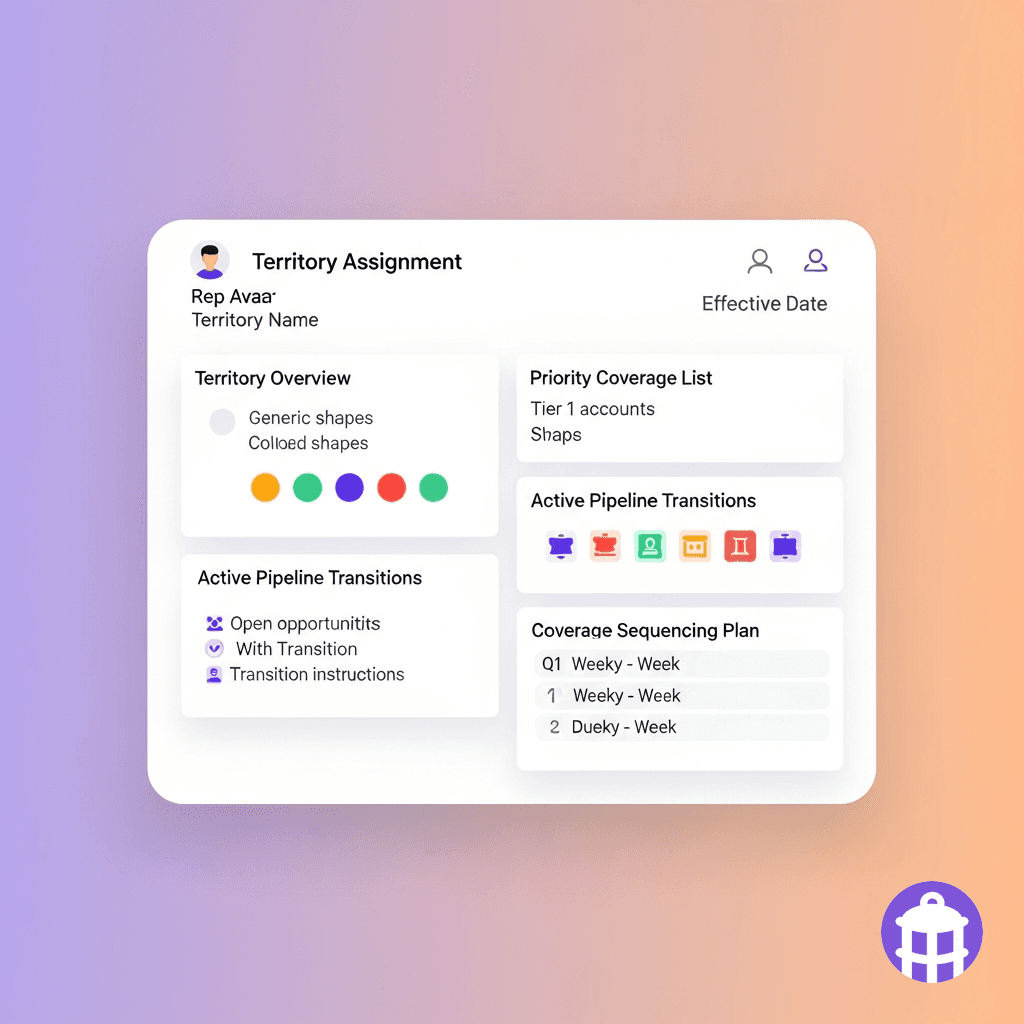
A territory plan is only useful if the sales team can implement it cleanly — and territory transitions create risk if they're not managed carefully. The agent produces complete territory documentation for each rep: their account list with opportunity scores and current relationship status, coverage priorities by tier, accounts in active pipeline that require transition protocols, and any accounts with existing relationships that warrant exception handling. For reps inheriting accounts from previous owners, the handoff package includes account history, last activity, open opportunities, and relationship notes so new territory owners don't start cold on accounts with existing context.
Territory documentation package — West Coast Mid-Market (Marcus T.): 847 total accounts. Tier 1: 43 (6 with active opportunities requiring transition protocol). Tier 2: 214. Tier 3: 590. Transition accounts: 6 opportunities totaling $380K in pipeline — each with relationship notes, last activity date, and transition owner. Coverage plan: prioritize 43 Tier 1 accounts for first-touch outreach in Q1, Tier 2 by intent score ranking.
Produces territory documentation and transition plans
A territory plan is only useful if the sales team can implement it cleanly — and territory transitions create risk if they're not managed carefully. The agent produces complete territory documentation for each rep: their account list with opportunity scores and current relationship status, coverage priorities by tier, accounts in active pipeline that require transition protocols, and any accounts with existing relationships that warrant exception handling. For reps inheriting accounts from previous owners, the handoff package includes account history, last activity, open opportunities, and relationship notes so new territory owners don't start cold on accounts with existing context.
Territory documentation package — West Coast Mid-Market (Marcus T.): 847 total accounts. Tier 1: 43 (6 with active opportunities requiring transition protocol). Tier 2: 214. Tier 3: 590. Transition accounts: 6 opportunities totaling $380K in pipeline — each with relationship notes, last activity date, and transition owner. Coverage plan: prioritize 43 Tier 1 accounts for first-touch outreach in Q1, Tier 2 by intent score ranking.
Today vs. with
Today vs. with
Plan Territories
Plan Territories
Today
Territory plans adjusted from last year's structure based on headcount changes — account distribution reflects org history more than current opportunity
Territory assignments made on geography or alphabet — no consideration of which rep is most likely to win in a given segment
Territory transitions handled ad-hoc — new reps inherit accounts cold, with no relationship history or pipeline context

With ABM Strategist
Every account scored on opportunity tier before assignment — territories balanced on opportunity, workload, and rep fit simultaneously
Rep-to-territory fit analysis matches reps to the segments and account types where their historical win rates are highest
Full documentation package per territory — account history, open pipeline transition protocols, and coverage sequencing for day one
Works with
Works with
Assign & Route Accounts
Executes the day-to-day account assignment and re-routing logic within the territory structure the Plan Territories agent designs.
Score Leads & Accounts
Account opportunity scores from lead and account scoring feed directly into territory opportunity weighting.
Source TAM
Total addressable market sizing informs how many accounts belong in the planning universe before territory scoring begins.
Three layers, one platform by Lantern
Three layers, one platform by Lantern
Every agent runs on three layers: a unified data model, 150+ enrichment providers, and an open-source engine where every decision is auditable.
Every agent runs on three layers: a unified data model, 150+ enrichment providers, and an open-source engine where every decision is auditable.
Data Waterfall
150+ enrichment providers. Sequential routing optimized per segment. The best answer wins. No vendor lock-in.

Agent Engine
Open-source execution engine. Workflows defined in code. Human-in-the-loop checkpoints. Full audit trail on every action.

Revenue Ontology
Every data source normalized into one model. Entity resolution across systems. Relationships stored, not inferred. Schema that evolves with your business.
FAQ
FAQ
How often should territory plans be revisited?
How does the agent handle named account programs alongside territories?
Can the model account for different quota levels per rep?
What if some reps push back on territory assignments?

Fair territories aren't a favor to reps — they're a prerequisite for accurate sales performance data.
Fair territories aren't a favor to reps — they're a prerequisite for accurate sales performance data.