
Grow Customers

Capture Voice of Customer

Capture Voice of Customer

Turn customer feedback into decisions — not slides no one reads.

Turn customer feedback into decisions — not slides no one reads.

average NPS increase for SaaS companies that implement structured closed-loop feedback programs within 12 months.

average NPS increase for SaaS companies that implement structured closed-loop feedback programs within 12 months.

THE brıef

Customer feedback is collected constantly and acted on rarely. Survey responses pile up in a tool, support tickets live in Zendesk, NPS comments are unread in a spreadsheet. The Capture Voice of Customer agent collects, tags, clusters, and synthesizes feedback from all of these sources into actionable insights for product, CS, and GTM teams — making the voice of the customer a live input to the business, not a quarterly report.
Ingests feedback from every collection channel

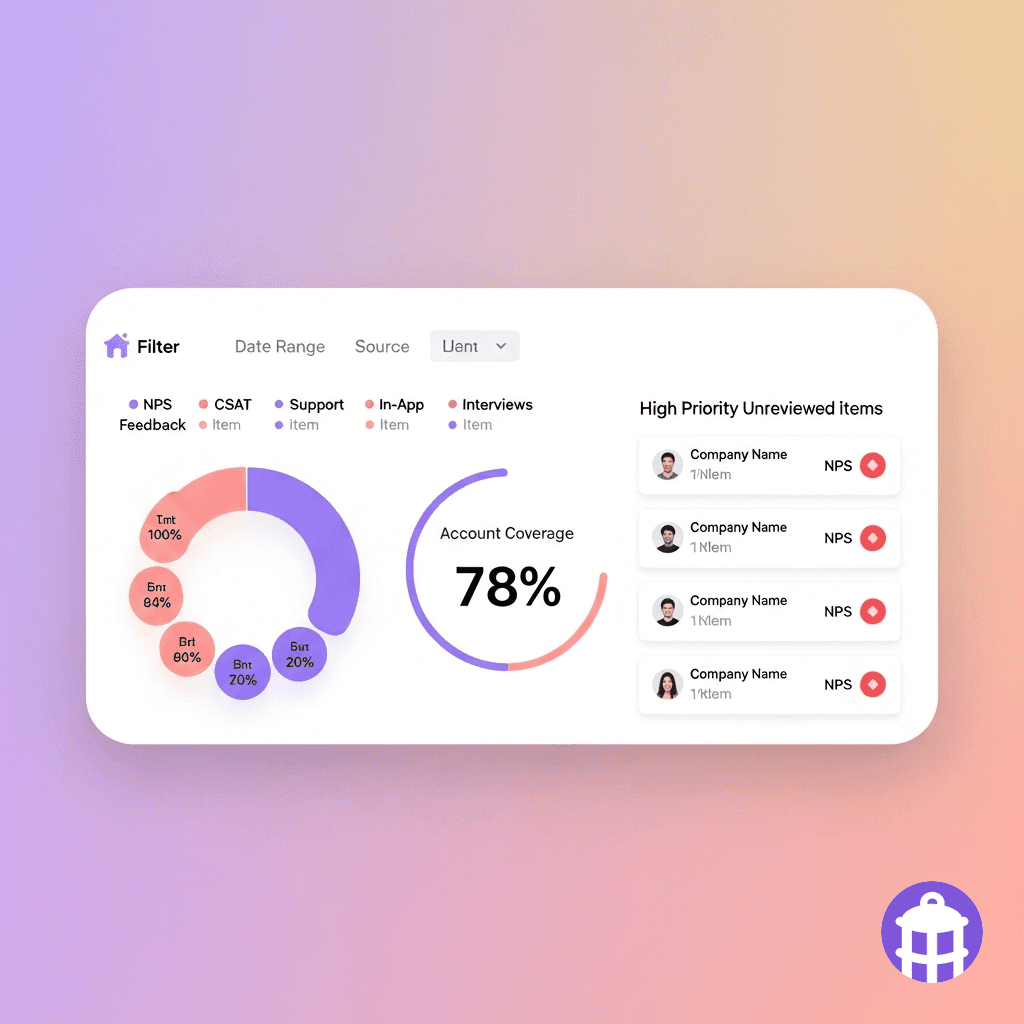
Customer feedback exists in at least five places in most SaaS companies: NPS surveys, CSAT scores, in-app feedback widgets, support tickets, and customer interviews or conversation notes. None of these are integrated, so the signal is fragmented. The agent connects to each source and ingests feedback into a unified repository — tagging each piece with the customer's account tier, industry, product usage level, tenure, and NPS score so that patterns can be cut by the attributes that matter. A low-NPS comment from a strategic account means something different than the same comment from a trial user. Context determines what to act on.

Feedback ingested: Q2. 1,847 items. Sources: NPS surveys (312), CSAT responses (608), support tickets (641), in-app widget (286). Customer coverage: 78% of active accounts have at least one feedback item. Unreviewed high-priority items (strategic accounts, NPS < 6): 14.

Ingests feedback from every collection channel

Customer feedback exists in at least five places in most SaaS companies: NPS surveys, CSAT scores, in-app feedback widgets, support tickets, and customer interviews or conversation notes. None of these are integrated, so the signal is fragmented. The agent connects to each source and ingests feedback into a unified repository — tagging each piece with the customer's account tier, industry, product usage level, tenure, and NPS score so that patterns can be cut by the attributes that matter. A low-NPS comment from a strategic account means something different than the same comment from a trial user. Context determines what to act on.

Feedback ingested: Q2. 1,847 items. Sources: NPS surveys (312), CSAT responses (608), support tickets (641), in-app widget (286). Customer coverage: 78% of active accounts have at least one feedback item. Unreviewed high-priority items (strategic accounts, NPS < 6): 14.

Tags and clusters feedback by theme and product area

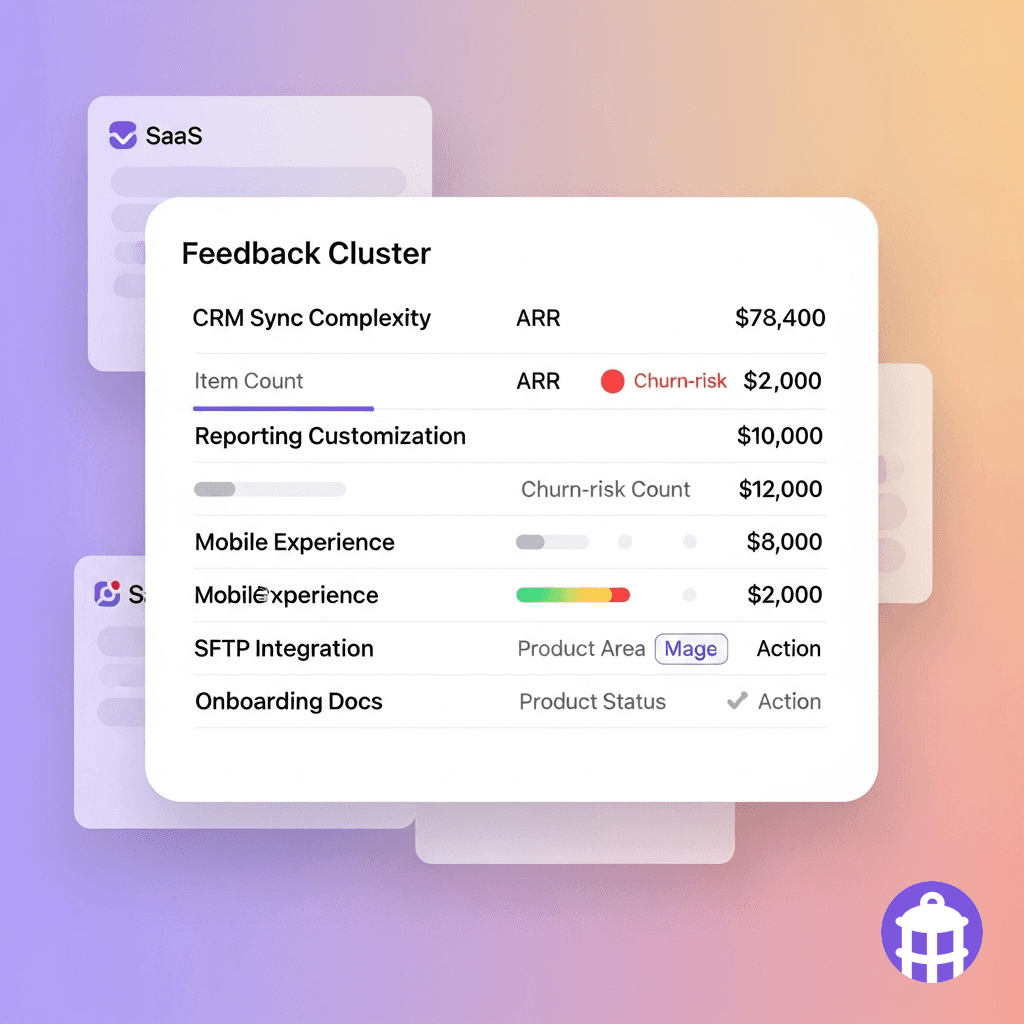
Raw feedback is noise until it's organized. The agent processes every feedback item through a tagging model that assigns product area (onboarding, core workflow, integrations, reporting, billing), sentiment (positive, negative, neutral, mixed), and issue category (feature request, bug report, UX complaint, documentation gap, missing integration, performance issue). Feedback items are then clustered by theme — a group of 40 tickets and NPS comments all pointing to difficulty setting up CRM sync is a different signal than a single strategic customer requesting a Salesforce feature. Clusters are ranked by frequency, ARR weight (how much revenue is expressing this theme), and urgency (how many items include explicit churn risk language).

Top feedback clusters Q2: (1) CRM sync setup complexity — 84 items, $1.2M ARR expressing, 6 churn-risk language flags. (2) Reporting customization — 61 items, $780K ARR. (3) Mobile app experience — 47 items, $420K ARR. (4) SFTP integration request — 31 items, $1.1M ARR (high ARR weight despite lower volume).

Tags and clusters feedback by theme and product area

Raw feedback is noise until it's organized. The agent processes every feedback item through a tagging model that assigns product area (onboarding, core workflow, integrations, reporting, billing), sentiment (positive, negative, neutral, mixed), and issue category (feature request, bug report, UX complaint, documentation gap, missing integration, performance issue). Feedback items are then clustered by theme — a group of 40 tickets and NPS comments all pointing to difficulty setting up CRM sync is a different signal than a single strategic customer requesting a Salesforce feature. Clusters are ranked by frequency, ARR weight (how much revenue is expressing this theme), and urgency (how many items include explicit churn risk language).

Top feedback clusters Q2: (1) CRM sync setup complexity — 84 items, $1.2M ARR expressing, 6 churn-risk language flags. (2) Reporting customization — 61 items, $780K ARR. (3) Mobile app experience — 47 items, $420K ARR. (4) SFTP integration request — 31 items, $1.1M ARR (high ARR weight despite lower volume).

Surfaces GTM insights from feedback patterns

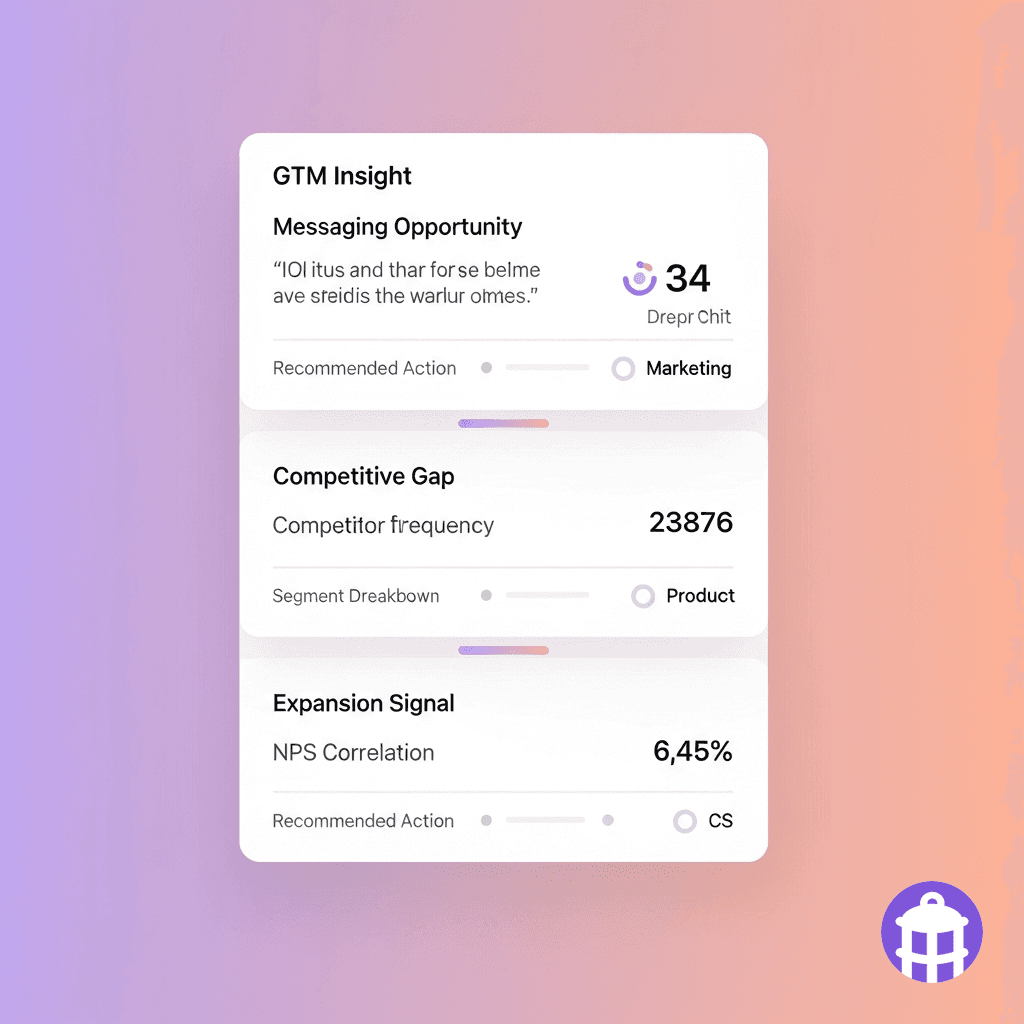
Customer feedback isn't only a product input — it's a GTM signal. The agent identifies patterns in feedback that inform positioning, ICP definition, and sales enablement. When a specific customer segment consistently mentions the same pain point as the reason they adopted the product, that's messaging evidence. When customers from a specific industry are disproportionately requesting the same integration, that's a vertical expansion signal. When detractor NPS comments consistently reference a competitor's feature, that's a competitive intelligence input. These GTM-relevant insights are surfaced separately from product feedback so the marketing and sales teams get the inputs that are relevant to them — not buried in a product backlog.

GTM insight flags Q2: (1) 23 customers in financial services mention 'audit trail' as primary value driver — not currently in core messaging. (2) 18 detractor comments reference [Competitor X]'s native Salesforce UI — competitive gap flagged for product. (3) Top NPS driver for accounts > 200 employees: 'time saved in rep onboarding' — expansion messaging opportunity.

Surfaces GTM insights from feedback patterns

Customer feedback isn't only a product input — it's a GTM signal. The agent identifies patterns in feedback that inform positioning, ICP definition, and sales enablement. When a specific customer segment consistently mentions the same pain point as the reason they adopted the product, that's messaging evidence. When customers from a specific industry are disproportionately requesting the same integration, that's a vertical expansion signal. When detractor NPS comments consistently reference a competitor's feature, that's a competitive intelligence input. These GTM-relevant insights are surfaced separately from product feedback so the marketing and sales teams get the inputs that are relevant to them — not buried in a product backlog.

GTM insight flags Q2: (1) 23 customers in financial services mention 'audit trail' as primary value driver — not currently in core messaging. (2) 18 detractor comments reference [Competitor X]'s native Salesforce UI — competitive gap flagged for product. (3) Top NPS driver for accounts > 200 employees: 'time saved in rep onboarding' — expansion messaging opportunity.

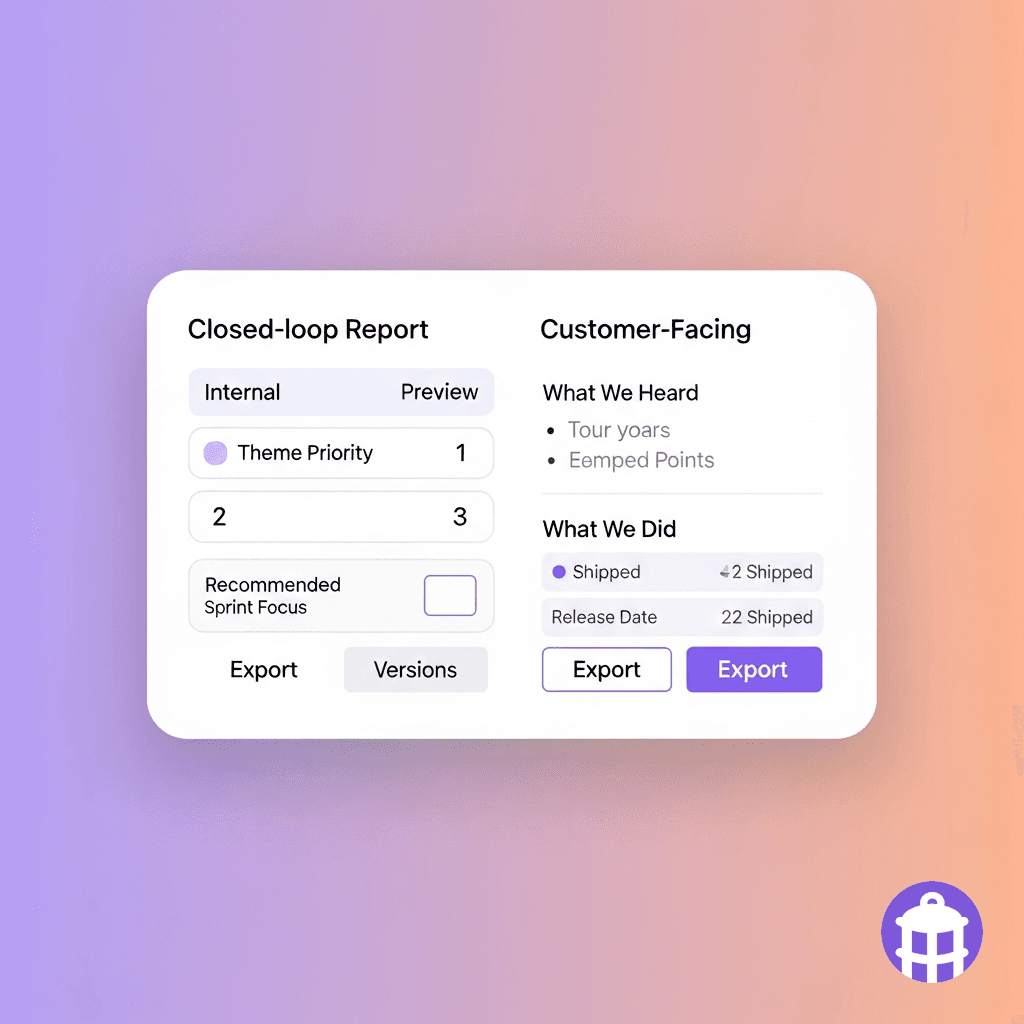
Generates closed-loop reports for product and leadership

Feedback programs fail when customers don't see evidence that their input was heard. The agent produces two reports: an internal synthesis report for product and leadership (top themes, ARR at risk, recommended prioritization) and a customer-facing closed-loop summary that CS teams can use to communicate 'here's what we heard and here's what we did about it.' The internal report is generated monthly and quarterly; the customer-facing summary is generated per account for QBR use. Both are derived from the same data — the difference is in framing and detail level. Teams that close the loop on feedback consistently report higher NPS scores in subsequent survey cycles.

Monthly synthesis report: April. Top action item: CRM sync setup complexity — 84 items, $1.2M ARR, 6 churn flags. Recommendation: product team sprint to simplify setup wizard + documentation rewrite. Customer-facing summary generated for 12 strategic accounts: 'We heard X from your team — here's what we shipped and here's what's coming.'

Generates closed-loop reports for product and leadership

Feedback programs fail when customers don't see evidence that their input was heard. The agent produces two reports: an internal synthesis report for product and leadership (top themes, ARR at risk, recommended prioritization) and a customer-facing closed-loop summary that CS teams can use to communicate 'here's what we heard and here's what we did about it.' The internal report is generated monthly and quarterly; the customer-facing summary is generated per account for QBR use. Both are derived from the same data — the difference is in framing and detail level. Teams that close the loop on feedback consistently report higher NPS scores in subsequent survey cycles.

Monthly synthesis report: April. Top action item: CRM sync setup complexity — 84 items, $1.2M ARR, 6 churn flags. Recommendation: product team sprint to simplify setup wizard + documentation rewrite. Customer-facing summary generated for 12 strategic accounts: 'We heard X from your team — here's what we shipped and here's what's coming.'

Today vs. with

Today vs. with

Capture Voice of Customer

Capture Voice of Customer

Today

NPS results are emailed to the product team quarterly as a spreadsheet attachment — they're reviewed for 10 minutes and filed.

Product and GTM teams have no shared view of customer feedback — product sees tickets, marketing sees NPS, CS sees support volume.

Customers give feedback and never hear what happened to it — next NPS survey sees lower response rates and higher detractor scores.

With ABM Strategist

Feedback is tagged, clustered, and ranked by ARR weight in real time — the top 3 themes and recommended actions are ready the day the survey closes.

Unified feedback repository with product, GTM, and CS-relevant insight layers surfaced separately for each team.

Closed-loop summaries per account give CS teams specific content to communicate back to customers — what was heard and what shipped.

Three layers, one platform by Lantern

Three layers, one platform by Lantern

Every agent runs on three layers: a unified data model, 150+ enrichment providers, and an open-source engine where every decision is auditable.

Every agent runs on three layers: a unified data model, 150+ enrichment providers, and an open-source engine where every decision is auditable.

Data Waterfall

150+ enrichment providers. Sequential routing optimized per segment. The best answer wins. No vendor lock-in.

Agent Engine

Open-source execution engine. Workflows defined in code. Human-in-the-loop checkpoints. Full audit trail on every action.

Revenue Ontology

Every data source normalized into one model. Entity resolution across systems. Relationships stored, not inferred. Schema that evolves with your business.

FAQ

FAQ

What feedback platforms does this integrate with?

How does the tagging model know which product area each piece of feedback relates to?

Can we track specific customers' feedback over time?

How does it handle duplicate or contradictory feedback?

Your customers are already telling you what to fix — the question is whether you're listening.

Your customers are already telling you what to fix — the question is whether you're listening.

USE CASES

Revenue Team

Marketing Team

Customer Success

PRICING

Pricing

RESOURCES

Blog

About Lantern

Status

Support

© LANTERN 2025

Terms

Privacy

Linkedin

USE CASES

Revenue Team

Marketing Team

Customer Success

PRICING

Pricing

RESOURCES

Blog

About Lantern

Status

Support

© LANTERN 2025

Terms

Privacy

Linkedin

USE CASES

Revenue Team

Marketing Team

Customer Success

PRICING

Pricing

RESOURCES

Blog

About Lantern

Status

Support

© LANTERN 2025

Terms

Privacy

Linkedin